Author

admin

Browsing

Nintendo on Friday announced that retail preorder for its Nintendo Switch 2 gaming system will begin on April 24 starting at $449.99.

Preorders for the hotly anticipated console were initially slated for April 9, but Nintendo delayed the date to assess the impact of the far-reaching, aggressive “reciprocal” tariffs that President Donald Trump announced earlier this month.

Most electronics companies, including Nintendo, manufacture their products in Asia. Nintendo’s Switch 1 consoles were made in China and Vietnam, Reuters reported in 2019. Trump has imposed a 145% tariff rate on China and a 10% rate on Vietnam. The latter is down from 46%, after he instituted a 90-day pause to allow for negotiations.

Nintendo said Friday that the Switch 2 will cost $449.99 in the U.S., which is the same price the company first announced on April 2.

“We apologize for the retail pre-order delay, and hope this reduces some of the uncertainty our consumers may be experiencing,” Nintendo said in a statement. “We thank our customers for their patience, and we share their excitement to experience Nintendo Switch 2 starting June 5, 2025.”

The Nintendo Switch 2 and “Mario Kart World bundle will cost $499.99, the digital version “Mario Kart World” will cost $79.99 and the digital version of “Donkey Kong Bananza” will cost $69.99, Nintendo said. All of those prices remain unchanged from the company’s initial announcement.

However, accessories for the Nintendo Switch 2 will “experience price adjustments,” the company said, and other future changes in costs are possible for “any Nintendo product.”

It will cost gamers $10 more to by the dock set, $1 more to buy the controller strap and $5 more to buy most other accessories, for instance.

Retailer Best Buy said Friday that it will also begin accepting preorders for the Nintendo Switch 2 console, games and accessories on April 24.

The company said that for the first time in six years, most of its stores will open at midnight for the official launch day, June 5, so that customers can “get their hands on their new Switch 2 immediately.”

This post appeared first on NBC NEWS

It was another erratic week in the stock market. There were several market-moving events sprinkled throughout this short trading week, including earnings, escalation of tariff wars, and Chairman Jerome Powell’s remarks at the Economic Club of Chicago. This extended to wild swings in the bond market as well.

We had several positive earnings from banks and Netflix, Inc. (NFLX). Others, such as UnitedHealth Group, Inc. (UNH), disappointed, sending the Dow Jones Industrial Average ($INDU) lower by 1.33%.

Chairman Powell stated that tariffs could increase inflation. This would cause economic growth to slow down and unemployment to increase. The hope is that inflation is transitory, and, after it becomes stable, the Fed can continue to focus on its dual mandate of maximum employment and price stability.

It’s an insecure time for investors, and many feel the pain. You’re probably wondering how long this pain will go on for. In an uncertain environment, the best you can do is turn to the bond market.

It’s All About Bonds

The recent wild swinging market activity can be encapsulated in the price action of Treasury yields. Since 2024, yields have been swinging up and down. In the past year, the 10-year Treasury yield has ranged from 3.60% to 4.81%, and when the range is this wide, it’s an indication of economic instability. Not to mention, economic instability could result in a weaker economy.

The daily chart of the 10-Year US Treasury Yield Index ($TNX) gives you an idea of the range of yields in the last year. More recently, the yield has risen from 3.89% to 4.59%, and has now pulled back to its 50-day simple moving average (SMA).

FIGURE 1. DAILY CHART OF 10-YEAR TREASURY YIELDS. Yields have been seeing some large up and down swings.Chart source: StockCharts.com. For educational purposes.

Generally, when stock prices fall, bond prices rise. Since bond yields move inversely to bond prices, you’d expect yields to fall. This scenario isn’t playing out. Instead, we’re seeing yields move erratically while bond prices remain suppressed. There needs to be stability in bond yields before a stock market recovery, and one way to do that is to monitor the chart of the Merrill Lynch Option Volatility Estimate, referred to as the MOVE Index ($MOVE).

The MOVE Index tracks bond volatility. Think of it as the bond counterpart to the Cboe Volatility Index ($VIX). The chart below displays the $MOVE/$VIX relationship, with the correlation between the two in the lower panel.

FIGURE 2. THE MOVE INDEX VS. VIX. A high correlation between the MOVE Index and VIX suggests interest rates and stock prices are tightly connected. A lower correlation would indicate stability in equities.Chart source: StockCharts.com. For educational purposes.

The two have been highly correlated since the end of March, which indicates that stocks and interest rates are tightly connected. This means the wild up and down swings in equities could continue. When the two are less correlated, we can expect equities to start settling down. Looking at the above chart, a correlation of 0.80 would be sufficient for signs of stability.

Both $VIX and $MOVE have come back slightly, but their correlation is at 0.93, which is relatively high.

Be sure to save both charts displayed in this article to your ChartLists. They could alert you to stability in the stock market ahead of other indicators.

The Bottom Line

Until stability returns, you could do the following:

  • Stay on the sidelines and keep some dry powder.
  • Invest in risk-off instruments such as gold and silver.
  • Park some of your money in defensive sectors.

Equities could slide lower before stability returns. If this happens, you could pick up some growth stocks for a bargain.

An empowered investor comes out ahead after market instability. So monitor the market closely and, when the time is right, make wise investment decisions.

End-of-Week Wrap-Up

  • S&P 500 down 1.50% on the week, at 5282.70, Dow Jones Industrial Average down 2.66% on the week at 39,142.23; Nasdaq Composite down 2.62% on the week at 16,286.45.
  • $VIX down 21.06% on the week, closing at 29.65.
  • Best performing sector for the week: Energy
  • Worst performing sector for the week: Consumer Discretionary
  • Top 5 Large Cap SCTR stocks: Palantir Technologies, Inc. (PLTR); Elbit Systems, Ltd. (ESLT); Anglogold Ashanti Ltd. (AU); Just Eat Takeaway.com (JTKWY); Kinross Gold Corp. (KGC)

On the Radar Next Week

  • Earnings season continues with Haliburton (HAL), Tesla (TSLA), Boeing Co. (BA), International Business Machines (IBM) and others reporting.
  • 30-Year Mortgage Rates
  • March New Home Sales and Building Permits
  • April S&P PMI
  • April Consumer Sentiment
  • Fed speeches from Jefferson, Harker, Kashkari, and others.

Disclaimer: This blog is for educational purposes only and should not be construed as financial advice. The ideas and strategies should never be used without first assessing your personal and financial situation, or without consulting a financial professional.

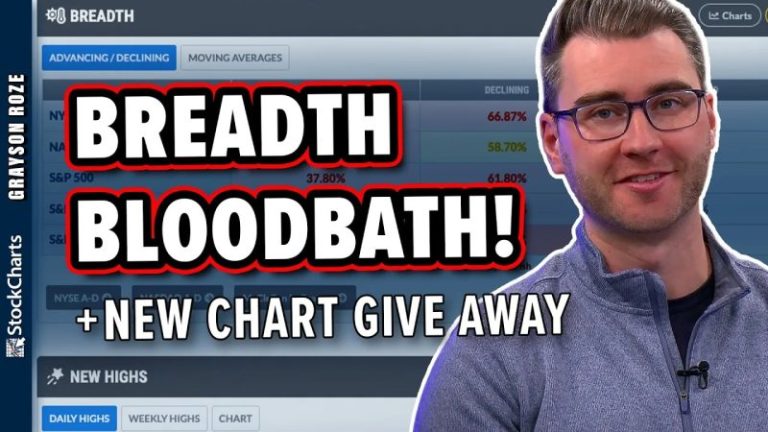
In this video, Grayson unveils StockCharts’ new Market Summary ChartPack—an incredibly valuable new ChartPack packed full of pre-built charts covering breadth, sentiment, volatility data and MUCH MORE!

From there, Grayson then breaks down what he’s seeing on the current Market Summary dashboard, illustrating how he’s putting this invaluable tool to work in the current climate. He highlights weakness in Small Cap stocks, uses the Factors Map to pinpoint the groups that investors are gravitating to, and explains why the sea of red across the breadth maps continues to be a clear indication of the weakness in this market.

This video originally premiered on April 18, 2024. Click on the above image to watch on our dedicated Grayson Roze page on StockCharts TV.

You can view previously recorded videos from Grayson at this link.

Stocks vs. bonds? In this video, Julius breaks down the asset allocation outlook and why defensive sectors, large-cap value, and bonds may continue to outperform in this volatile market. He starts at the asset allocation level using Relative Rotation Graphs (RRGs) to analyze stocks vs bonds performance, then highlights the ongoing defensive sector rotation, and identifies strength in large-cap value stocks.

To close out the show, Julius dives into stock-specific opportunities based on the relative rotation of sector constituents, pointing to potential leadership shifts as market volatility rises.

This video was originally published on April 17, 2025. Click on the icon above to view on our dedicated page for Julius.

Past videos from Julius can be found here.

#StayAlert, -Julius

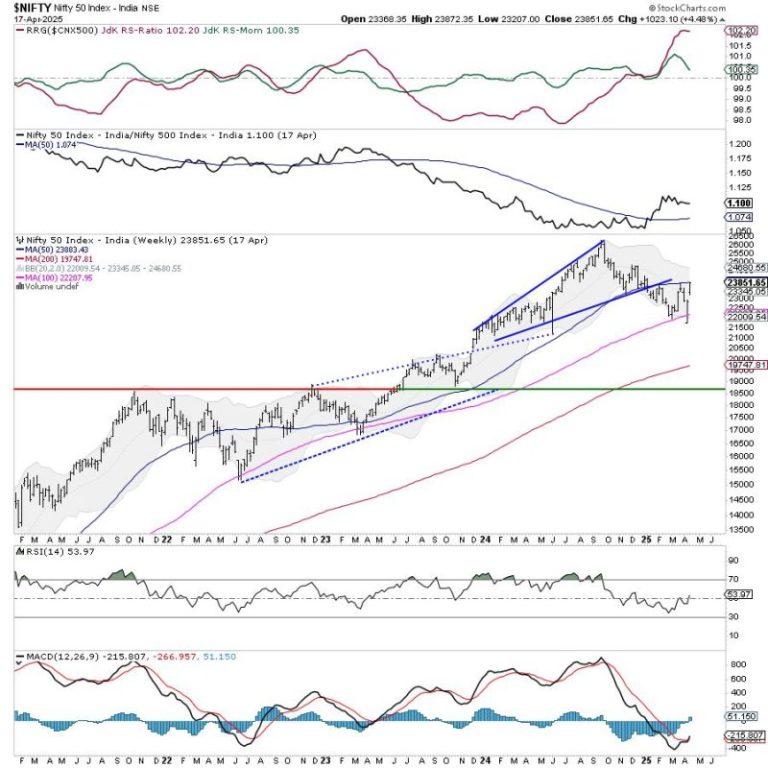
The week that went by was a short trading week with just three trading days. However, the Indian equities continued to surge higher, demonstrating resilience, and the week ended on a positive note. In the week before this one, the Nifty was able to defend the 100-week MA; last week, it surged higher and closed just at the 50-week MA. The trading range got narrower; the Index oscillated in a 665.35-point range. The volatility, too, cooled off; the India Vix declined by 23.08% to 15.47. While staying largely stable with a strong underlying bias, the headline Index closed with a net weekly gain of 1023.10 points (+4.48%).

There are a few technical levels that need to be closely observed. The Nifty resisted the 100-day moving average (DMA) at 23395 before breaking out above that level. Zooming out to the weekly chart, the Nifty has closed at the 50-week MA, currently placed at 23885. This point and the 200-DMA at 24050 create an important resistance zone for the Nifty. While there is room for Nifty to move higher towards the 24000 level, there are strong possibilities of the markets consolidating between the 23900 and 24000 levels. While no major drawdowns are expected, there is a high chance that the upmove may at least take a breather around this level. It is important to watch Nifty’s behavior against this level.

The coming week may start on a stable note; the levels of 24,000 and 24,210 are likely to act as resistance points. The support will come lower at 23500 and then at 23345, which is the 20-week MA.

The weekly RSI is 53.94; it has formed a 14-period high, indicating a bullish trend. The weekly MACD has shown a positive crossover; it is now bullish and trades above its signal line.

The pattern analysis on the weekly chart shows that the Nifty has returned to the important level of the 50-week moving average, which it previously violated when it initiated its corrective move. This level and the 200-DMA placed at a short distance at 24050 are likely to offer resistance. This would mean that the markets are entering a major resistance zone; unless 24050 is taken out on the upside, we can expect the markets to consolidate, showing minor retracements over the coming days.

Overall, it is time for one to focus on protecting the gains at higher levels. While one may continue staying invested on the long side, new purchases must focus on the pockets that have shown the improvement of relative strength at lower levels and show strong signs of reversing their trend. Effective rotation into sectors that show improvement in their relative strength and protecting gains in the pockets that have run up hard would be important. A cautiously positive outlook is advised for the coming week.


Sector Analysis for the coming week

In our look at Relative Rotation Graphs®, we compared various sectors against CNX500 (NIFTY 500 Index), which represents over 95% of the free float market cap of all the stocks listed.

Relative Rotation Graphs (RRG) show the Nifty PSU Bank and Consumption sector Index has rolled inside the leading quadrant. The Commodities, Financial Services, Banknifty, Infrastructure, and Metal Index are also placed inside the leading quadrant. While the Metal Index is showing a weakening of relative momentum, these groups are likely to relatively outperform the broader Nifty 500 index.

There are no sectors inside the weakening quadrant.

The Pharma Sector Index has rolled inside the lagging quadrant. The IT index also continues to languish inside this quadrant, along with the Midcap 100 index. The  Realty and the Media Indices are also inside the lagging quadrant; however, they are seen sharply improving their relative momentum against the broader markets.

The Nifty PSE, Energy, and FMCG Indices are inside the improving quadrant; they are expected to continue improving on their relative performance over the coming week.


Important Note: RRG charts show the relative strength and momentum of a group of stocks. In the above Chart, they show relative performance against NIFTY500 Index (Broader Markets) and should not be used directly as buy or sell signals.  


Milan Vaishnav, CMT, MSTA

Consulting Technical Analyst

www.EquityResearch.asia | www.ChartWizard.ae

Reflecting on the price action over this shortened holiday week, I’m struck by how the leadership trends have not really changed too much. We’ve observed bombed-out market breadth indicators, and the S&P 500 remains clearly below its 200-day moving average despite a strong upside swing off the early April market low.

But how much as the leadership of this market changed over the last couple weeks? I would argue that conditions remain fairly consistent over that period, and are still not overwhelmingly bullish.

Defensive Sectors Still Outperforming Offense

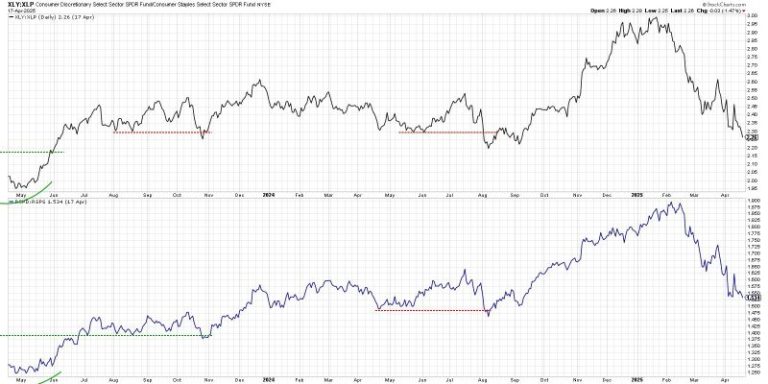
Here’s one of my favorite charts for analyzing offense vs. defense, a chart that holds a place of honor on my Market Misbehavior LIVE ChartList. We’re comparing the Consumer Discretionary and Consumer Staples using both cap-weighted and equal-weighted ETFs.

When the ratios are going higher, investors are favoring “things you want” over “things you need”, which implies optimism for economic growth. When the ratios slope lower, that suggests more defensive positioning as investors are skeptical of growth prospects.

We can see that the cap-weighted version of this ratio made a peak in January, while the equal-weighted version made its own top in February. Both ratios have been in a fairly consistent downtrend of lower highs and lower lows, even through last week’s sudden spike on tariff policy changes.

How bullish do I want to be when these ratios are sloping lower? Generally speaking, I’ve found that until investors start believing in the upside potential of Consumer Discretionary over the relative defense of Consumer Staples, it’s best to remain on the sidelines.

Using the RRG to Visualize Offense vs. Defense

While I often refer to relative strength ratios of sector ETFs vs. the S&P 500 index, I also enjoy leveraging the power of Relative Rotation Graphs (RRG®) to monitor a series of relative strength ratios in one simple but powerful visualization.

Here, I’m showing the 11 S&P 500 economic sectors relative to the S&P 500, and I’m highlighting Consumer Discretionary and Consumer Staples to monitor their relative positions. If you click “Animate” for this visualization, you’ll see that toward the end of 2024, offense was clearly outperforming defense. The XLY was in the Leading quadrant, the XLP was in the Lagging quadrant, and the rotations suggested a classic bull market configuration.

Fast-forward to February and March and you’ll see how Consumer Discretionary rotated into the Weakening and then Lagging quadrant. Meanwhile, Consumer Staples strengthened during that same period. At this point, the RRG is telling me defense over offense, in a classic bearish configuration.

Sticking With Groceries, Guns, and Gold

So, given the bearish leadership configuration in spite of a sudden bounce of the April market low, where can we find potential opportunities? I’ll highlight three ideas that I’ll summarize as “Groceries, Guns, and Gold.”

Playing off the “things you need” theme implied above, grocery retailer Kroger Co. (KR) has managed to pound out a fairly consistent pattern of higher highs and higher lows. With improving momentum and a new 12-month relative high this week, this is a chart continuing in a clear uptrend despite broad market weakness.  By the way, KR was one of the Top Ten Charts for April 2025 I presented with Grayson Roze!

Defense stocks like Northrop Grumman Corp. (NOC) have experienced an upside resurgence given geopolitical instability in 2025. From a technical perspective, I love how charts like NOC have rallied since mid-February, while most stocks, as well as our equity benchmarks, have been trending lower! There’s a significant resistance level to overcome around $550, but a confirmed break higher could open the door to further gains.

Gold has experienced an incredible run so far in 2025, finishing the week up 26% for the year compared to the S&P 500’s 10% loss over the same period. Similar to the chart of NOC, Newmont Corporation (NEM) is addressing a key resistance level from a major high in October 2024. But, so far in 2025, NEM has been scoring higher highs and higher lows, potentially building momentum for a break to a new all-time high.

It can be super tempting to consider the April low as “the bottom” and go all-in on growth stocks and offensive plays. But, given the lack of leadership rotation in April, I’m inclined to stick with charts that remain in strong uptrends during uncertain times.

RR#6,

Dave

P.S. Ready to upgrade your investment process? Check out my free behavioral investing course!


David Keller, CMT

President and Chief Strategist

Sierra Alpha Research LLC


Disclaimer: This blog is for educational purposes only and should not be construed as financial advice. The ideas and strategies should never be used without first assessing your own personal and financial situation, or without consulting a financial professional.

The author does not have a position in mentioned securities at the time of publication. Any opinions expressed herein are solely those of the author and do not in any way represent the views or opinions of any other person or entity.

Capital One Financial’s application to acquire Discover Financial Services in a $35.3 billion all-stock deal has officially been approved by the Federal Reserve and the Office of the Comptroller of the Currency, the regulators announced on Friday.

“The Board evaluated the application under the statutory factors it is required to consider, including the financial and managerial resources of the companies, the convenience and needs of the communities to be served by the combined organization, and the competitive and financial stability impacts of the proposal,” the Fed said in a release.

Capital One first announced it had entered into a definitive agreement to acquire Discover in February 2024. It will also indirectly acquire Discover Bank through the transaction, which was approved by the Office of the Comptroller of the Currency on Friday.

Under the agreement, Discover shareholders will receive 1.0192 Capital One shares for each Discover share or about a 26% premium from Discover’s closing price of $110.49 at the time, Capital One said in a release.

Capital One and Discover are among the largest credit card issuers in the U.S., and the merger will expand Capital One’s deposit base and its credit card offerings. 

As a condition of the merger, Capital One said it will comply with the Fed’s action against Discover, according to the release. The Fed fined Discover $100 million for overcharging certain interchange fees from 2007 through 2023, and the company is repaying those fees to affected customers.

The OCC said it approved Capital One’s application on the condition that it would take “corrective actions” to remediate harm and address the “root causes” of outstanding enforcement actions against Discover.

After the deal closes, Capital One shareholders will hold 60% of the combined company, while Discover shareholders own 40%, according to the February 2024 release.

In a joint statement, Capital One and Discover said they expect to close the deal on May 18.

This post appeared first on NBC NEWS

Alphabet’s Google illegally dominated two markets for online advertising technology, a judge ruled Thursday, dealing another blow to the tech giant and paving the way for U.S. antitrust prosecutors to seek a breakup of its advertising products.

U.S. District Judge Leonie Brinkema in Alexandria, Virginia, found Google liable for “willfully acquiring and maintaining monopoly power” in markets for publisher ad servers and the market for ad exchanges, which sit between buyers and sellers. Websites use publisher ad servers to store and manage their ad inventories.

Antitrust enforcers failed to prove a separate claim that Google had a monopoly in advertiser ad networks, she wrote.

Lee-Anne Mulholland, Google’s vice president of regulatory affairs, said Google will appeal the ruling.

“We won half of this case and we will appeal the other half,” she said in a statement, adding that the company disagrees with the decision about its publisher tools. “Publishers have many options and they choose Google because our ad tech tools are simple, affordable and effective.’

Google’s shares were down around 2.1% at midday.

The decision clears the way for another hearing to determine what Google must do to restore competition in those markets, such as sell off parts of its business at another trial that has yet to be scheduled.

The Justice Department has said Google should have to sell off at least its Google Ad Manager, which includes the company’s publisher ad server and ad exchange.

However, a Google representative said Thursday that Google was optimistic it would not have to divest part of the business as part of any remedy, given the court’s view that its acquisition of advertising tech companies like DoubleClick were not anticompetitive.

Google still faces the possibility that two U.S. courts will order it to sell assets or change its business practices. A judge in Washington will hold a trial next week on the Justice Department’s request to make Google sell its Chrome browser and take other measures to end its dominance in online search.

Google has previously explored selling off its ad exchange to appease European antitrust regulators, Reuters reported in September.

Brinkema oversaw a three-week trial last year on claims brought by the Justice Department and a coalition of states.

Google used classic monopoly-building tactics of eliminating competitors through acquisitions, locking customers in to using its products and controlling how transactions occurred in the online ad market, prosecutors said at trial.

Google argued the case focused on the past, when it was still working on making its tools able to connect to competitors’ products. Prosecutors also ignored competition from Amazon.com, Comcast and other technology companies as digital ad spending shifted to apps and streaming video, Google’s lawyer said.

The ruling was issued as a district court in Washington, D.C., held its fourth day of an antitrust trial between Meta and the Federal Trade Commission, in which the government similarly accused the company then known as Facebook of monopolizing the social networking market through its acquisitions of Instagram and WhatsApp.

A Google representative said the partially favorable ruling in its case Thursday could point to success for Meta, as well, in defending its acquisitions from the government’s antitrust allegations.

This post appeared first on NBC NEWS

Harvard’s brewing conflict with the Trump administration could come at a steep cost — even for the nation’s richest university.

On April 14, Harvard University President Alan Garber announced the institution would not comply with the administration’s demands, including to “audit” Harvard’s students and faculty for “viewpoint diversity.” The federal government, in response, froze $2.2 billion in multi-year grants and $60 million in multi-year contracts with the university.

According to CNN and multiple other news outlets, the Trump administration has now asked the Internal Revenue Service to revoke Harvard’s tax-exempt status. If the IRS follows through, it would have severe consequences for the university. The many benefits of nonprofit status include tax-free income on investments and tax deductions for donors, education historian Bruce Kimball told CNBC.

Bloomberg estimated the value of Harvard’s tax benefits in excess of $465 million in 2023.

Nonprofits can lose their tax exemptions if the IRS determines they are engaging in political campaign activity or earning too much income from unrelated activities. Few universities have lost their non-profit status. One of the few examples was Christian institution Bob Jones University, which lost its tax exemption in 1983 for racially discriminatory policies.

White House spokesperson Harrison Fields told the Washington Post that the IRS started investigating Harvard before President Donald Trump suggested on Truth Social that the university should be taxed as a “political entity.” The Treasury Department did not reply to a request for comment from CNBC.

A Harvard spokesperson told CNBC that the government has “no legal basis to rescind Harvard’s tax exempt status.”

“The government has long exempted universities from taxes in order to support their educational mission,” the spokesperson wrote in a statement. “Such an unprecedented action would endanger our ability to carry out our educational mission. It would result in diminished financial aid for students, abandonment of critical medical research programs, and lost opportunities for innovation. The unlawful use of this instrument more broadly would have grave consequences for the future of higher education in America.” 

The federal government has challenged Harvard on yet another front, with the Department of Homeland Security threatening to stop international students from enrolling. The Student and Exchange Visitor Program is administered by Immigration and Customs Enforcement, which falls under the DHS.

International students make up more than a quarter of Harvard’s student body. However, Harvard is less financially dependent on international students than many other U.S. universities as it already offers need-based financial aid to international students in its undergraduate program. Many other universities require international students to pay full tuition.

The Harvard spokesperson declined to comment to CNBC on whether the university would sue the administration over the federal funds or any other grounds. Lawyers Robert Hur of King & Spalding and William Burck of Quinn Emanuel are representing Harvard, stating in a letter to the federal government that its demands violate the First Amendment.

Harvard, the nation’s richest university, has more resources than other academic institutions to fund a long legal battle and weather the storm. However, its massive endowment — which has raised questions during the recent developments — is not a piggy bank.

Harvard has an endowment of nearly $52 billion, averaging $2.1 million in endowed funds per student, according to a study by the National Association of College and University Business Officers, or NACUBO, and asset manager Commonfund.

That size makes it larger than than the GDP of many countries.

The endowment generated a 9.6% return last fiscal year, which ended June 30, according to the university’s latest annual report.

Founded in 1636, Harvard has had more time to accumulate assets as the nation’s oldest university. It also has robust donor base, receiving $368 million in gifts to the endowment in 2024. While the university noted that more than three-quarters of the gifts averaged $150 per donor, Harvard has a history of headline-making donations from ultra-rich alumni.

Kimball, emeritus professor of philosophy and history of education at the Ohio State University, attributes the outsized wealth of elite universities like Harvard to a willingness to invest in riskier assets.

University endowments were traditionally invested very conservatively, but in the early 1950s Harvard shifted its allocation to 60% equities and 40% bonds, taking on more risk and creating the opportunity for more upside.

“Universities that didn’t want to assume the risk fell behind,” Kimball told CNBC in March.

Other universities soon followed suit, with Yale University in the 1990s pioneering what would become the “Yale Model” of investing in alternative assets like hedge funds and natural resources. Though it proved lucrative, only universities with large endowments could afford to take on the risk and due diligence that was needed to succeed in alternative investments, according to Kimball.

According to Harvard’s annual report, the largest chunks of the endowment are allocated to private equity (39%) and hedge funds (32%). Public equities constitute another 14% while real estate and bonds/TIPs make up 5% each. The remainder is divided between cash and other real assets, including natural resources.

The university has made substantial portfolio allocation changes over the past seven years, the report notes. The Harvard Management Company has cut the endowment’s exposure to real estate and natural resources from 25% in 2018 to 6%. These cuts allowed the university to increase its private equity allocation. To limit equity exposure, the endowment has upped its hedge fund investments.

University endowments, though occasionally staggering in size, are not slush funds. The pools are actually made up of hundreds or even thousands of smaller funds, the majority of which are restricted by donors to be dedicated to areas including professorships, scholarships or research.

Harvard has some 14,600 separate funds, 80% of which are restricted to specific purposes including financial aid and professorships. Last fiscal year, the endowment distributed $2.4 billion, 70% of which was subject to donors’ directives.

“Most of that money was put in for a specific purpose,” Scott Bok, former chairman of the University of Pennsylvania, told CNBC in March. “Universities don’t have the ability to break open the proverbial piggy bank and just grab the money in whatever way they want.”

Some of these restrictions are overplayed, according to former Northwestern University President Morton Schapiro.

“It’s true that a lot of money is restricted, but it’s restricted to things you’re going to spend on already like need-based aid, study abroad, libraries,” Bok said previously.

Harvard has $9.6 billion in endowed funds that are not subject to donor restrictions. The annual report notes that “while the University has no intention of doing so,” these assets “could be liquidated in the event of an unexpected disruption” under certain conditions.

Liquidating $9.6 billion in assets, nearly 20% of total endowed funds, would come at the cost of future cash flow, as the university would have less to invest.

Harvard did not respond to CNBC’s queries about increasing endowment spending. Like most universities, it aims to spend around 5% of its endowment every year. Assuming the fund generates high-single-digit investment returns, spending just 5% allows the principal to grow and keep pace with inflation.

For now, Harvard is taking a hard look at its operating budget. In mid-March, the university started taking austerity measures, including a temporary hiring pause and denying admission to graduate students waitlisted for this upcoming fall.

Harvard is also issuing $750 million in taxable bonds due September 2035. This past February, the university issued $244 million in tax-exempt bonds. A slew of universities including Princeton and Colgate are also raising debt this spring.

So far, Moody’s has not updated its top-tier AAA rating for Harvard’s bonds. However, when it comes to higher education as a whole, the ratings agency isn’t so optimistic, lowering its outlook to negative in March.

This post appeared first on NBC NEWS

The gold price reached yet another record high on Wednesday (April 16), breaking US$3,300 per ounce.

The precious metal has gained significant momentum since the beginning of the year. In trading on Wednesday it surged past the US$3,200 mark, climbing as high as US$3,354.10 per ounce. The price retreated below the US$3,300 mark on Thursday (April 17).

The rise comes after statements from US Federal Reserve Chairman Jerome Powell made at the Economic Club of Chicago on Wednesday. In his remarks, he said that he expects US President Donald Trump’s tariff policy to negatively impact US economic growth and further fuel inflation.

In addition to gold climbing to record highs, the US dollar sank to its lowest point in three years with the DXY dollar index falling to 99.3 points on Thursday.

Gold price chart, April 10, 2025, to April 17, 2025.

Gold prices have soared in recent weeks amidst the chaos caused by Donald Trump’s tariff announcements on April 2.

Those measures included a 10 percent tariff on all but a handful of countries, including Canada and Mexico, with more severe reciprocal tariffs to come into effect this week. However, on April 9, Trump announced he would pause the additional tariffs for 90 days, saying more than 70 countries had contacted him to make deals.

Trump may have also been feeling pressure from economic advisors as a surge in treasury yields signaled a potential economic crisis brewing in the US bond market. Normally a safe haven during market volatility, the bond market saw a significant selloff this week as US tariffs and worries about the US economy’s stability spooked traders.

Although the pause gave most countries some breathing room, tariffs against China were left on the table. After much back and forth, US tariffs levied against China have now increased to 145 percent.

The net effect of Trump’s actions has been political and financial turmoil, sparking selloffs in major stock markets and pushing prices for safe-haven assets like gold to fresh records.

Additionally, China, Japan and South Korea agreed on March 30 to seek deeper free trade ties in response to the threat of tariffs from the US government. The deal marks a significant move by the three countries following decades of US diplomacy to maintain close relationships with Japan and South Korea.

Securities Disclosure: I, Dean Belder, hold no direct investment interest in any company mentioned in this article.

Keep reading…Show less
This post appeared first on investingnews.com