
Author

admin

Browsing

Finlay Minerals Ltd.( TSXV: FYL) (OTCQB: FYMNF) (‘Finlay’ or the ‘Company’) announces that the Company has entered into two definitive earn-in agreements (the ‘Earn-In Agreements’) with Freeport-McMoRan Mineral Properties Canada Inc. (‘Freeport’), a wholly owned subsidiary of Freeport-McMoRan Inc. (NYSE: FCX), pursuant to which it has granted Freeport separate options to earn an 80% interest in its PIL and ATTY Properties (the ‘Properties’) in the Toodoggone District of northern British Columbia.

Highlights

  • Freeport may earn 80% of the PIL and ATTY Projects by expending $35 million in Exploration Expenditures and making Cash Payments of $4.1 million – (Refer to Table 1 below for further details);
  • Finlay will act as the Operator during the Earn-In period; and
  • Exploration Program planning is underway and will be announced shortly.

The earn-in in respect of each of the Properties may be exercised separately. Following the completion of the earn-in on either of the Properties, Freeport and Finlay will respectively hold interests of 80% and 20% in such Property, and a joint venture will be formed for further exploration and development. In the event that a party does not fund their portion of further joint venture programs, their interests in the joint venture will dilute. Any party that dilutes to below a 10% interest in the joint venture will exchange its joint venture interest for a net smelter returns (‘NSR‘) royalty of 1% on the applicable Property, which is subject to a 0.5% buyback for USD $2,000,000.

The earn-in requirements can be accelerated by Freeport at its discretion. During the earn-in period, Finlay will be the Operator on the Properties, collecting an operator’s fee, under the direction of a technical committee that will approve work programs and budgets during the earn-in period.

The PIL & ATTY Properties are each subject to a 3.0% NSR royalty held by Electrum Resource Corporation (‘Electrum’), a private company, the outstanding voting shares of which are held by Company directors: John A. Barakso and Ilona B. Lindsay. The Company has a current right to buy back ½ of the royalty (1.5%) on each property for an aggregate payment of $2,000,000 and $1,500,000 respectively. Finlay and Electrum have agreed that upon the exercise of the earn-in in respect of each Property by Freeport, the buy-back right will be amended to provide for a 2.0% buyback for each Property, in consideration for an increased buy-back payment to be sole-funded by Freeport without joint venture dilution to Finlay, and will be divided equally between Finlay and Electrum.

Freeport-McMoRan (FCX) is a leading international metals company focused on copper, with major operations in the Americas and Indonesia and significant reserves of copper, gold, and molybdenum.

The Earn-In Agreements were executed and delivered on April 17, 2025 and are subject to approval of the TSX Venture Exchange. Finlay and Freeport are arms-length parties and no finders’ fees were incurred with these transactions.

About the PIL Property:

The 100% owned PIL Property covers 13,374 hectares of highly prospective ground in the prolific Toodoggone mining district of north-central British Columbia. The core PIL claims were staked over 30 years ago by the founders of the Company. Over the decades, numerous Cu-Au-Mo porphyry and porphyry-related Au-Ag epithermal targets have been identified at PIL. The identified targets are central to a broader 70 km porphyry corridor trend, which includes: Centerra Gold’s past producing Kemess South Cu-Au porphyry mine and Kemess Underground Cu-Au-Ag porphyry resource, Thesis Gold’s Lawyers-Ranch Au-Ag epithermal resource, and the newly discovered Amarc Resources and Freeport AuRORA Cu-Au-Ag porphyry. Readers are cautioned that mineralization on the foregoing regional properties is not necessarily indicative of mineralization on the PIL Property. The PIL Property is road accessible and permitted for the 2025 season. (Refer to Figure 2 Map.)

About the ATTY Property:

The 100% owned ATTY Property covers 3,875 hectares in the prolific Toodoggone mining district of north-central British Columbia. The ATTY Property adjoins Centerra Gold’s Kemess Project and Amarc Resources and Freeport’s JOY property. Several epithermal-style Ag ± Au ± Cu ± base-metal veins are exposed on the ATTY Property, and geochemical and geophysical work have outlined at least two promising porphyry targets, including the drill-ready KEM Target. The ATTY Property is road accessible and permitted for the 2025 season.

Qualified Person:

Wade Barnes, P. Geo. and Vice President, Exploration for Finlay and a qualified person as defined by National Instrument 43-101, has reviewed and approved the technical content of this news release.

About Finlay Minerals Ltd.

Finlay is a TSXV company focused on exploration for base and precious metal deposits with four 100% owned properties in northern British Columbia: the PIL and ATTY properties in the Toodoggone, the Silver Hope Cu-Ag Property (21,322 ha) and the SAY Cu-Ag Property (15,246 ha).

Finlay Minerals is advancing the PIL, ATTY, SAY and Silver Hope Properties that host copper-gold porphyry and gold-silver epithermal targets within different porphyry districts of northern and central BC. Each property is located in areas of recent development and porphyry discoveries with the advantage of hosting the potential for new discoveries.

Finlay trades under the symbol ‘FYL’ on the TSXV and under the symbol ‘FYMNF’ on the OTCQB. For further information and details, please visit the Company’s website at www.finlayminerals.com

On behalf of the Board of Directors,
Robert F. Brown
President, CEO & Director

Neither the TSXV nor its Regulation Services Provider (as that term is defined in the policies of the TSXV) accepts responsibility for the adequacy or accuracy of this release.

Forward-Looking Information: This news release includes certain ‘forward-looking information’ and ‘forward-looking statements’ (collectively, ‘forward-looking statements’) within the meaning of applicable Canadian securities legislation. All statements in this news release that address events or developments that we expect to occur in the future are forward-looking statements. Forward-looking statements are statements that are not historical facts and are generally, although not always, identified by words such as ‘expect’, ‘plan’, ‘anticipate’, ‘project’, ‘target’, ‘potential’, ‘schedule’, ‘forecast’, ‘budget’, ‘estimate’, ‘intend’ or ‘believe’ and similar expressions or their negative connotations, or that events or conditions ‘will’, ‘would’, ‘may’, ‘could’, ‘should’ or ‘might’ occur. All such forward-looking statements are based on the opinions and estimates of management as of the date such statements are made. Forward-looking statements in this news release include statements regarding, among others, the exploration plans for the Properties and the potential exercise of Freeport’s option to acquire an interest in the Properties. Although Finlay believes the expectations expressed in such forward-looking statements are based on reasonable assumptions, such statements are not guarantees of future performance and actual results or developments may differ materially from those forward-looking statements. Factors that could cause actual results to differ materially from those in forward-looking statements include market prices, exploration successes, and continued availability of capital and financing and general economic, market or business conditions. These forward-looking statements are based on a number of assumptions including, among other things, assumptions regarding general business and economic conditions, the timing and receipt of regulatory and governmental approvals, the ability of Finlay and other parties to satisfy stock exchange and other regulatory requirements in a timely manner, the availability of financing for Finlay’s proposed transactions and programs on reasonable terms, and the ability of third-party service providers to deliver services in a timely manner. Investors are cautioned that any such statements are not guarantees of future performance and actual results or developments may differ materially from those projected in the forward-looking statements, and accordingly undue reliance should not be put on such statements due to the inherent uncertainty therein. Finlay does not assume any obligation to update or revise its forward-looking statements, whether as a result of new information, future or otherwise, except as required by applicable law.

Source

This post appeared first on investingnews.com

As gold and silver continue to prove their worth as sound investments, market participants should know how precious metals investments are taxed in the US.

While the majority of gold and silver investing comes with a certain degree of taxation, there are different levels of tax based on how market participants decide to invest in these precious metals, how long the investments are held for and the investors individual tax bracket.

Read on for a breakdown of the taxes associated with investing in gold and silver bullion, ETFs and stocks, as well as the forms involved with reporting precious metals investments.

In this article

    How are physical gold and silver taxed?

    Gold and silver bullion, coins and bars are seen as collectibles by the Internal Revenue Service (IRS) in the US. Thus, physical gold and silver, no matter the form, are subject to a higher rate of capital gains tax when they are sold. The same is true for fellow precious metals platinum and palladium.

    While long-term capital gains would typically carry a top bracket of 20 percent, collectibles can be taxed at a higher 28 percent.

    The total an investor will owe in capital gains tax when selling physical gold and silver is based both on their income bracket and the length of time they held the asset.

    The long-term capital gains tax on physical gold and silver is equal to an investor’s marginal tax rate, up to a maximum of 28 percent due to their status as a collectible, meaning those in higher tax brackets still only have to pay 28 percent on long-term gains from physical precious metals sales.

    It is worth noting that the 28 percent maximum is only for long-term capital gains, which applies to metals that an investor has held for more than one year. Short-term capital gains on precious metals held for less than one year are taxed at ordinary income rates.

    For example, a person in the highest tax bracket purchased 100 ounces of physical gold at US$1,800 per ounce and two years later sold their holdings for US$2,000 per ounce. While they are in the 37 percent tax bracket, they would pay 28 percent tax on the capital gains made from these sales. As they earned US$20,000 in capital gains, that would translate to US$5,600 in income tax.

    However, if the investor sold the gold at the same gain just 11 months after they purchased it, it would count as short-term capital gains, and the investor would be taxed at 37 percent and owe US$7,400.

    Investors who are in one of the tax brackets below 28 percent are taxed at the standard rate of their bracket when selling their solid gold and silver assets, whether they are held short- or long-term.

    Similarly to other investments, precious metals sold at a loss can be used to offset capital gains.

    How are gold and silver ETFs taxed?

    Like all other exchange-traded funds (ETFs), gold ETFs and silver ETFs act in the same manner as individual stocks, meaning that investing in these ETFs is similar to trading a stock on an exchange. There are two main types of gold and silver ETFs: those that track the prices of those metals and those that track gold or silver stocks.

    ETFs that follow metals prices provide exposure to either physical gold or silver, or gold or silver futures contracts. It is important to keep in mind that investing in these ETF platforms does not allow investors to own any physical gold or silver — in general, even an investment in an ETF that tracks physical gold or silver cannot be redeemed for the tangible metal.

    ETFs that invest in gold or silver companies provide exposure to gold- and silver-mining stocks, as well as gold- or silver-streaming stocks.

    In terms of taxation, capital gain taxes from selling gold and silver ETFs is determined by the ETF’s holdings, the investors tax bracket and how long they held the asset for.

    Funds will often supply investors with tax forms that they can use to fill out their income tax. The webpage for a fund should have a document describing how income tax is handled for that fund, which is worth reading before investing in it.

    Long-term capital gains from selling shares of gold and silver ETFs are subject to a 28 percent maximum federal income tax rate if they hold physical precious metals and 20 percent if they hold stocks. While long-term capital gains would typically be capped at 20 percent maximum rate. This is because the holdings are considered collectibles, as described in the section above. Short-term gains made from selling gold or silver ETFs are subject to a maximum federal rate of 37 percent.

    Additionally, these gains could get slapped with a 3.8 percent net investment income tax for high net-worth investors, and a state income tax may also apply.

    Futures-based commodity ETFs can come with their own set of rules that you can learn about here. Briefly, they are often taxed in a 60/40 hybrid, with 60 percent treated as long-term gains and 40 percent treated as short-term gains. Additionally, this is calculated at the end of each tax year, whether a sale is made or not.

    ETFs that hold stocks are taxed in the same way as traditional securities, which you can read more about below.

    How are gold and silver stocks taxed?

    In terms of tax on gold and silver stocks, long-term gains from selling are subject to the standard 20 percent maximum federal rate, while short-term gains will face a maximum federal rate of 37 percent. For investors in higher income brackets, there is the potential for gold and silver stock investments to also be hit with the 3.8 percent net investment income tax as well as state income tax.

    Unlike physical precious metals and ETFs that hold them, precious metals stocks are not classified as collectibles, which is why the long-term capital gains tax is capped at 20 percent instead of 28 percent.

    Stocks sold at a loss are important as well as they can be used to offset capital gains when filing income tax.

    How to report taxes on physical gold and silver investments

    Market participants who sell precious metals in the US for a profit are required to report that profit on their income tax return, regardless of whether or not the dealer has any reporting obligation.

    When selling gold and silver investments in the US, there are two different sets of reporting guidelines — one applies to the dealer through which a person sells and the other applies to the investor who is selling the asset.

    It is important to note that taxes on the sale of gold and silver will not be due the moment that the sale is made, and the tax bill for all of these sales is due at the same time as a standard income tax bill.

    For investors selling precious metals, capital gains or losses need to be reported on Schedule D of Form 1040 when making a tax return.

    Investors will first need to detail their precious metals transactions on Form 8949, including the length of time the investments were held. This form must be filed alongside Schedule D. Investors then use this information alongside the 28% Rate Gain Worksheet included in the Schedule D instructions.

    Depending on the type of metal being sold, Form 1099-B may have to be submitted to the IRS by the broker when the sale closes, as such transactions are considered income. As for when a broker will need to file Form 1099-B, there are specific rules that determine which sales of precious metals require the dealer to file this form that apply to transactions over a 24 hours period.

    For gold sales, reportable items include specific gold coins, including the 1 ounce Canadian Gold Maple Leaf and Gold Kruggerand, and gold bars and rounds of at least 0.995 fineness. As for quantity, only sales of more than 25 gold coins and or more than 1 kilogram in gold bars and rounds will require the form.

    Sales of 0.999 fine silver bars and rounds totaling over 1,000 ounces qualify. For silver coins, US coins with above 90 percent silver are reportable, but Silver American Eagle coins are not. Sales of silver coins exceeding US$1,000 will require a form.

    When it comes to selling gold and silver overseas, market participants must follow the laws as they apply to the sale of gold and silver investments in that particular country.

    The information in this article does not constitute tax advice, and investors should work with a tax professional or program to help them make sure everything is reported accurately.

    Securities Disclosure: I, Lauren Kelly, currently hold no direct investment interest in any company mentioned in this article.

    Keep reading…Show less
    This post appeared first on investingnews.com

    On April 17 (Thursday), Judge Leonie Brinkema of the US District Court for the Eastern District of Virginia ruled against Google (NASDAQ:GOOGL) in the antitrust case concerning its advertising technology business, casting a shroud of uncertainty over the future of the tech giant’s online advertising business.

    Brinkema will now need to determine what remedies to impose on Google to restore fair market competition. The plaintiffs sought to force Google to divest its Ad Manager, which includes the company’s publisher ad server and its ad exchange, to restore competition in the market. This outcome is far more likely following Judge Brinkema’s ruling.

    This is a developing story happening alongside a similar case against Meta Platforms (NASDAQ:META), which is being sued by the Federal Trade Commission (FTC) for allegedly monopolizing social media through its acquisition of Instagram in 2012 and WhatsApp in 2014.

    This trial against Google began in September 2024, and the plaintiffs in the lawsuit comprise the Department of Justice (DOJ) and attorneys general from eight states.

    The plaintiffs argued that Google’s dominance in ad tech allowed it to charge higher prices and take a larger share of ad sales. They accused Google of stifling competition by controlling the technology used to place ads on websites across the internet.

    The ruling against Google marks a significant step in one of numerous anti-competitive cases brought against Google in the past few years, both in the US and internationally.

    It follows an earlier ruling in August 2024 in which Google was found to have an illegal monopoly in the online search market in the US. That case will move into the remedies phase next week, with a court date of April 21, 2025.

    “This is a game-changer,” wrote Connecticut Attorney General William Tong, one of the plaintiffs in both cases. “As Judge Brinkema writes in her decision, Google was in direct violation of the Sherman Act by dictating how digital ads are sold and the terms under which its rivals can compete.

    ‘With this victory in hand, we can hopefully work now towards restoring a fair, free, and competitive digital advertising marketplace. This decision is the first step in opening up competition so that Connecticut businesses and consumers will pay less for advertising – and therefore less for goods and services. We will no longer be under the thumb of a gigantic multinational conglomerate.”

    US District Judge Amit Mehta, who ruled against Google in the August 2024 case, has considered imposing structural remedies that could involve forcing Google to divest its Chrome business, although Google has argued divestiture would hurt consumers. Instead, the company has suggested allowing browser companies to have multiple default agreements with various search engines.

    Regulators have been digging into various aspects of Google’s business, including its advertising technology, search practices and mobile operating system.

    In addition to the current case, Google is also facing scrutiny from antitrust regulators in Europe, the UK and other jurisdictions. The outcomes of these cases could have far-reaching implications for Google’s business model and the tech industry as a whole.

    Today’s ruling signifies a major development in the ongoing scrutiny of Big Tech’s market dominance, which echoes efforts to dismantle AT&T’s (NYSE:T) phone monopoly in the 1980s. The eventual outcome of that case led to AT&T’s breakup into seven independent enterprises, which laid the groundwork for some of today’s major telecommunications and internet services providers, including Verizon (NYSE:VZ) and Lumen Technologies (NYSE:LUMN). It also gave cable companies like Comcast room to expand into internet services.

    Whatever outcome Judge Brinkema decides, the ruling could reshape the online advertising landscape and have far-reaching implications for both the company and the broader tech industry.

    Securities Disclosure: I, Meagen Seatter, hold no direct investment interest in any company mentioned in this article.

    Keep reading…Show less
    This post appeared first on investingnews.com

    Westport Fuel Systems Inc. (TSX: WPRT Nasdaq: WPRT) (‘Westport’ or the ‘Company’) announces that the Company will release Q1 2025 financial results on Tuesday, May 13, 2025, after market close. A conference call and webcast to discuss the financial results and other corporate developments will be held on Wednesday, May 14, 2025.

    Time: 10:00 a.m. ET (7:00 a.m. PT)
    Call Link: https://register-conf.media-server.com/register/BI73bcac200e5f4652873668cf803d72ed
    Webcast: https://investors.wfsinc.com

    Participants may register up to 60 minutes before the event by clicking on the call link and completing the online registration form. Upon registration, the user will receive dial-in info and a unique PIN, along with an email confirming the details.

    The webcast will be archived on Westport’s website and a replay will be available at https://investors.wfsinc.com .

    Annual General and Special Meeting

    Westport will host its 2025 Annual General and Special Meeting (the ‘Meeting’) virtually on May 15, 2025 at 10:00 a.m. PT (1:00 p.m. ET).

    To streamline the virtual meeting process, Westport encourages shareholders to vote in advance of the Meeting using the voting instruction form or the form of proxy which has been shared with shareholders with the Meeting materials. Further instructions on voting and accessing the meeting are contained in the Management Information Circular under ‘Section 1: Voting’ – upon receipt, please review these materials carefully.

    Registered Shareholders and duly appointed proxyholders can attend the meeting online at https://meetnow.global/MD2JR55 to participate, vote, or submit questions during the meeting’s live webcast.

    About Westport Fuel Systems

    At Westport Fuel Systems, we are driving innovation to power a cleaner tomorrow. We are a leading supplier of advanced fuel delivery components and systems for clean, low-carbon fuels such as natural gas, renewable natural gas, propane, and hydrogen to the global transportation industry. Our technology delivers the performance and fuel efficiency required by transportation applications and the environmental benefits that address climate change and urban air quality challenges. Headquartered in Vancouver, Canada, with operations in Europe, Asia, North America, and South America, we serve our customers in approximately 70 countries with leading global transportation brands. At Westport Fuel Systems, we think ahead. For more information, visit www.wfsinc.com.

    Investor Inquiries:
    Investor Relations
    T: +1 604-718-2046
    E: invest@wfsinc.com

    News Provided by GlobeNewswire via QuoteMedia

    This post appeared first on investingnews.com

    French luxury group Hermès will raise its U.S. prices from the start of May in order to offset the impact of President Donald Trump’s tariffs, the company’s finance chief said Thursday.

    The company — which earlier this week overtook rival LVMH as the world’s biggest luxury firm by market capitalization — is best-known for its Birkin and Kelly handbags, along with colorful scarves retailing for hundreds of dollars. Other products include jewelry, watches, shoes, perfume and make-up.

    “The price increase that we’re going to implement will be just for the U.S. since it’s aimed at offsetting the tariffs that only apply to the American market, so there won’t be price increases in the other regions,” Eric du Halgouët, Hermès’ executive vice president for finance, said during an analyst call that followed the firm’s first-quarter results release on Thursday.

    Hermès said prices will rise from May 1 and aim to “fully offset” the impact of the universal 10% tariff imposed by the White House in early April, rather than the 20% duties the European Union may face unless it can negotiate a new deal during Trump’s 90-day reprieve.

    U.S. consumers are expected to contend with higher prices on a host of items, ranging from electronics and clothes to cars and houses, as the impact of tariffs bites.

    In its first-quarter results, Hermès reported 11% sales growth in the Americas, which accounted for nearly 17% of its sales revenue in the first three months of the year.

    First-quarter revenue growth came in at 7% on a constant currency basis overall, just shy of consensus expectations of an 8% to 9% increase, Deutsche Bank analysts said in a note. It also represented a slowdown from 17.6% growth in the fourth quarter of 2024.

    The Deutsche Bank analysts said that the results were nonetheless “robust,” with weakness driven by watches and perfume sales, while Citi described them as “a respectable outcome.”

    Hermès shares dipped 1.3% in Thursday morning deals, taking its value to 244.5 billion euros ($278.2 billion) — just shy of LVMH’s 245.7 billion euros — according to a CNBC calculation of LSEG data.

    LVMH, controlled by France’s billionaire Arnault family, unsuccesfully tried to acquire Hermès a decade ago. Despite drawing level in market cap, Hermès’ annual revenue is less than a fifth that of sprawling LVMH, which owns luxury brands Louis Vuitton and Dior, alcohol business Moët Hennessy, U.S. jeweler Tiffany and beauty chain Sephora.

    LVMH on Tuesday reported an unexpected decline in first quarter sales, flagging a fall in its dominant fashion and leather goods division.

    Analysts have predicted the luxury sector will be less impacted by tariffs than other retailers due to their ability to pass on increased import costs to a high-spending clientele. However, they would encounter major headwinds from a broad pullback in consumer spending as a result of weaker global economic growth or recessionary fears.

    This post appeared first on NBC NEWS

    Target CEO Brian Cornell will meet with the Rev. Al Sharpton this week in New York as the retailer faces calls for a boycott and a slowdown in foot traffic that began after it walked back key diversity, equity and inclusion programs, the civil rights leader told CNBC Wednesday.

    The meeting, which Target asked for, comes after some civil rights groups urged consumers not to shop at Target in response to the retailer’s decision to cut back on DEI. While Sharpton has not yet called for a boycott of Target, he has supported efforts from others to stop shopping at the retailer’s stores.

    “You can’t have an election come and all of a sudden, change your old positions,” said Sharpton. “If an election determines your commitment to fairness then fine, you have a right to withdraw from us, but then we have a right to withdraw from you.”

    The civil rights leader said he would consider calling for a Target boycott if the company doesn’t confirm its commitment to the Black community and pledge to work with and invest in Black-owned businesses.

    “I said, ‘If [Cornell] wants to have a candid meeting, we’ll meet,’” Sharpton said of the phone call Target made to his office. “I want to first hear what he has to say.”

    A Target spokesman confirmed to CNBC that the company reached out to Sharpton for a meeting and that Cornell will talk to him in New York this week. The company declined further comment.

    In January, Target said it would end its three-year DEI goals, no longer share company reports with external diversity-focused groups like the Human Rights Campaign’s Corporate Equity Index and end specific efforts to get more products from Black- and minority-owned businesses on its shelves. 

    Just days after the announcement, foot traffic at Target stores started to slow down. Since the week of Jan. 27, Target’s foot traffic has declined for 10 straight weeks compared to the year-ago period, according to Placer.ai, an analytics firm that uses anonymized data from mobile devices to estimate overall visits to locations. Target traffic had been up weekly year over year before the week of Jan. 27.

    The metric, which tallies visits to brick-and-mortar locations, does not capture sales in stores or online, but can indicate which retailers are drawing steadier business. While Target has been struggling to grow its sales for months as shoppers watch their spending, the stretch of declining visits came as some civil rights groups and social media users criticized the DEI decision and urged shoppers to spend their money elsewhere.

    Target declined to comment on the figures, saying it doesn’t discuss third-party data.

    At the convention earlier this month for his civil rights organization, the National Action Network, Sharpton said the group would call for a boycott of PepsiCo if the company didn’t agree to meet with the organization within 21 days. In February, the food and beverage company behind brands like Doritos and Mountain Dew announced it would end its DEI workforce representation goals and transition its chief DEI officer role into another position, among other changes.

    This week, leaders from Pepsi met with Sharpton and his team. He did not confirm whether Pepsi made any commitments, but did say it was encouraging that Pepsi’s CEO Ramon Laguarta attended. He added that the two will continue their discussions.

    Sharpton’s meetings with companies including PepsiCo and Target — and his openness to boycotts — mark one of the first meaningful efforts to push back against the war conservative activists like Robby Starbuck have waged on DEI. Starbuck, a movie director-turned-activist, has urged companies to drop DEI policies in part by sharing what he considers unflattering information about their initiatives with his social media followers. He has successfully pressured a wide range of corporate giants to rethink their programs.

    With its decision to roll back DEI efforts, the cheap chic retailer Target joined Walmart, McDonald’s, Tractor Supply and a slew of others that scrapped at least some DEI initiatives as they grew concerned that the programs could alienate some customers or land them in the crosshairs of President Donald Trump, who has vowed to end every DEI program across the federal government.

    Target’s decision contrasted with Costco, which shook off pressure from conservative activists to maintain its DEI programs. Shareholders of the membership-based wholesale club soundly rejected a proposal in late January that requested a report on the risks of DEI initiatives.

    NAN has called for so-called “buy-cotts” at Costco, and has brought people to stores in Tennessee, New York and New Jersey. It gave them gift cards to shop with at the warehouse club.

    In the month of March, Target’s store traffic declined 6.5%, while the metric rose 7.5% year over year at Costco, Placer.ai data show.

    Target’s challenges run deeper than DEI backlash, and resistance to its policy change only added to its issues. The discounter’s annual revenue has been roughly flat for four years in a row as it’s struggled to drive consistent sales gains.

    Margins have been under pressure, as consumers buy more of groceries and necessities and less of more profitable categories like home goods and clothing. And the company has pinned its problems on a laundry list of problems in recent years, including having the wrong inventory; losing money from theft, damaged goods and other types of inventory losses; backlash to its collection for Pride Month and pricier costs from rushing shipments.

    Competition has grown fiercer too, as big-box rival Walmart has remodeled stores, launched new private brands and attracted more high-income shoppers.

    In February, Target gave weak guidance for the first quarter and said it expected sales to grow 1% for the full year. 

    In his meeting with Cornell, Sharpton said he will ask for Target to follow through on pledges it made after police killed George Floyd in the company’s hometown of Minneapolis.

    “You made commitments based on the George Floyd movement … what changed?” said Sharpton. “Are you trying to say … everything’s fine now, because the election changed? That’s insulting to us.”

    In the wake of Floyd’s murder, Cornell said the event moved him.

    “That could have been one of my Target team members,” Cornell said in 2021 at an event hosted by the Economic Club of Chicago, recounting his thoughts as he watched the video of Floyd taking his final breaths.

    At the time, he said it motivated him to step up Target’s efforts to fight racial inequities.

    “We have to be the role models that drive change and our voice is important,” he said at the event. “We’ve got to make sure that we represent our company principles, our values, our company purpose on the issues that are important to our teams.”

    This post appeared first on NBC NEWS

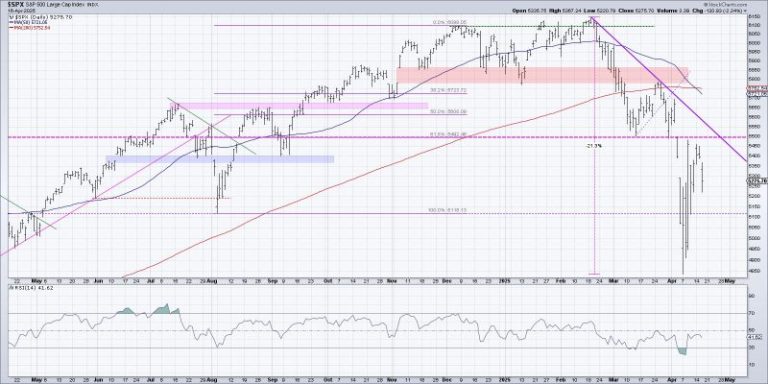
    When markets get more volatile and more unstable, I get the urge to take a step back and reflect on simple assessments of trend and momentum.  Today we’ll use one of the most common technical indicators, the 200-day moving average, and discuss what this simple trend-following tool can tell us about conditions for the S&P 500 index.

    Nothing Good Happens Below the 200-Day Moving Average

    I’ve received a number of questions recently as to why I’m not way more bullish after the sudden rally off last Wednesday’s low.  I love to respond with Paul Tudor Jones’ famous quote, “Nothing good happens below the 200-day moving average.”

    To be clear, the 200-day moving average is almost 500 points above current levels, so it would take quite a rally to achieve that price level any time soon.  But with the VIX still well above the 30 level, that means the market is expecting wide price swings and big moves could be very possible.

    But generally speaking, any time I see a chart where the price is below a downward-sloping 200-day moving average, I feel comfortable making the basic assumption that the primary trend is down.  And until the SPX can regain this long-term trend barometer, I’m inclined to treat the market as “guilty until proven innocent.”

    Tracking the 200-Day With the New Market Summary Page

    The new and updated version of the StockCharts Market Summary page features a table of major equity indexes and includes a comparison to the 200-day moving average for each index.  I’ve sorted today’s table in descending order based on this metric, which allows us to compare the relative position of different indexes and focus on which areas of the equity market are showing real strength.

    We can see that only the Dow Utilities remain above the 200-day moving average, even with the strong bounce we’ve observed over the last week.  The S&P 500 is about 8% below its 200-day moving average, and for the Nasdaq Composite it’s over 11%.  So this basically implies that the S&P could see another 8% rally, drawing in all sorts of investors, yet still remain in a bearish phase based on its position relative to the 200-day.

    Three Stocks Facing a Crucial Test This Week

    One chart I’m watching closely this week involves three key growth stocks that are actually very near their own 200-day moving average.  If these Magnificent 7 stocks have enough upside momentum to power through the 200-day, then there could definitely be hope for the S&P 500 and Nasdaq to follow suit in the coming weeks.  

    Note in the top panel how Meta Platforms (META) powered above the 200-day last Wednesday after the announcement of a 90-day pause in tariffs.  But after closing above the 200-day for that one day, META broke right back below the next day.  META has closed lower every trading day since that breakout.

    Neither Amazon.com (AMZN) nor Tesla (TSLA) reached their own 200-day on last Wednesday’s rally, and both are now rapidly approaching their lows for 2025.  And if mega cap growth stocks like META, AMZN, and TSLA are unable to power above their 200-day moving averages, why should we expect our growth-dominated benchmarks to do the same?

    With a flurry of news headlines every trading day, and an earnings season that could paint a disturbing picture of lowered expectations for economic growth and consumer sentiment, I feel that there is more downside to be had before the great bear market of 2025 is completed.  But instead of trying to predict the future, I choose to simply follow the trends.  And based on the shape of the 200-day moving average for these important charts, the primary trend appears to still be down.

    RR#6,

    Dave

    PS- Ready to upgrade your investment process?  Check out my free behavioral investing course!

    David Keller, CMT

    President and Chief Strategist

    Sierra Alpha Research LLC

    Disclaimer: This blog is for educational purposes only and should not be construed as financial advice.  The ideas and strategies should never be used without first assessing your own personal and financial situation, or without consulting a financial professional.  

    The author does not have a position in mentioned securities at the time of publication.    Any opinions expressed herein are solely those of the author and do not in any way represent the views or opinions of any other person or entity.

    Moving average strategy, trend trading, and multi-timeframe analysis are essential tools for traders. In this video, Joe demonstrates how to use two key moving averages to determine if a stock is in an uptrend, downtrend, or sideways phase. He then expands on applying this concept across multiple timeframes to gain a significant edge when trading pullbacks.

    In addition, Joe provides insights into the current state of commodities, highlighting areas showing signs of improvement, and covers major indices. Finally, he addresses viewer-submitted symbol requests, including LMT, BABA, and more, offering his technical analysis on each.

    The video premiered on April 16, 2025. Click this link to watch on Joe’s dedicated page.

    Archived videos from Joe are available at this link. Send symbol requests to stocktalk@stockcharts.com; you can also submit a request in the comments section below the video on YouTube. Symbol Requests can be sent in throughout the week prior to the next show.

    With so many articles and videos on popular media channels advising you not to look at your 401(k) during this market downturn, avoiding taking the other side is tough. If you are close to retirement or retired, isn’t a market downturn a good excuse to look at your 401(k)? After all, you’ve stashed away hard-earned money to enjoy those big post-retirement plans.

    The stock market is well-known for its uncanny ability to throw you surprises, but the recent headline-driven price action is especially difficult to navigate. While it’s true that, over the longer term, the broader market tends to trend higher, if you’re not in a position to patiently wait for that to occur, you may want to reevaluate your portfolio sooner rather than later. The “set-it-and-forget-it” strategy can work at times but not always.

    Is the Stock Market Headed Lower?

    Let’s look at where the overall stock market stands by analyzing the S&P 500 ($SPX), starting with the daily chart.

    FIGURE 1. DAILY CHART OF S&P 500. After falling below its 200-day moving average, the S&P 500 is struggling to remain above its 5400 level. Will it hold? Chart source: StockCharts.com. For educational purposes.

    It’s clear the S&P 500 is trending lower and that the 50-day simple moving average (SMA) has crossed below the 200-day SMA, further confirming the downward trend of the index. After reaching a high of 6147.43 on February 19, 2025, $SPX started its decline, falling below its 50-day SMA and then its 200-day SMA.

    Although the index tried to bounce back to its 200-day SMA, it failed to break above it and fell to a low of 4835.04 on April 7, 2025. Since then, the S&P 500 has been trying to bounce back. It filled the April 4 down gap, but has been stalling around the 5400 level since then, on lower volume. It’s almost as if investors are sitting on the sidelines for the next tariff-related news which could send the S&P 500 higher or lower.

    Going back, the 5400 was a support level for the September 2024 lows, between the end of July and early August, and in mid-June. There have also been price gaps at this level during those times. The chart of the S&P 500 has a horizontal line overlay at the 5400 level. This could act as a resistance level for a while, or the index could soar above it, in which case this level could act as a support level.

    Save the chart in one of your ChartLists and watch how the price action unfolds for the next few weeks.

    Where’s the Breadth?

    It’s worth monitoring the Bullish Percent Index (BPI) of the S&P 500. The chart below displays the S&P 500 BPI ($BPSPX) in the top panel and $SPX in the bottom panel.

    FIGURE 2. BULLISH PERCENT INDEX FOR THE S&P 500. The $BPSPX recovered after falling below 12.5. Even a move over 50 should be eyed with caution. Chart source: StockCharts.com. For educational purposes.

    The recent slide in the S&P 500 took the $BPSPX to well below 12.5. It has reversed and is above 30, which is encouraging. A rise above 50 is bullish but, as you can see in the chart, the last time $BPSPX crossed above 50 (dashed blue vertical lines), it turned back lower, only to start its descent to the lowest level in the past year. Save your excitement until the $BPSPX is over 50 and a turnaround in the $SPX is in place.

    This could take a while, which is why, if you’re close to retirement or already retired, you may have to consider selling the rip, or if the situation turns bullish, buy the dip. It may be time to unwind some positions, so evaluate your portfolio and make decisions that are aligned with your lofty retirement plans.

    So, heck yeah! Look at your 401(k) now!


    Disclaimer: This blog is for educational purposes only and should not be construed as financial advice. The ideas and strategies should never be used without first assessing your own personal and financial situation, or without consulting a financial professional.

    Here’s a quick recap of the crypto landscape for Wednesday (April 16) as of 9:00 p.m. UTC.

    Get the latest insights on Bitcoin, Ethereum and altcoin performance along with a round-up of key cryptocurrency market news.

    Bitcoin and Ethereum price update

    At the time of this writing, Bitcoin (BTC) was priced at US$84,336.30 and is up 0.4 percent in 24 hours. The day’s range has seen a low of US$83,592.79 and a high of US$85,311.80.23.

    Bitcoin’s price movements on April 16.

    Chart via TradingView.

    Trade tension escalation between China and the US continues to drag on the crypto market.

    Ethereum (ETH) is priced at US$1,588.68, a 1.1 percent decrease over the past 24 hours. The cryptocurrency reached an intraday low of US$1,551.41 and a high of US$1,605.30.

    Altcoin price update

    • Solana (SOL) is currently valued at US$132.69, up 3.7 percent over the past 24 hours. SOL experienced a low of US$124.95 and peaked as the stock markets closed on Wednesday.
    • XRP is trading at US$2.11, reflecting a 0.6 percent decrease over the past 24 hours. The cryptocurrency recorded an intraday low of US$2.07 and reached its highest point as markets closed for the day.
    • Sui (SUI) is priced at US$2.11, showing a decreaseof 0.7 percent over the past 24 hours. It achieved a daily low of US$2.04 and a high of US$2.13
    • Cardano (ADA) is trading at US$0.6130, down 0.9 percent over the past 24 hours. Its lowest price on Wednesday was US$0.6007, with a high of US$0.6152.

    Today’s crypto news to know

    Analysts confirm crypto bear market

    Recent market analysis suggests the cryptocurrency market has been experiencing a bear market cycle. Bitcoin’s price has been below its 200-day simple moving average (SMA) since March. The 200-day SMA is a key metric used to identify trends in Bitcoin’s price movements and potential market cycles.

    “The 200DMA model on bitcoin does suggest that the token’s recent steep decline qualifies this as a bear market cycle starting in late March. But the same exercise performed on the COIN50 index (which includes the top 50 tokens by market capitalization) shows the asset class as a whole has been unequivocally trading in bear market territory since the end of February,” David Duong, global head of research at Coinbase Institutional, said in a note published Monday.

    “All of these structural pressures stem from the uncertainty of the broader macro environment, where traditional risk assets have faced sustained headwinds from fiscal tightening and tariff policies, contributing to the paralysis in investment decision making.’

    The authors of the report urge cautious trading for the next month or so, after which the sentiment could change “rather quickly.” Duong said the market could rebound in the second half of 2025.

    A market analysis by Bitcoin researcher Axel Adler Jr also points to potential for price recovery later in the year, noting the increasing dominance of US-regulated exchanges and a recurring bullish technical signal. Reduced supply, noted by analyst Borin Vest, could also contribute to upward price movement.

    Janover increases Solana holdings

    According to an April 15 announcement from real estate-focused financial technology firm Janover (NASDAQ:JNVR), the company’s Solana holdings have doubled to 163,651.7 after its latest purchase of 80,567 tokens for roughly US$10.5 million.

    Janover’s total Solana holdings are now worth about US$21.2 million, including staking rewards.

    Janover recently raised approximately US$42 million in a convertible note and warrants sale to bolster its digital asset treasury strategy. This funding round saw participation from investors including Pantera Capital, Kraken, Arrington Capital, Protagonist, The Norstar Group, Third Party Ventures, Trammell Venture Partners and 11 angel investors.

    The company intends to utilize the newly acquired capital to enhance its digital asset treasury strategy, including immediate staking of recently purchased SOL to generate additional revenue.

    Ripple Labs and SEC appeal paused amid settlement talks

    In the ongoing legal dispute between Ripple Labs and the SEC, an appeals court has approved a request to halt proceedings while settlement discussions take place, raising speculation about a potential imminent resolution. The SEC is required to provide an update on the situation by June 15.

    China faces a regulatory dilemma over seized crypto assets

    China’s growing trove of seized cryptocurrencies — confiscated from fraud, money laundering and gambling cases — has become a legal and political hot potato as local governments debate how to convert illicit digital wealth into usable state revenue, Reuters reported.

    With crypto trading banned and virtual assets not recognized as legal tender, authorities currently rely on loosely regulated private firms to offload seized tokens on offshore exchanges, raising concerns over transparency, corruption and inconsistent enforcement.

    Legal experts, judges and financial authorities are now calling for new national guidelines, including proposals to centralize asset management, establish crypto disposal agencies or even hold confiscated Bitcoin as sovereign reserves — a potential pivot that could reshape China’s crypto stance amid broader geopolitical and economic shifts.

    OKX ramps up US presence with exchange launch, wallet rollout

    OKX, one of the world’s top cryptocurrency exchanges, is making a calculated leap into the US market with a phased rollout of its centralized trading platform and a powerful self-custody Web3 wallet for retail and institutional users.

    Spearheading this expansion is newly appointed US CEO Roshan Robert and a fresh San Jose headquarters, signaling the company’s strategic commitment to regulatory compliance and American market penetration.

    The exchange offers deep liquidity, low fees and fast execution, while the new wallet — compatible with over 130 blockchains — lets users manage NFTs, tokens and dApps across multiple ecosystems.

    OKX is also prioritizing transparency, publishing monthly proof-of-reserves reports verified by third-party auditors to reinforce user trust in its custodial holdings.

    Semler Scientific doubles down on Bitcoin despite substantial unrealized loss

    Healthcare technology firm Semler Scientific (NASDAQ:SMLR) revealed a US$41.8 million paper loss on its Bitcoin investment as of Q1 2025 following a sharp decline in Bitcoin’s price — from US$93,500 in January to US$82,350 in March — but has nonetheless pledged to press forward with its crypto acquisition strategy.

    As of March 31, the company held 3,182 Bitcoin valued at over US$263 million. It remains undeterred, announcing plans to issue up to US$500 million in securities to support further purchases and shore up operating capital.

    Semler also disclosed a tentative US$30 million settlement with the Department of Justice related to a civil probe, signaling ongoing legal pressures even as it pushes into risky, non-core asset classes.

    The firm’s stock is down 36 percent this year, remaining a polarizing example of Bitcoin’s expanding foothold in non-crypto industries.

    Oklahoma pulls out of Bitcoin reserve race after narrow senate vote

    Oklahoma’s ambitious plan to become a state-level crypto pioneer came to an abrupt halt after its Strategic Bitcoin Reserve Act (HB1203) failed to pass the Senate Revenue and Taxation Committee by a razor-thin 6–5 vote.

    The proposed legislation would have allowed the State Treasurer to allocate up to 10 percent of public fund assets into Bitcoin and other large-cap digital assets, while also exploring staking mechanisms and crypto integration into retirement accounts.

    Supporters argued the bill could hedge against inflation and government overreach, but critics raised concerns about volatility, fiduciary responsibility and the need for deeper regulatory safeguards.

    With the bill’s collapse, Oklahoma joins a growing list of states backing away from crypto investment, leaving Arizona, Texas and New Hampshire as the frontrunners in the race to make Bitcoin a strategic public asset.

    Securities Disclosure: I, Giann Liguid, hold no direct investment interest in any company mentioned in this article.

    Securities Disclosure: I, Meagen Seatter, hold no direct investment interest in any company mentioned in this article.

    Keep reading…Show less
    This post appeared first on investingnews.com