Galan Lithium (GLN:AU) has announced HMW Phase 1 Funding & Offtake Secured with US Based Partner
Download the PDF here.
This post appeared first on investingnews.com


Galan Lithium (GLN:AU) has announced HMW Phase 1 Funding & Offtake Secured with US Based Partner
Download the PDF here.

Lode Gold Resources Inc. (TSXV: LOD) (OTCQB: LODFF) (‘Lode Gold’ or the ‘Company’) is pleased to announce that it has closed on its first tranche of its non-brokered private placement offering. The Company has raised $790,186 through the issuance of 4,389,922 Units at a price of $0.18 per Unit. The cash raised will be used for the execution of the 2025 business plan and general working capital. In Yukon, the Company will conduct field work, including geological mapping, soil sampling, and channel sampling to advance drill target development. In California, the funds will support the completion of a 2025 Preliminary Economic Assessment( PEA) focused on bulk mining, underground channel sampling to upgrade resources, and moving towards the pre-feasibility study (PFS) at the Fremont project.
Each $0.18 Unit shall consist of one common share and one common share purchase warrant. Each warrant shall entitle the holder to purchase one common share at an exercise price of $0.35 per common share for a period of three years following the date of closing. The Company may accelerate the expiry date if the shares trade at $0.65 or more for a period of 10 days, including days where no trading occurs.
Lode Gold is extending the closing date of its private placement to April 30, 2025, for the second tranche. The Company may sell additional Units in the offering in one or more subsequent closings, on or before this date. Closing of the offering is subject to certain conditions including, but not limited to, the receipt of all necessary approvals, including acceptance by the TSX-V.
The Units were offered by way of private placement pursuant to exemptions from prospectus requirements and in accordance with National Instrument 45-106, Prospectus Exemptions. All securities issued in this closing are subject to a four month hold period, in accordance with applicable securities laws and the policies of the TSX Venture Exchange.
About Lode Gold
Lode Gold (TSXV: LOD) is an exploration and development company with projects in highly prospective and safe mining jurisdictions in Canada and the United States. In Canada, its Golden Culvert and WIN Projects in Yukon, covering 99.5 km2 across a 27-km strike length, are situated in a district-scale, high grade gold mineralized trend within the southern portion of the Tombstone Gold Belt. A total of four RIRGS targets have been confirmed on the property. A NI 43-101 technical report has been completed in May 2024.
In New Brunswick, Lode Gold has created one of the largest land packages with its Acadian Gold JV Co; consisting of an area that spans 445 km2 and a 44 km strike. McIntyre Brook covers 111 km2 and a 17-km strike in the emerging Appalachian/Iapetus Gold Belt; it is hosted by orogenic rocks of similar age and structure as New Found Gold’s Queensway Project. Riley Brook is a 335 km2 package covering a 26 km strike of Wapske formation with its numerous felsic units. A NI 43-101 technical report has been completed in August 2024.
In the United States, the Company is advancing its Fremont Gold project. This is a brownfield project with over 43,000 m drilled and 23 km of underground workings. It was previously mined at 10.7 g/t Au in the 1930’s. Mining was halted in 1942 due the gold mining prohibition in World War Two (WWII) just as it was ramping up production. Unlike typical brownfield projects that are mined out; only 8% of the veins have been exploited. The Company is the first owner to investigate an underground high grade mine potential at Fremont. The project is located on 3,351 acres of private and patented land in Mariposa County. The asset is a 4 km strike on the prolific 190 km Mother Lode Gold Belt, California that produced over 50,000,000 oz of gold and is instrumental in creating the towns, businesses and infrastructure in the 1800s gold rush. It is 1.5 hours from Fresno, California. The property has year-round road access and is close to airports and rail. An NI 43-101 MRE has been reported on March 5, 2025. A complete technical report will be filed 45 days later on SEDAR+.
Previously, in March 2023, the company completed an NI 43-101 Preliminary Economic Assessment (‘PEA’) for the Fremont Gold project. A sensitivity to the March 31, 2023 PEA at USD $2,000/oz gold gives an after-tax NPV of USD $370M and a 31% IRR over an 11-year LOM. At $1,750 /oz gold, NPV (5%) is $217M. The project hosts an NI 43-101 resource of 1.16 Moz at 1.90 g/t Au within 19.0 MT Indicated and 2.02 Moz at 2.22 g/t Au within 28.3 MT Inferred. The MRE evaluates only 1.4 km of the 4 km strike of Fremont property. Three step-out holes at depth (up to 1200 m) hit structure and were mineralized. All NI 43-101 technical reports are available on the Company’s profile on SEDAR+ (www.sedarplus.ca) and the Company’s website (www.lode-gold.com)
ON BEHALF OF THE COMPANY
Wendy T. Chan
CEO & Director
Information Contact
Winfield Ding
CFO
info@lode-gold.com
+1-(604)-977-GOLD (4653)
Kevin Shum
Investor Relations
kevin@lode-gold.com
+1 (604) -977-GOLD (4653)
Cautionary Note Related to this News Release and Figures
This news release contains information about adjacent properties on which the Company has no right to explore or mine. Readers are cautioned that mineral deposits on adjacent properties are not indicative of mineral deposits on the Company’s properties.
Cautionary Statement Regarding Forward-Looking Information
Neither the TSX Venture Exchange nor its Regulation Services Provider (as that term is defined in the policies of the TSX Venture Exchange) accepts responsibility for the adequacy or accuracy of this release.
This news release includes ‘forward-looking statements’ and ‘forward-looking information’ within the meaning of Canadian securities legislation. All statements included in this news release, other than statements of historical fact, are forward-looking statements including, without limitation, statements with respect to the completion of the transaction and the timing thereof, the expected benefits of the transaction to shareholders of the Company, the structure, terms and conditions of the transaction and the execution of a definitive agreement, the timing of submission to the CSE and TSXV, Gold Orogen raising an additional $1,500,000 and the anticipated use of proceeds. Forward-looking statements include predictions, projections and forecasts and are often, but not always, identified by the use of words such as ‘anticipate’, ‘believe’, ‘plan’, ‘estimate’, ‘expect’, ‘potential’, ‘target’, ‘budget’ and ‘intend’ and statements that an event or result ‘may’, ‘will’, ‘should’, ‘could’ or ‘might’ occur or be achieved and other similar expressions and includes the negatives thereof.
Forward-looking statements are based on a number of assumptions and estimates that, while considered reasonable by management based on the business and markets in which the Company operates, are inherently subject to significant operational, economic, and competitive uncertainties, risks and contingencies. These include assumptions regarding, among other things: that the Company and GRM will be able to negotiate the definitive agreement on the terms and within the time frame expected, that the Company and GRM will be able to make submissions to the CSE and TSXV within the time frame expected, that the Company and GRM will be able to obtain shareholder approval for the transaction, that the Company and GRM will be able to obtain necessary third party and regulatory approvals required for the transaction, if completed, that the transaction will provide the expected benefits to the Company and its shareholders.
There can be no assurance that forward-looking statements will prove to be accurate and actual results, and future events could differ materially from those anticipated in such statements. Important factors that could cause actual results to differ materially from the Company’s expectations include adverse market conditions, general economic, market or business risks, unanticipated costs, the failure of the Company and GRM to negotiate the definitive agreement on the terms and conditions and within the timeframe expected, the failure of the Company and GRM to make submissions to the CSE and TSXV within the timeframe expected, the failure of the Company and GRM to obtain shareholder approval for the transaction, the failure of the Company and GRM to obtain all necessary approvals for the transaction, and r other risks detailed from time to time in the filings made by the Company with securities regulators, including those described under the heading ‘Risks and Uncertainties’ in the Company’s most recently filed MD&A. The Company does not undertake to update or revise any forward-looking statements, except in accordance with applicable law.
To view the source version of this press release, please visit https://www.newsfilecorp.com/release/248662
News Provided by Newsfile via QuoteMedia

Epic things are coming to Orlando.
In a little more than a month, Universal will officially open the doors of its newest theme park, the first major theme park in the Florida area in 25 years, spurring a major shift in Orlando’s tourism industry.
Epic Universe is the largest of all Universal properties at 750 acres and features five themed worlds: The Wizarding World of Harry Potter — The Ministry of Magic, Super Nintendo World, How to Train Your Dragon — The Isle of Berk, Celestial Park and Dark Universe.
It will join Universal Studios and Walt Disney World in theme park mecca Orlando.
Tourism has long been the leading sector in central Florida, drawing both domestic and international visitors. More than 74 million people journeyed to Orlando in 2023, contributing around 50% of the total sales tax collected in Orange County.
Epic Universe is not only expected to bolster theme park revenues for Universal, as well as its rival just down the highway, Disney, but also bring in billions of dollars to the local economy.
“This is the first major, entirely new theme park in the U.S. in 25 years. This is a compelling reason to visit Orlando,” said Casandra Matej, CEO of Visit Orlando, a tourism trade association. “So, when you see a major milestone project such as Epic Universe, you know it’s going to have definitely a domino effect of economic benefits for our community.”
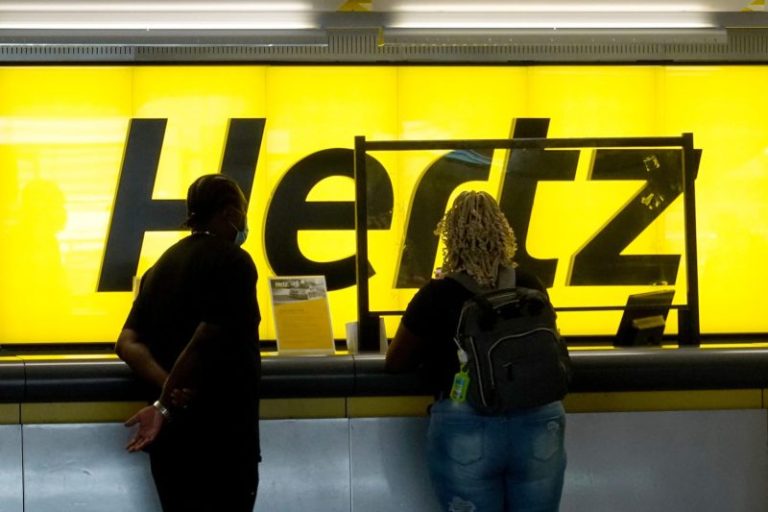
Hertz is notifying customers that a data hack late last year may have exposed their personal data.
The rental-car giant said an analysis of the incident that it completed on April 2 found the breach affected some customers’ birthdates, credit card and driver’s license data and information related to workers’ compensation claims.
The hack occurred between October and December 2024, Hertz said, adding that “a very small number of individuals” may have had their Social Security numbers, passport information and Medicare or Medicaid IDs impacted as well.
The company didn’t disclose how many of its customers were affected by the cyberattack.
Hertz said the hackers accessed the information through systems operated by Cleo Communications, one of its software vendors, and said it was one of “many other companies affected by this event.”
Cleo didn’t immediately respond to a request for comment.
“Hertz takes the privacy and security of personal information seriously,” the company said in a statement, adding that it has reported the breach to law enforcement and is also alerting the relevant regulators. It’s offering two years of free identity-monitoring services to Hertz customers affected by the breach.
Panic selling and oversold extremes gave way to a rip higher last week. Stocks are poised to open strong on Monday as the market reacts positively to tariff news. Last week’s bounce is considered an oversold bounce within a bear market. Thrust signals are setting up, but strong follow through is needed to trigger actual signals. This report will first review the panic indicators and the short-term oversold condition, and then show what it would take to move from a bear market bounce to a bullish breadth thrust.
3 Standard Deviation Decline
The chart below shows SPY dipping below the lower Bollinger Band (200,3) on April 4th. This means SPY was more than 3 standard deviations below its 200-day SMA, which is an extreme oversold condition. For reference, SPY has reached this extreme 27 times in the last 25 years. Such a move reflects panic selling pressure that often gives way to a bounce, which we got on Wednesday, April 9th.
TrendInvestorPro highlighted this 3 standard deviation move and extreme oversold conditions in our reports on April 7th and 8th. Click here to learn more and gain immediate access.
Oversold Extremes for Long-term Breadth
The next chart shows S&P 500 Percent Above 200-day SMA ($SPXA200R) dipping below 20% on April 7th to become extremely oversold. This means more than 80% of S&P 500 stocks were below their 200-day SMAs as traders sold pretty much everything. Extremely oversold readings in long-term breadth foreshadowed bounces June 2022, September 2022 and April 2025.
NYSE Zweig Breadth Thrust Sets Up
The NYSE Zweig Breadth Thrust is setting up as it finished below .40 on Friday. Actually, this indicator has been below .40 for four of the last five days. Readings below .40 reflect a short-term oversold condition that could give way to a bounce. The indicator first dipped below .40 on April 4th and stocks rebounded last week.
This indicator is also setting up for a possible Zweig Breadth Thrust. Currently, stocks are in the midst of an oversold bounce within a bigger downtrend. This would become a bullish Zweig Breadth Thrust should we see follow through and surge above .615 with 10 days. The countdown begins.
The Zweig Breadth Thrust indicator is the 10-day EMA of Advances/(Advances + Declines). Why did Zweig use a 10-day EMA? I believe he wanted to separate 1-5 day bear market bounces from bounces with follow through. The current bounce is just a bear market bounce and we need to see follow through within 10 days for a Zweig Breadth Thrust to trigger.
It is important to monitor more than one breadth indicator for thrust signals because you never know which one will trigger. The NYSE Zweig Breadth Thrust might miss, but the S&P 500 or S&P 1500 Zweig Breadth Thrust indicators may catch the signal, especially if Nasdaq stocks or small and mid caps lead. TrendInvestorPro monitors thrust indicators based on the percentage of stocks above their 20 and 50 day SMAs, and we have a breadth thrust index that aggregates thrust signals in over a dozen breadth indicators. This analysis continues for subscribers to TrendInvestorPro.
////////////////////////////////////////////////


Ole Hansen, head of commodity strategy at Saxo Bank, shares his outlook for the gold, silver, copper and oil sectors as tariff uncertainty continues.
‘If you’re actively trading these markets, keep your position to a level that reflects the new and higher volatility,’ he said, urging investors to be mindful amid the current turmoil.
Securities Disclosure: I, Charlotte McLeod, hold no direct investment interest in any company mentioned in this article.
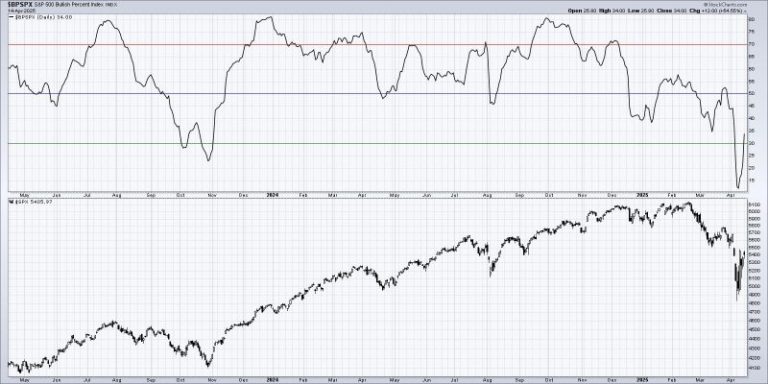
One of my favorite market breadth indicators remained in an extreme bearish reading through the end of last week, standing in stark contrast to growing optimism after last Wednesday’s sudden spike higher. Monday’s session saw the Bullish Percent Indexes cross above the crucial 30% level for both the S&P 500 and Nasdaq 100. While I remain skeptical of meaningful upside without further confirmation, this bullish rotation does seem to confirm a short-term tactical rally for stocks.
The Bullish Percent Index uses point & figure charts to analyze the percentage of stocks in a universe that are in uptrends. By looking at the most recent buy or sell signal on each individual point & figure chart, the indicator can help validate when a critical mass of stocks have rotated from a bearish phase to a bullish phase.
At the end of September 2024, the S&P 500 Bullish Percent Index showed a reading just above 80%. By early December, the indicator was down to around 70%, and at the February 2025 high had reached 55%. Last week, the S&P 500 Bullish Percent Index was just above 10%. Indeed, almost all of the S&P 500 members were in confirmed point & figure downtrends.
The Bullish Percent Index for the Nasdaq 100 as well as the S&P 500 both spiked higher by the end of last week following the latest changes to US tariff policy. As of Monday’s close the Nasdaq 100 Bullish Percent Index had reached 39%, up from 6% a week earlier.
We can see four other times in the last two years where the Bullish Percent Index has touched the 30% level, and in three of the four times this reversal marked a significant low for the Nasdaq 100. The most recent observation was last month, which saw a brief upswing before the latest downturn for the major equity averages.
So for both the Nasdaq 100 as well as the S&P 500, a move back above the 30% threshold appears to indicate a decent chance at a tradable move higher. But will that upswing necessarily lead to sustainable gains?
Let’s take a longer look back to the year 2000 and see what has happened following a move below the 30% level for the S&P 500 Bullish Percent Index. Now we can see that while major lows often coincide with the indicator moving back above 30%, we can also see plenty of times where an initial bounce higher was eventually met with further selling.
Note the extreme low readings in June 2022, August 2015, and January 2009. Even though there was an initial swing higher in all three cases, the market made a new swing low before achieving an eventual bottom for the bear cycle.
With the Bullish Percent Indexes rotating back to a more neutral reading this week, we are seeing plenty of signs of a tactical rally. We may even see our Market Trend Model turn bullish on the short-term time frame as early as this Friday. But with the major averages still making a clear pattern of lower lows and lower highs, we feel further confirmation is necessary before declaring any sort of “all clear” for US stocks.
RR#6,
Dave
PS- Ready to upgrade your investment process? Check out my free behavioral investing course!
David Keller, CMT
President and Chief Strategist
Sierra Alpha Research LLC
Disclaimer: This blog is for educational purposes only and should not be construed as financial advice. The ideas and strategies should never be used without first assessing your own personal and financial situation, or without consulting a financial professional.
The author does not have a position in mentioned securities at the time of publication. Any opinions expressed herein are solely those of the author and do not in any way represent the views or opinions of any other person or entity.
The market has been overvalued for some time but how overvalued is it? Today Carl brings his earnings chart to demonstrate how overvalued the market is right now. We have the final data for Q4 2024.
The market continues to show high volatility but it did calm down somewhat Monday. Carl reviews the market charts you need to see going into this week. He covered not only the market in general, but also covered Bitcoin, Yields, Bonds, Dollar, Gold, Crude Oil and more.
After his market overview, Carl walked us through both the daily and weekly charts of the Magnificent Seven to determine if there is any strength visible. Clue: Not much.
After his review of the Mag 7, Carl discussed Altria (MO) and his strategy to buy high dividend stocks like this one after the market finishes declining from this bear market or beyond. He’s looking for a 50% drawdown eventually.
Erin then took over to talk about sector rotation. Defensive groups are leading as we would expect with Technology trying to stage a comeback. Erin dives into these sectors under the hood to determine participation readings and the ability of them to continue to rally.
Next up Carl brought out his earnings chart to discuss how overvalued the market currently is. He shows his estimates for future movement and discusses where we are right now.
The pair finished the program with a look at viewers’ symbol requests.
00:58 DP Scoreboards
03:33 Market Overview
15:26 Magnificent Seven
20:56 Dividend Discussion
23:34 Sector Rotation
33:29 Earnings Chart
36:41 Questions
40:13 Symbol Requests
Before you trade any stock or ETF, you need to know the trend and condition of the market. The DP Alert gives you all you need to know with an executive summary of the market’s current trend and condition. It not only covers the market! We look at Bitcoin, Yields, Bonds, Gold, the Dollar, Gold Miners and Crude Oil! Only $50/month! Or, use our free trial to try it out for two weeks using coupon code: DPTRIAL2. Click HERE to subscribe NOW!
Learn more about DecisionPoint.com:
Technical Analysis is a windsock, not a crystal ball. –Carl Swenlin
(c) Copyright 2025 DecisionPoint.com
Disclaimer: This blog is for educational purposes only and should not be construed as financial advice. The ideas and strategies should never be used without first assessing your own personal and financial situation, or without consulting a financial professional. Any opinions expressed herein are solely those of the author, and do not in any way represent the views or opinions of any other person or entity.
DecisionPoint is not a registered investment advisor. Investment and trading decisions are solely your responsibility. DecisionPoint newsletters, blogs or website materials should NOT be interpreted as a recommendation or solicitation to buy or sell any security or to take any specific action.
Helpful DecisionPoint Links:
Price Momentum Oscillator (PMO)
Swenlin Trading Oscillators (STO-B and STO-V)
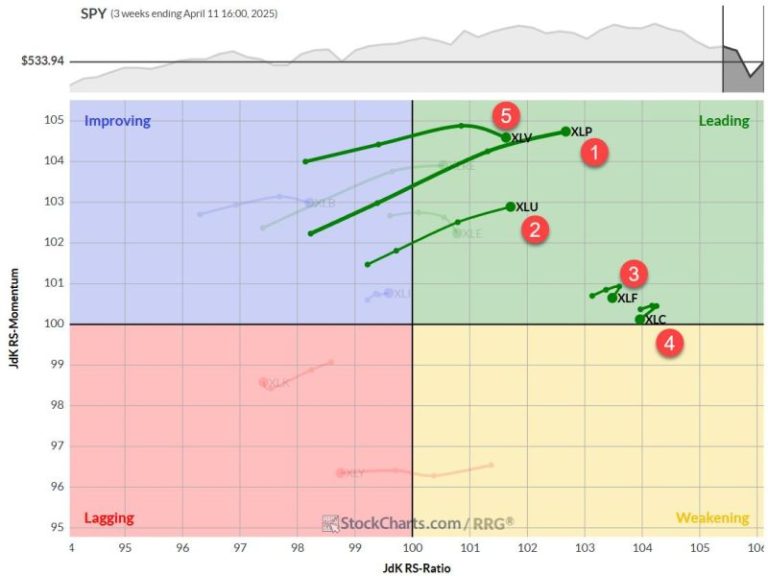
After a wild week in the markets, the sector ranking got quite a shake-up. Although only one sector changed in the top 5, the entire top 5 changed positions. In the bottom half of the ranking, only two sectors remained stationary.
The Healthcare sector re-entered the top 5 after dropping out two weeks earlier. This happened at the expense of Energy, which dropped to #7. Consumer Staples jumped from the #4 position and is now leading, followed by Utilities. Financials and Communication Services dropped to #4 and #5, down from #1 and #2.
In the bottom half, Real-Estate jumped to #6 from #9. Energy, dropping from the top 5, is now at #7, and pushed Industrials and Consumer Discretionary down to #8 and #9.
Materials and Technology remain on positions #10 and #11.
On the weekly RRG, Financials and Communication services remain at high JdK RS-Ratio levels, but have started to roll over while still inside the leading quadrant.
XLV dropped on the JdK RS-Momentum axis, but is still moving higher on RS-Ratio. The two strongest tails are for XLP and XLU, which are pushing further into leading at positive RRG-Headings.
On the daily RRG, XLP and XLU are starting to lose relative momentum, but it is happening at high RS-Ratio levels. This is combined with the strong weekly tails, which keep both sectors comfortably in the top 5.
XLV and XLF are rotating through the weekly quadrant, while XLC has crossed over into lagging.
XLP dipped back to support near 75, but recovered strongly back into its previous range. As a result, the raw RS-Line is challenging its overhead resistance, dragging both RRG-Lines sharply higher. This is now clearly the strongest sector.
During the week, XLU dropped below support but managed to come back within the range at Friday’s close. Just like Staples, raw RS is about to break its upper boundary, away from its range. Both RRG-Lines are accelerating higher, pushing the tail deeper into leading.
XLF tested support around 42, but the bounce stopped near its old support level of around 47.50. RS has steadily moved higher within the boundaries of its rising channel.
A big price drop was caught just above horizontal support near 83. The recovery, so far, has not reached overhead resistance at 95, the old support level. This makes XLC the most vulnerable sector inside the top 5. Relative strength remains stable at high RS-Ratio readings and flat RS-Momentum.
The Healthcare sector re-entered the top 5 after one week of absence. This brings all three defensive sectors back into the RRG portfolio. On the price chart, XLV is battling with the former horizontal support area, now resistance, around 136. Relative strength continues to rise, putting the XLV tail well inside the leading quadrant.
Last week’s volatility was a bit too much for the portfolio to keep up with, and it is now lagging the S&P 500 by almost 2%.
#StayAlert –Julius