Trigg Minerals (TMG:AU) has announced ANTIMONY EXEMPT FROM US TARIFF POLICY
Download the PDF here.
This post appeared first on investingnews.com


Trigg Minerals (TMG:AU) has announced ANTIMONY EXEMPT FROM US TARIFF POLICY
Download the PDF here.
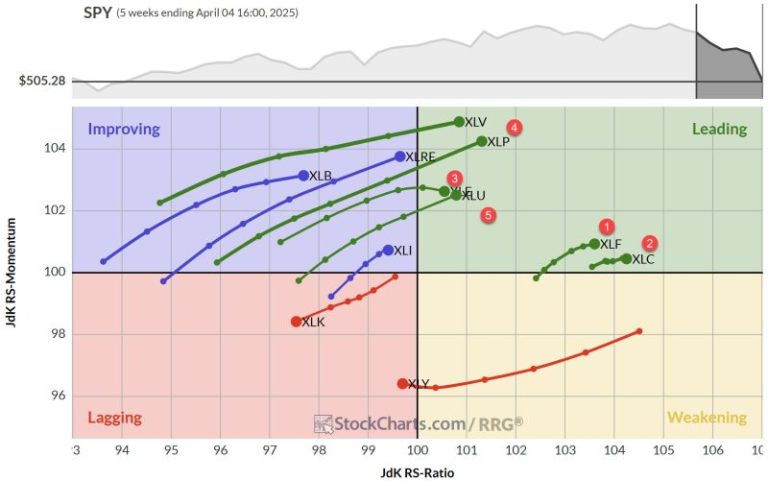
I am attending and speaking at the CMTA West Coast Regional Summit in San Francisco from Friday, 4/4, to Sunday, 4/6, so I don’t have enough time to write a full blog article updating the best five sectors.
So, instead, I have added the graphs and the new ranking to this article for review, and I will update the text and the positions in the portfolio on Monday.

How low can the S&P and the Nasdaq fall? More importantly, how can an investor navigate this volatile environment?
In this eye-opening video, Mary Ellen McGonagle delves into the stock market’s fall, identifies key support levels, and compares them to past bear markets. She also discusses inverse ETFs and their past price action. Don’t miss out on these key technical points. They will help you identify when the market is getting ready to reverse.
The video was originally published on April 4, 2025. You can watch it on our dedicated page for Mary Ellen’s videos.
New videos from Mary Ellen premiere weekly on Fridays. You can view all previously recorded episodes at this link.
If you’re looking for stocks to invest in, be sure to check out the MEM Edge Report! This report gives you detailed information on the top sectors, industries and stocks so you can make informed investment decisions.
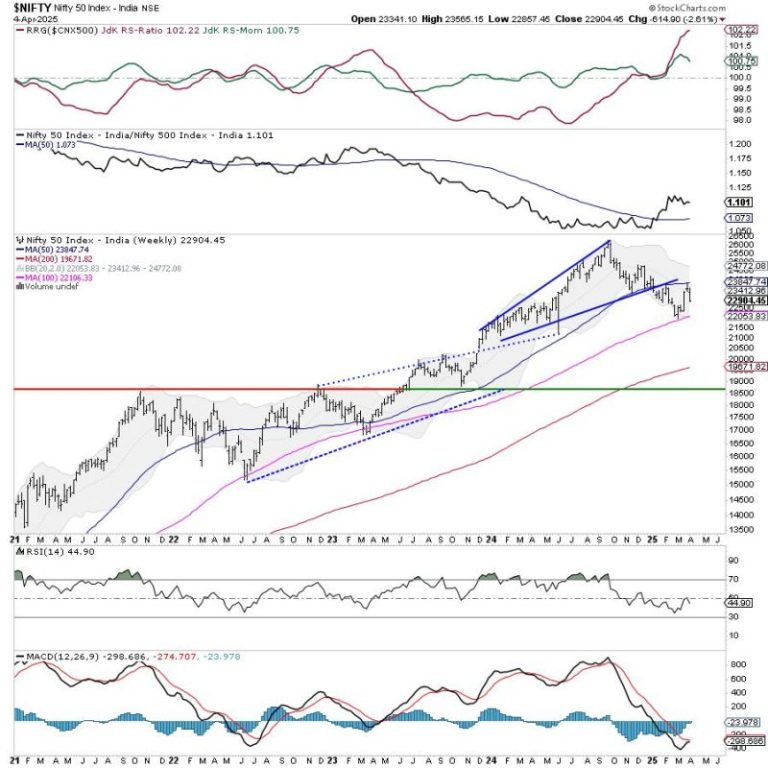
The previous week was short; the Indian markets traded for four days owing to one trading holiday on account of Ramadan Id. However, while staying largely bearish, the markets weathered the storm inflicted by the US announcing reciprocal tariffs on almost everyone and kicking off a serious trade war. The Indian markets stayed extremely resilient but ended the week on a negative note. The Index moved in the range of 707.70 points over the past four sessions. The volatility also rose; the India VIX surged 8.16% on a weekly basis to 13.76. The Indian benchmark Index closed with a net weekly loss of 614.90 points (-2.61%).
The equity markets across the world are likely to stay under pressure and in a bit of turmoil. However, the Indian markets are likely to remain relatively resilient. We live in an interconnected world; it is not surprising if we see the markets staying under pressure along with the other equity markets. However, what is expected to stand out will be the Indian market’s expected relative outperformance. This was evident over the previous week as while the Nifty and Nifty 500 lost 2.61% and 2.50%, the US key indices SPX, Nasdaq, and the Dow lost 9.08%, 10.02%, and 7.86%, respectively. While India’s VIX spiked just over 8%, the CBOE VIX has spiked 109.14% on a weekly basis. While the Indian markets may also show jitters and stay under pressure, this relative outperformance is likely to persist.
The weekly RSI is at 44.93; it stays neutral and does not show any divergence against the price. The weekly MACD is bearish; however, the sharply narrowing Histogram hints at a likely positive crossover in the future. A strong black-bodied candle showed the sustained downward pressure on the markets.
The pattern analysis of the weekly chart shows that after rebounding off the 100-week MA, the Nifty staged a strong rally that halted at the 50-week MA. This MA is placed at 23849; this was the support that the Index had violated on its way down, and now acts as a resistance. The previous week also saw the Nifty slipping below the 20-week MA positioned at 23412. While the Index stays in a secondary trend, it remains in a large but well-defined trading range that is created between 23400 on the upper side and 22100 on the lower side.
Despite being short, the coming week is expected to see a wider trading range and some more volatility staying ingrained in it. It is strongly recommended that while the valuations look tempting enough to initiate buying, all fresh buying should be done in a staggered manner. One must not go out and buy everything all at once, but one should do it in a staggered way while allowing the prices to stabilize and indicate a potential reversal point. Leveraged positions must be kept at modest levels, and fresh purchases must be kept limited to the places where there is emerging relative strength. A cautious approach is advised for the coming week.
In our look at Relative Rotation Graphs®, we compared various sectors against CNX500 (NIFTY 500 Index), which represents over 95% of the free float market cap of all the stocks listed.
Relative Rotation Graphs (RRG) show the Nifty Bank and Financial Services indices are rolling strongly inside the leading quadrant. Besides these two indices, the Nifty Commodities, Metal, Infrastructure, and Services Sector Indices are also inside the leading quadrant.
The Nifty Pharma Index is the only one inside the weakening quadrant.
The Nifty IT Index has rolled inside the lagging quadrant and is languishing inside that quadrant along with the Nifty Midcap 100 index. The Nifty Realty and the Media Index are also in the lagging quadrant; however, they are improving relative momentum against the broader markets.
The Nifty PSE and Energy Indices are inside the improving quadrant along with the PSU Bank index, which is seen as strongly improving its relative momentum. The FMCG, Auto, and Consumption Indexes are also inside the improving quadrant but are seen rolling towards the lagging quadrant again while giving up on their relative momentum against the broader markets.
Important Note: RRG charts show the relative strength and momentum of a group of stocks. In the above Chart, they show relative performance against NIFTY500 Index (Broader Markets) and should not be used directly as buy or sell signals.
Milan Vaishnav, CMT, MSTA
Consulting Technical Analyst
Tech stocks led a week-long decline as US President Donald Trump’s global retaliatory tariffs were announced on Wednesday (April 2).
The announcement led to a market-wide sell-off that erased over US$6 trillion in market value and drove the Nasdaq Composite (INDEXNASDAQ:.IXIC) into a confirmed bear market.
This week’s pullback was the worst day in the stock market since the early days of the COVID-19 pandemic in March 2020.
New developments may arise unexpectedly as this situation unfolds.
On Tuesday (April 1), the Information reported on a US$400 million funding round led by private equity firm WP Global for humanoid robot maker Agility Robotics.
The report cites an individual who claims to have seen the term sheet, noting that the new funding will give Agility Robotics, whose CEO is former Microsoft (NASADQ:MSFT) executive Peggy Johnson, a valuation of US$1.75 billion.
Prior to the report, the company unveiled advancements to its Digit robotic system on Monday (March 31), including extended battery, more efficient power usage, autonomous docking for charging, enhanced safety features and new, robust limbs and end effectors. The company says these structural changes will allow for a wider range of grasping angles and expanded manipulation capabilities.
Digit’s target applications include warehouse automation and last-mile delivery.
OpenAI finalized a US$40 billion funding deal on Monday, closing the largest private tech deal ever recorded.
The company received US$40 billion from SoftBank (3AG1.BE) and US$10 billion from a syndicate of additional investors that included long-time major investor Microsoft. This round increased OpenAI’s valuation to US$300 billion.
OpenAI will initially receive US$10 billion, with the remainder to be paid out by the end of the year. Anonymous sources for CNBC note that US$18 billion is reserved for the company’s US$500 billion Stargate project commitment.
The funding may also be reduced to US$30 billion if OpenAI doesn’t restructure into a for-profit entity by December 31, 2025. Restructuring would require approval by Microsoft and California’s AG.
In an announcement, OpenAI said it would deploy the funds to “push the frontiers of AI research even further, scale our compute infrastructure, and deliver increasingly powerful tools.’
Meanwhile, in a subsequently released report from Bloomberg, Japan Credit Rating Agency and S&P Global Ratings lowered their ratings for SoftBank as the company sought a bridge loan of up to US$16.5 billion to help fund its US AI investment commitments, according to sources who claim to know of early-stage discussions the company has had with lenders.
Earlier this week, the Information reported on a proposal from the Trump administration that would form a US-based TikTok subsidiary called TikTok America in an attempt to prevent a national ban of the popular social media app.
According to reports, the deal would see new US investors take a 50 percent stake in the company, licensing the algorithm from ByteDance, which would retain a 19 percent stake. Additional current investors would own about one-third.
The deal would put ByteDance in compliance with the Protecting Americans from Foreign Adversary Controlled Applications Act, which came into effect in January 2025. The law states that TikTok must be divested in a way that it is no longer considered to be controlled by a foreign adversary.
However, according to a Friday (April 4) Bloomberg report, representatives for ByteDance told the administration that the deal was off until Chinese officials could negotiate tariffs — which reached as high as 54 percent on several Chinese imports — announced by the Trump administration on Wednesday.
On Friday, Trump said he would extend the deadline to reach a deal by another 75 days.
“China has always respected and protected the legitimate rights and interests of enterprises and opposed practices that violate the basic principles of the market economy and harm the legitimate interests of enterprises,” spokesperson Liu Pengyu said. “China’s opposition to the imposition of additional tariffs has always been consistent and clear.”
An anonymous source for Bloomberg claims that Meta Platforms (NASDAQ:META) is the unnamed company named in a previously reported US$837 million deal to develop a data center in Wisconsin.
According to the source, Meta will invest up to US$1 billion to build the center in Wisconsin, which offers an incentive deal to companies meeting investment thresholds across different counties.
Meta already has data centers in Iowa and Illinois and previously announced plans to build one in Louisiana.
During the company’s fourth quarter earnings call in January, CEO Mark Zuckerberg said his company intends to invest up to US$65 billion in AI infrastructure this year.
During an event commemorating Microsoft’s 50th anniversary, the company announced upcoming changes to its Copilot digital assistant that will allow users to tailor it to their own needs.
“You can now let Copilot live up to its name,” Mustafa Suleyman, who leads Microsoft’s consumer AI work, said during the event, which was held at its headquarters in Redmond, Washington.
Microsoft says users will have the ability to choose information Copilot can retain, such as preferences or past life events. Copilot will then be able to recall that information in future conversations. Users also have the option to opt out of personalization. The new features will roll out in the coming months.
Securities Disclosure: I, Meagen Seatter, hold no direct investment interest in any company mentioned in this article.
Americans nearing retirement and recent retirees said they were anxious and frustrated following a second day of market turmoil that hit their 401(k)s after President Donald Trump’s escalation of tariffs.
As the impending tariffs shook the global economy Friday, people who were planning on their retirement accounts to carry them through their golden years said the economic chaos was hitting too close to home.
Some said they are pausing big-ticket purchases and reconsidering home renovations, while others said they fear their quality of life will be adversely affected by all the turmoil.
“I’m just kind of stunned, and with so much money in the market, we just sort of have to hope we have enough time to recover,” said Paula, 68, a former occupational health professional in New Jersey who retired three years ago.
Paula, who spoke on the condition of anonymity because she feared retaliation for speaking out against Trump administration policies, said she was worried about what lies ahead.
“What we’ve been doing is trying to enjoy the time that we have, but you want to be able to make it last,” Paula said Friday. “I have no confidence here.”
Trump fulfilled his campaign promise this week to unleash sweeping tariffs, including on the United States’ largest trading partners, in a move that has sparked fears of a global trade war. The decision sent the stock market spinning. On Friday afternoon, the broad-based S&P 500 closed down 6%, the tech-heavy Nasdaq dropped 5.8%, and the Dow Jones Industrial Average fell more than 2,200 points, or about 5.5%.
As Wall Street reeled Friday after China hit back with tariffs against the U.S., millions of Americans with 401(k)s watched their retirement funds diminish along with the stock market.
“I looked at my 401(k) this morning and in the last two days that’s lost $58,000. That’s stressful,” said Victor Fettes, 54, of Georgia, who retired last week as a senior director of risk management and compliance at Verizon. “If that continues, I can’t stay retired.”
Trump has said the tariffs will force businesses to relocate manufacturing and production back to the U.S. and bring back jobs. Some investors and business groups have pushed back, saying they are likely to lead to higher prices for U.S. consumers.
“Our country has been looted, pillaged, raped and plundered by nations near and far, both friend and foe alike,” Trump said recently. “But it is not going to happen anymore.”
The president has acknowledged the potential pain coming to some Americans’ wallets, but he continues to staunchly defend his agenda.
“MY POLICIES WILL NEVER CHANGE,” he posted to social media Friday. Later, he wrote, “ONLY THE WEAK WILL FAIL.”
Trump’s tariffs are steeper and more widespread than any in modern American history. They are potentially even broader than the tariffs of 1930 that historians said worsened the Great Depression.
Some Americans thinking about retirement told NBC News they feel their economic stability is being played with.
“I don’t want to have to worry that everyone is constantly changing my financial reality,” said Alison Carey, 64, of Oregon, a freelancer in the theater industry. “Let the economy do its machinations, but don’t put me in the gears.”
Paula said she and other older Americans are living with “anxiety about something where you don’t really know what’s going to happen. You can’t do anything though.”
She and her husband have decided to pause and reduce spending on big-ticket items. They are reconsidering vacations and home renovations.
“We can’t change anything right now, except our spending,” she said. “I’m sure there are consumers across the board that want to be cautious, too. Then it becomes a vicious cycle. Consumer confidence goes down.”
One in five Americans age 50 and over have no retirement savings, and more than half, 61%, are worried they will not have enough money to support them in retirement, according to a survey published by the AARP last April.
“It makes you realize how out of touch the current administration is with regular people,” said Benajah Cobb, 63, Carey’s husband, who also works in the theater industry.
He said he hoped the last few days of stock market turmoil would motivate lawmakers to put more checks and balances on the president.
“It’s happening so quickly. Things are falling apart so quickly,” he said. “I’m hoping Congress will try to step up a bit, the Republicans in Congress.”
Fettes said he has been calling his representatives about the tariffs and other issues “to make sure that as a constituent, our voices are being heard.”
“We believe firmly in our family that a democracy is a participatory game, and so we want to make sure that our representatives understand where we’re at and what we would like for them to do to represent,” he said.
Paula said that as she and her husband continue to monitor their retirement accounts, their biggest fear is how Trump’s policies could impact the quality of the rest of their lives — and when their funds will run out.
“That’s my big worry, when is that shortfall going to happen now?” she said.

Warren Buffett went on the record Friday to deny social media posts after President Donald Trump shared on Truth Social a fan video that claimed the president is tanking the stock market on purpose with the endorsement of the legendary investor.
Trump on Friday shared an outlandish social media video that defends his recent policy decisions by arguing he is deliberately taking down the market as a strategic play to force lower interest and mortgage rates.
“Trump is crashing the stock market by 20% this month, but he’s doing it on purpose,” alleged the video, which Trump posted on his Truth Social account.
The video’s narrator then falsely states, “And this is why Warren Buffett just said, ‘Trump is making the best economic moves he’s seen in over 50 years.’”
The president shared a link to an X post from the account @AmericaPapaBear, a self-described “Trumper to the end.” The X post itself appears to be a repost of a weeks-old TikTok video from user @wnnsa11. The video has been shared more than 2,000 times on Truth Social and nearly 10,000 times on X.
Buffett, 94, didn’t single out any specific posts, but his conglomerate Berkshire Hathaway outright rejected all comments claimed to be made by him.
“There are reports currently circulating on social media (including Twitter, Facebook and Tik Tok) regarding comments allegedly made by Warren E. Buffett. All such reports are false,” the company said in a statement Friday.
CNBC’s Becky Quick spoke to Buffett Friday about this statement and he said he wanted to knock down misinformation in an age where false rumors can be blasted around instantaneously. Buffett told Quick that he won’t make any commentary related to the markets, the economy or tariffs between now and Berkshire’s annual meeting on May 3.
While Buffett hasn’t spoken about this week’s imposition of sweeping tariffs from the Trump administration, his view on such things has pretty much always been negative. Just in March, the Berkshire CEO and chairman called tariffs “an act of war, to some degree.”
“Over time, they are a tax on goods. I mean, the tooth fairy doesn’t pay ’em!” Buffett said in the news interview with a laugh. “And then what? You always have to ask that question in economics. You always say, ‘And then what?’”
During Trump’s first term, Buffett opined at length in 2018 and 2019 about the trade conflicts that erupted, warning that the Republican’s aggressive moves could cause negative consequences globally.
“If we actually have a trade war, it will be bad for the whole world … everything intersects in the world,” Buffett said in a CNBC interview in 2019. “A world that adjusts to something very close to free trade … more people will live better than in a world with significant tariffs and shifting tariffs over time.”
Buffett has been in a defensive mode over the past year as he rapidly dumped stocks and raised a record amount of cash exceeding $300 billion. His conglomerate has a big U.S. focus and has large businesses in insurance, railroads, manufacturing, energy and retail.

The stock market hoped for curtailment of tariffs on Wednesday, but that didn’t happen. Even the better-than-expected March non-farm payrolls weren’t enough to turn things around.
The stock market slid sharply with the S&P 500 ($SPX), Nasdaq Composite, and Dow breaking through key technical support levels and closing very close to the low of the day’s range.
The StockCharts MarketCarpets was a sea of deep red with a few small green islands. All S&P sectors were trading lower on Friday.
The selloff was across the board and precious metals, which soared in the early part of the week, got slammed after the tariff announcement. When investors sell off equities and precious metals, it’s a sign of elevated fear, which is reflected in the spike in the Cboe Volatility Index ($VIX). It closed at 45.12, close to its high of 45.56.
The adage, “The stock market takes the stairs up and the elevator down,” rings true. Unfortunately, things got ugly quickly. It’s a volatile environment, and if your portfolio includes mostly equities, you’re probably beside yourself. But it’s not time to let your emotions get the better of you. Neither is it the time to engage in dip buying. If you look at any chart of the market, it’s clear which direction the market is heading.
The three-year weekly chart of the S&P 500 ($SPX) below shows the index has dropped below its August lows.
FIGURE 1. THREE-YEAR WEEKLY CHART OF THE S&P 500 INDEX. It was a rough week in the stock market with the S&P 500 closing below its 100-week simple moving average. Chart source: StockCharts.com. For educational purposes.
In March, the S&P 500 crossed below its 40-week simple moving average (SMA), the equivalent of the 200-day SMA. Wednesday’s tariff announcements sent the index even lower, breaching its 100-week SMA, approximately a two-year average. Another concerning point is that Friday’s close is below the August 2024 low. This increases the probability of the index dropping further, perhaps as low as its 150-week SMA. But then again, you never know what the market is going to do.
A smart investor is always engaged with the market in good times and bad. It’s important to observe the price action at key support levels to get an insight into when buyers come back into the market.
The Bullish Percent Index (BPI), a breadth indicator that gives a bird’s eye view of the internals of different indexes and sector ETFs, isn’t encouraging, at the moment. The only sectors or indexes at or above 50, as of this writing, are the S&P Consumer Staples Sector BPI ($BPSTAP) and the S&P Utilities Sector BPI ($BPUTIL). Despite the slightly bullish values, the corresponding ETFs are trading below their 50-day SMA.
The chart below displays $BPUTIL with the chart of the Utilities Select Sector SPDR Fund (XLU). Even though the BPI of the Utilities sector is above 50, it’s still trending lower and XLU just crossed below its 50-day SMA.
FIGURE 2. THE UTILITIES SECTOR IS ONE SECTOR WITH A BPI OVER 50. While a BPI over 50 indicates bulls are in favor, the chart of XLU has fallen below its 50-day SMA. Generally, breadth is leaning towards bearishness. Chart source: StockCharts.com. For educational purposes.
Sellers are in control across the board. The key will be to identify when buyers are in favor. And for that, you need to monitor the BPI and other breadth indicators.
Investor sentiment got overly bearish quickly. When this occurs, investors usually look for signs of capitulation. We’re not seeing those signs yet, but it’s worth adding sentiment indicators to your toolkit.
At some point, the selling will stop and buyers will come back in. The worst action to take now is to enter positions when you think the market has hit its low, only to catch a falling knife.
When markets are at extreme levels of fear or greed, sentiment indicators such as the VIX can be helpful. Besides the VIX, the American Association of Individual Investors (AAII) Sentiment Survey helps identify when investors are extremely optimistic or pessimistic. Generally, when emotions reach extreme levels, it may be an alert to move in the opposite direction of the crowds.
The five-year weekly chart below displays the S&P 500 with the AAII bullish minus bearish sentiment in the lower panel.
FIGURE 3. S&P 500 AND BULLISH VS. BEARISH SENTIMENT. Bearish sentiment is relatively high and the S&P 500 could fall if the bearish sentiment persists. Chart source: StockCharts.com. For educational purposes.
The lower panel shows that investor sentiment is negative, similar to between April 2022 and September 2022. Note how the market went through a correction before resuming its uptrend.
The price action in the S&P 500 coincides with extreme bearish sentiment and could remain this way for an extended period. How will you know if sentiment has reached extreme levels? It can be challenging but constant monitoring of market breadth and sentiment indicators can reveal a shift in behavior. When buyers come back in, the indexes break above resistance levels, and momentum indicators turn bullish, there’s a chance the bullish trend will resume.
Investors should stay on the sidelines until the unwinding of positions is in the rearview mirror. As painful as it may be to watch your portfolio lose value, at some point the selling will stop and buyers will get back in. Look for signs of this occurring before adding any positions to your portfolio. Congratulations to investors who followed the traditional 60% stocks, and 40% bonds portfolio mix. Rising bond prices provide some cushion to falling equity prices.
Disclaimer: This blog is for educational purposes only and should not be construed as financial advice. The ideas and strategies should never be used without first assessing your own personal and financial situation, or without consulting a financial professional.

Why focus on a utility that isn’t reporting earnings this week? It’s because the biggest question of the week is where should you put your money when markets are in turmoil. Hence, we review American Water.
Do you want safety with a 2% dividend, a little international exposure, and no tariff implications? Then I give you Jersey’s finest, American Water Works Co, Inc. (AWK).
Technically, the stock is breaking out to new highs and trying to hold on. If this market sell-off is more prolonged, then this is a good place to hide out and is also a nice diversification for your portfolio. It won’t run like a tech stock, but the risk/reward set-up is favorable.
Use the $146 level to set stops on the downside with upside targets based on the breakout from this rounded bottom formation at roughly $175. The candle formation put in on Friday to close the week was not ideal but may be worth the risk given the volatility.
And if you like lagging indicators, a “golden cross” formed last week and is another technical reason to look positively on the stock.
Delta Air Lines (DAL) shares have nosedived 50% from its January peak as it heads into earnings week. Shares fell 16% when the company slashed its first-quarter outlook in early March.
Delta cited declining consumer confidence amid growing uncertainty over the economy, which resulted in weaker domestic demand. It cut its revenue guide to rise between 3% and 4% compared to an outlook of 7–9%.
Technically, the damage has been done. The stock has been oversold since March and is beginning to show a bullish divergence. In this case, price makes a new low but the RSI does not. Look for a break above 30 in the RSI as a buy signal.
The risk/reward is good but not great. DAL has tested and held a support area just above $35 going back to early 2024. A break and close below $35 and downside risk takes the price to $30.
A sharp V-shaped rally could happen with good earnings results and positive guidance. That’s a big IF, given the continued air of uncertainty. A small rally could see the stock get back to $44.
Historically the trends in the airline stocks last for months and are rarely neutral. Follow the trend higher if it changes. Otherwise, a landing lower is likely.
J.P. Morgan Chase (JPM) will be one of the most watched earnings of the quarter. Not only is it one of the largest weighted financial stocks in the world, but its CEO, Jamie Dimon, isn’t one to mince words.
Shares have fallen 25% from its February 9 peak as the market has corrected in the face of tariff uncertainty and a global trade war. Dimon has been somewhat quiet but is always one to give a great sound bite or two, come the conference call.
Technically, we have a problem
Shares have broken a 16-month uptrend. The stock price breached its 50-day moving average in March, then failed to recapture it—old support became resistance. After one successful test of its rising 200-day moving average, the stock broke through it last week with some vigor.
On a rally, look for that 200-day moving average at $228 to become resistance. The sellers are now in charge until something changes. To the downside, we have a target of $180 based on a head and shoulders topping pattern as outlined above.
The gold price surged this week, rising to yet another new all-time high of more than US$3,160 per ounce ahead of tariff updates from US President Donald Trump.
The yellow metal’s latest move follows a strong Q1, during which it continually hit new records amid widespread uncertainty and achieved its best quarterly performance since 1986.
However, Trump’s Wednesday (April 2) tariff announcement took some of the wind out of gold’s sails. While it showed resilience on Thursday (April 3), rebounding back above US$3,100 after falling below that level, the yellow metal lost substantial ground on Friday (April 4), sinking to just above US$3,020.
Major US indexes have also taken hits — the S&P 500 (INDEXSP:.INX), Dow Jones Industrial Average (INDEXDJX:.DJI) and Nasdaq Composite (INDEXNASDAQ:.IXIC) have all seen steep declines this week.
There’s still much uncertainty surrounding tariffs, but here’s what we know at this point.
After declaring a national economic emergency, Trump has put tariffs of at least 10 percent on all countries. Higher tariffs have been levied on about 60 nations that have large trade deficits with the US and have been deemed the ‘worst offenders.’
While Trump has called the tariffs reciprocal, that’s not exactly how they’ve panned out.
A tariff calculation formula published by the White House indicates that the math involves taking the trade deficit for the US in goods with a particular country, dividing that by the total goods imports from that country and then dividing that number by two. A BBC explainer shows how the formula works for the EU, where the US has instated a 20 percent tariff based on what it believes the EU charges.
The situation is more complex for countries like China, which already had a 20 percent tariff in place from the US. Trump has now added a further 34 percent tariff, bringing China’s total rate to 54 percent. Canada and Mexico, which have also already faced tariffs from the US, avoided further charges this week.
While Trump’s new tariffs are sweeping in nature, there are exclusions — among them are steel, aluminum, copper, pharmaceuticals and semiconductors, as well as bullion, which includes gold, plus ‘energy and other certain minerals’ not available in the US.
The news that gold won’t face levies is reportedly cooling its flow from London to New York. In recent months, traders have been rushing to bring the metal into the US ahead of potential tariffs; with this week’s clarity, the transfers no longer appear necessary.
A Section 232 investigation into copper tariffs is ongoing.
Trump has referred to Wednesday as ‘Liberation Day,’ saying that tariffs will help reinvigorate the US manufacturing industry and help the country grow.
‘Jobs and factories will come roaring back into our country, and you see it happening already. We will supercharge our domestic industrial base. We will pry open foreign markets and break down foreign trade barriers, and ultimately, more production at home will mean stronger competition and lower prices for consumers’ — Trump
However, there are widespread concerns that the tariffs will boost inflation in the US, putting pressure on Americans who are already struggling with high prices.
Let’s take a look at it from both angles.
Keith Weiner of Monetary Metals noted that while he doesn’t define inflation as an increase in consumer prices, that’s the standard definition. In his view, tariffs could boost consumer prices in several ways:
If inflation is defined as an increase in consumer prices, and you’ve forced them to manufacture in a high-cost jurisdiction with much higher regulatory costs, and then deport a lot of labor to drive up the price of labor even more, then you’re going to find consumer prices have a one-two punch.
The third punch is — what is everybody’s solution from a monetary policy perspective to so-called inflation? Hiking interest rates. Which means hike the cost of financing new factories, and hike the cost of automation … Every company when faced with massively increased demand for labor and massively higher labor (costs) is going to want to automate. Well, the cost of financing the automation is going to be hiked. So we’re going to see a one-two-three punch for the forces pushing up consumer prices.
Jim Thorne of Wellington-Altus took a different approach to the question. He explained the relationship between tariffs and inflation as follows:
Tariffs slow growth — one. So that’s why we’ve been talking about a growth scare. We’ll have a balance sheet recession in Canada, we will have a slow growth period in the US.
What tariffs do is they change the relative prices in an economy, they don’t change the general price level. And so no, they’re not inflationary. And Tiff Macklem knows that, and Jay Powell knows that, because that’s third year macro.
Click the links above to watch the full interviews with Weiner and Thorne.
Securities Disclosure: I, Charlotte McLeod, hold no direct investment interest in any company mentioned in this article.