
Author

admin

Browsing

Nickel prices experienced a volatile year in 2024 on uncertainty on both the demand and supply sides. This trend has continued into the first quarter of 2025 and is expected to remain for the year. While this environment has been tough, some nickel stocks are still thriving.

Supply is expected to outflank demand over the short term, but the longer-term outlook for the metal is strong. Demand from the electric vehicle (EV) industry is one reason nickel’s outlook looks bright further into the future.

Battery nickel demand is poised to triple by 2030, according to Benchmark Mineral Intelligence.

“Mid and high level performance EVs will be the primary driver of battery nickel demand growth in the coming years, particularly in Western markets,” said Jorge Uzcategui, senior nickel analyst at the firm. “There will be growth in China, but it won’t be as pronounced as in ex-China markets.”

As for Canada, nickel is listed as a top priority in the government’s Critical Minerals Strategy. The country is the world’s fifth largest producer of nickel, with much of its production coming from mines in Ontario’s Sudbury Basin, including Vale’s (NYSE:VALE) Sudbury operation and Glencore’s (LSE:GLEN,OTC Pink:GLCNF) Sudbury Integrated Nickel Operations.

How have Canadian nickel stocks performed in 2025? Below are the top nickel stocks in Canada on the TSX, TSXV and CSE by share price performance so far this year.

All year-to-date and share price data was obtained on March 26, 2025, using TradingView’s stock screener. Canadian nickel stocks with market caps above C$10 million at that time were considered.

1. Power Metallic Mines (TSXV:PNPN)

Year-to-date gain: 40.37 percent
Market cap: C$364.15 million
Share price: C$1.53

Power Metallic Mines, formerly Power Nickel, is developing its 80 percent owned Nisk polymetallic property in Québec, Canada, which hosts high-grade nickel, copper, platinum, palladium, gold and silver mineralization. The polymetallic nature of the project is a plus for the economic case for future nickel production in a low price environment.

The company was recognized as one of the 2024 top 50 performers on the TSX Venture Exchange, ranking as the top mining company and fourth overall company due to posting a 365 percent share price appreciation for the year.

Ongoing work at the Nisk project has generated positive news flow for Power Metallic in 2025. After starting the year at C$1.07, Power Metallic’s share price climbed to C$1.49 by January 30 following two key announcements in late January. First, the company released drill results from the 2024 fall campaign on Nisk’s Lion zone and the start of its winter 2025 drill campaign. Shortly after, it announced a new discovery 700 meters east from the Lion zone, now named the Tiger zone, which it plans to target as part of its winter drilling.

From there, Power Metallic’s share price jumped more than 26 percent to reach C$1.88 on February 6, its highest point of Q1. This followed further drill results out its 2024 fall campaign with with notable assays further demonstrating the high-grade nature of the mineralization.

Other notable news supporting the company’s share price this quarter included the closing of a C$50 million private placement and the plan to scale up its 2025 winter drill campaign from three to six rigs in the second quarter. Additionally, further results from the 2024 fall campaign expanded the Lion zone with the deepest assayed intersection to date, plus initial nickel-copper assays from the new Tiger zone.

2. Magna Mining (TSXV:NICU)

Year-to-date gain: 25.93 percent
Market cap: C$273.59 million
Share price: C$1.70

Magna Mining is a base metal exploration and development company based in Sudbury, Ontario, Canada. The company’s flagship assets are the Shakespeare mine and the Crean Hill project. Shakespeare is a past-producing nickel, copper and platinum group metals mine with major permits in place. It hosts an indicated open-pit resource of 16.51 million metric tons at 0.56 percent nickel equivalent. Crean Hill also hosts a past-producing mine that produced the same resources.

Magna Mining was also included in the 2025 TSX Venture 50 list.

Last year, Magna signed a definitive offtake agreement with Vale Base Metals’ wholly owned subsidiary Vale Canada for the advanced exploration portion of Crean Hill, and inked a toll-milling agreement with Glencore Canada for the surface bulk sample of the 109 Footwall zone at Crean Hill. Magna completed an updated preliminary economic assessment at Crean Hill in November.

Magna’s share price started off the year at C$1.42, and gradually climbed throughout the following weeks to reach a year-to-date high of C$1.84 on February 5.

Its share price was supported by continued positive updates on its acquisition of a portfolio of base metals assets located in the Sudbury Basin, including the producing McCreedy West copper-nickel mine, through a share purchase agreement with a subsidiary of KGHM Polska Miedz (FWB:KGHA). The company completed the acquisition at the end of February.

Magna also closed a C$33.5 million private placement in early March.

3. Talon Metals (TSX:TLO)

Year-to-date gain: 23.53 percent
Market cap: C$79.45 million
Share price: C$0.105

Talon Metals is focused on developing high-grade nickel resources for the US domestic battery supply chain. The company has partnered with mining giant Rio Tinto (ASX:RIO,NYSE:RIO,LSE:RIO) on the Tamarack nickel-copper project located in Minnesota, US. Talon has an earn-in right to acquire up to 60 percent of Tamarack and currently owns 51 percent. The US Department of Defense awarded Talon a US$20.6 million grant in September 2023.

An environmental review process is underway for the proposed Tamarack underground mine. The company plans to process ore from the mine at a proposed battery mineral processing facility in North Dakota. The company plans to initiate the permitting process for the processing facility in 2025.

Talon has a six year offtake agreement with Tesla (NASDAQ:TSLA) for a total of 75,000 metric tons, or 165 million pounds, of nickel concentrate, as well as cobalt and iron by-products, from the Tamarack project once it’s in commercial production.

The company is also the operator of the Boulderdash nickel-copper discovery and numerous high-grade nickel-copper prospects in Michigan, which it optioned to Lundin Mining (TSX:LUN) in early March.

Talon Metal’s share price reached a year-to-date high of C$0.105 on March 26. That day, the company announced a significant massive sulfide discovery at Tamarack with an intercept measuring over 8.25 meters logged as 95 percent sulfide content.

4. Stillwater Critical Minerals (TSXV:PGE)

Year-to-date gain: 16.67 percent
Market cap: C$32.61 million
Share price: C$0.14

Stillwater Critical Metals’ flagship asset is its Stillwater West polymetallic project in Montana, US. In addition to the platinum group elements, copper, cobalt, and gold resources identified on the property, a January 2023 NI 43-101 inferred mineral resource estimate on Stillwater West shows it to have the largest nickel resource in an active US mining district.

Stillwater Critical Metal’s share price reached a year-to-date high of C$0.14 on March 26.

On this day, the company reported multiple large-scale magmatic sulfide targets following analysis of the property-wide third-party MobileMtm magneto-telluric geophysical survey completed in late 2024.

The data from the survey was also used to build a new 3D geological model of the lower Stillwater Igneous Complex that will help the company to further prioritize targets at Stillwater West in an upcoming planned drill campaign.

5. First Atlantic Nickel (TSXV:FAN)

Year-to-date gain: 15.22 percent
Market cap: C$25.22 million
Share price: C$0.265

First Atlantic Nickel is developing its wholly owned Atlantic nickel project in Newfoundland and Labrador, Canada. The large-scale project hosts a naturally occurring nickel-iron alloy that contains about 75 percent nickel with no sulfur or sulfides. Known as awaruite, it is known for its strong magnetic properties. Its also easier and cleaner to separate and concentrate than conventional nickel ores as it can be processed without a smelter.

A series of catalysts in February gave the company’s stock value a boost to the upside. On February 19, it shared that drilling confirmed ‘the RPM zone extends 400 meters along strike and 500 meters wide, remaining open at depth and along strike to the north and west, indicating significant expansion potential.’

Initial Phase 1 assay results from the Super Gulp zone were released on February 26 showing up to 0.32 percent nickel with an average of 0.25 percent nickel over the entire 293.8 meter length. First Atlantic Nickel stated the results confirmed ‘the presence of a major new nickel zone.’ That same day, shares in First Atlantic surged to C$0.33.

The next month, on March 4, First Atlantic reported a new discovery at the RPM zone with intersects of 0.24 percent nickel over 383.1 meters, and 10 kilometers downstrike from Super Gulp.

First Atlantic shares reached their highest year-to-date value of C$0.35 on March 13 after the company announced initial metallurgical test results from the first drill hole at the RPM zone. The company said “the results confirm the potential for magnetic separation as a viable processing method for awaruite nickel mineralization previously identified at the RPM Zone.”

FAQs for nickel investing

How to invest in nickel?

There are a variety of ways to invest in nickel, but stocks and exchange-traded products are the most common. Nickel-focused companies can be found globally on various exchanges, and through the use of a broker or a service such as an app, investors can purchase companies and products that match their investing outlook.

Before buying a nickel stock, potential investors should take time to research the companies they’re considering; they should also decide how many shares will be purchased, and what price they are willing to pay. With many options on the market, it’s critical to complete due diligence before making any investment decisions.

Nickel stocks like those mentioned above could be a good option for investors interested in the space. Experienced investors can also look at nickel futures.

What is nickel used for?

Nickel has a variety of applications. Its main use is an alloy material for products such as stainless steel, and it is also used for plating metals to reduce corrosion. It is used in coins as well, such as the 5 cent nickel in the US and Canada; the US nickel is made up of 25 percent nickel and 75 percent copper, while Canada’s nickel has nickel plating that makes up 2 percent of its composition.

Nickel’s up-and-coming use is in electric vehicles as a component of certain lithium-ion battery compositions, and it has gotten extra attention because of that purpose.

Where is nickel mined?

The world’s top nickel-producing countries are primarily in Asia: Indonesia, the Philippines and Russia make up the top three. Rounding out the top five are Canada and China. Indonesia’s production stands far ahead of the rest of the pack, with 2024 output of 2.2 million metric tons compared to the Philippines’ 330,000 metric tons and Canada’s 190,000 metric tons.

Significant nickel miners include Norilsk Nickel (OTC Pink:NILSY,MCX:GMKN), Nickel Asia, BHP Group (NYSE:BHP,ASX:BHP,LSE:BHP) and Glencore (LSE:GLEN,OTC Pink:GLCNF).

Securities Disclosure: I, Melissa Pistilli, hold no direct investment interest in any company mentioned in this article.


This post appeared first on investingnews.com

Here’s a quick recap of the crypto landscape for Friday (April 4) as of 9:00 p.m. UTC.

Bitcoin and Ethereum price update

At the time of this writing, Bitcoin (BTC) had recovered to US$83,879.15, up 2.3 percent in 24 hours. The day’s range has brought a low of US$81,950.04 and a high of US$84,497.52.

Bitcoin performance, April 4, 2025.

Chart via TradingView.

The crypto market staged an apparent recovery by the end of Friday’s trading session. US President Donald Trump’s announcement of new global tariffs has unsettled financial markets, as reflected in risk assets.

Ethereum (ETH) is priced at US$1,808.88, a 1.3 percent increase over 24 hours. The cryptocurrency reached an intraday low of US$1,772.16 and a high of US$1,823.14.

Altcoin price update

  • Solana (SOL) is currently valued at US$122.36, up 6.2 percent over the past 24 hours. SOL experienced a low of US$114.16 and a high of US$123.31 on Friday.
  • XRP is trading at US$2.12, reflecting a 3.5 percent increase over the past 24 hours. The cryptocurrency recorded an intraday low of US$2.04 and a high of US$2.15.
  • Sui (SUI) is priced at US$2.27, showing a 2.4 percent increase over the past 24 hours. It achieved a daily low of US$2.18 and a high of US$2.30.
  • Cardano (ADA) is trading at US$0.6606, reflecting a 3.5 percent increase over the past 24 hours. Its lowest price on Friday was US$0.6667, with a high of US$0.6325.

Crypto news to know

Trumps tap crypto after Trump Organization’s ‘cancellation’

Eric Trump has revealed to CNBC that his family’s business pivoted toward the cryptocurrency sector following what he describes as ‘unprecedented financial deplatforming.’

After the Trump Organization faced legal scrutiny and banking restrictions — including the closure of over 300 accounts by Capital One Financial (NYSE:COF) — the Trump brothers decided to turn to digital assets.

This led to the creation of World Liberty Financial, a US dollar-backed stablecoin venture, and American Bitcoin, a new Bitcoin-mining company co-founded with Hut 8 (NASDAQ:HUT) CEO Asher Genoot.

According to Eric Trump, the shift to crypto was as much about financial opportunity as it was about resistance.

He claims that during what he calls a ‘war on the industry,’ major banks were shutting down accounts simply for holding Bitcoin, and regulatory agencies were targeting crypto firms through aggressive lawsuits.

Now, with Donald Trump back in the White House, the US has taken a more crypto-friendly stance, including signing an executive order to establish a strategic Bitcoin reserve and pardoning Silk Road founder Ross Ulbricht.

Atkins moves closer to SEC chair position

US lawmakers in the Senate Committee on Banking voted to advance Paul Atkins as chair of the US Securities and Exchange Commission (SEC) on Thursday (April 3) through a final vote of 13 to 11.

If approved, Atkins will take over for Gary Gensler, who resigned as chair on January 20. Gensler’s term ends in June 2026, after which Atkins will serve a second consecutive term that will terminate in 2031.

Atkins’ nomination will now move to a full Senate vote on a yet-to-be-determined date. Experts predict a likely confirmation. Interim Chair Mark Uyeda is currently sitting in the role.

Coinbase files for XRP futures contracts

Crypto exchange Coinbase Global (NASDAQ:COIN) filed on Thursday with the US Commodity Futures Trading Commission (CFTC) to launch futures contracts tracking Ripple’s token, XRP.

“We’re excited to announce that Coinbase Derivatives has filed with the CFTC to self-certify XRP futures — bringing a regulated, capital-efficient way to gain exposure to one of the most liquid digital assets,” Coinbase said in an X post that day, adding that it anticipates that the contract will go live on April 21.

Monthly-settled, margined contracts will trade under the symbol XRP. Each contract will represent 10,000 XRP, worth about US$20,000 at the current value. Trading will halt if the spot XRP price deviates over 10 percent in an hour.

In other news, Grayscale filed an S-1 application with the SEC on Friday to convert its Grayscale Solana Trust into a spot SOL exchange-traded fund trading under the ticker symbol GSOL.

Circle, Klarna and Chime may delay IPOs

A Friday report from the Wall Street Journal suggests that stablecoin firm Circle may delay its initial public offering (IPO). The event was originally slated for April 11, according to the firm’s S-1 filing.

“Circle had been nearing its next steps in going public but is now watching anxiously before deciding what to do,” the news outlet’s report reads, before suggesting that fintech companies Klarna and Chime may also postpone their IPOs amid ongoing market turmoil triggered by the unfolding global trade war.

Securities Disclosure: I, Giann Liguid, hold no direct investment interest in any company mentioned in this article.
Securities Disclosure: I, Meagen Seatter, hold no direct investment interest in any company mentioned in this article.
This post appeared first on investingnews.com

The gold price surged this week, rising to yet another new all-time high of more than US$3,160 per ounce ahead of tariff updates from US President Donald Trump.

The yellow metal’s latest move follows a strong Q1, during which it continually hit new records amid widespread uncertainty and achieved its best quarterly performance since 1986.

However, Trump’s Wednesday (April 2) tariff announcement took some of the wind out of gold’s sails. While it showed resilience on Thursday (April 3), rebounding back above US$3,100 after falling below that level, the yellow metal lost substantial ground on Friday (April 4), sinking to just above US$3,020.

Major US indexes have also taken hits — the S&P 500 (INDEXSP:.INX), Dow Jones Industrial Average (INDEXDJX:.DJI) and Nasdaq Composite (INDEXNASDAQ:.IXIC) have all seen steep declines this week.

Bullet briefing — Tariffs rock global markets

Trump’s ‘Liberation Day’

There’s still much uncertainty surrounding tariffs, but here’s what we know at this point.

After declaring a national economic emergency, Trump has put tariffs of at least 10 percent on all countries. Higher tariffs have been levied on about 60 nations that have large trade deficits with the US and have been deemed the ‘worst offenders.’

While Trump has called the tariffs reciprocal, that’s not exactly how they’ve panned out.

A tariff calculation formula published by the White House indicates that the math involves taking the trade deficit for the US in goods with a particular country, dividing that by the total goods imports from that country and then dividing that number by two. A BBC explainer shows how the formula works for the EU, where the US has instated a 20 percent tariff based on what it believes the EU charges.

The situation is more complex for countries like China, which already had a 20 percent tariff in place from the US. Trump has now added a further 34 percent tariff, bringing China’s total rate to 54 percent. Canada and Mexico, which have also already faced tariffs from the US, avoided further charges this week.

Gold, copper excluded from tariffs

While Trump’s new tariffs are sweeping in nature, there are exclusions — among them are steel, aluminum, copper, pharmaceuticals and semiconductors, as well as bullion, which includes gold, plus ‘energy and other certain minerals’ not available in the US.

The news that gold won’t face levies is reportedly cooling its flow from London to New York. In recent months, traders have been rushing to bring the metal into the US ahead of potential tariffs; with this week’s clarity, the transfers no longer appear necessary.

A Section 232 investigation into copper tariffs is ongoing.

Will tariffs cause inflation?

Trump has referred to Wednesday as ‘Liberation Day,’ saying that tariffs will help reinvigorate the US manufacturing industry and help the country grow.

‘Jobs and factories will come roaring back into our country, and you see it happening already. We will supercharge our domestic industrial base. We will pry open foreign markets and break down foreign trade barriers, and ultimately, more production at home will mean stronger competition and lower prices for consumers’ — Trump

However, there are widespread concerns that the tariffs will boost inflation in the US, putting pressure on Americans who are already struggling with high prices.

Let’s take a look at it from both angles.

Keith Weiner of Monetary Metals noted that while he doesn’t define inflation as an increase in consumer prices, that’s the standard definition. In his view, tariffs could boost consumer prices in several ways:

If inflation is defined as an increase in consumer prices, and you’ve forced them to manufacture in a high-cost jurisdiction with much higher regulatory costs, and then deport a lot of labor to drive up the price of labor even more, then you’re going to find consumer prices have a one-two punch.

The third punch is — what is everybody’s solution from a monetary policy perspective to so-called inflation? Hiking interest rates. Which means hike the cost of financing new factories, and hike the cost of automation … Every company when faced with massively increased demand for labor and massively higher labor (costs) is going to want to automate. Well, the cost of financing the automation is going to be hiked. So we’re going to see a one-two-three punch for the forces pushing up consumer prices.

Jim Thorne of Wellington-Altus took a different approach to the question. He explained the relationship between tariffs and inflation as follows:

Tariffs slow growth — one. So that’s why we’ve been talking about a growth scare. We’ll have a balance sheet recession in Canada, we will have a slow growth period in the US.

What tariffs do is they change the relative prices in an economy, they don’t change the general price level. And so no, they’re not inflationary. And Tiff Macklem knows that, and Jay Powell knows that, because that’s third year macro.

Click the links above to watch the full interviews with Weiner and Thorne.

Securities Disclosure: I, Charlotte McLeod, hold no direct investment interest in any company mentioned in this article.

This post appeared first on investingnews.com

CleanTech Lithium PLC (AIM: CTL), a lithium exploration and development company operating in Chile, further to its announcement on 15 January 2025 (‘Application RNS’), provides an update regarding the Special Lithium Operating Contract (‘CEOL’) application process for the Laguna Verde project.

As outlined in the Application RNS, the Company expected the simplified procedure for the CEOL Award Mechanism to be as follows: Submission of applications closed on 31 January 2025 following which the Ministry IT and legal departments had 5 business days to register and organise the submittal. The Ministry´s Lithium and Salar Unit then has 45 business days to review and analyse the request. Once this analysis is completed and the Lithium and Salar Unit verifies that all the information and documents needed to enter the simplified procedure have been submitted then an administrative act to accept the application will be made.

This timetable indicated that an update from the Government was expected at the beginning of April confirming which applicants will enter direct negotiation on the CEOL with the Ministry. So far, no such update has been made and following recent discussions between CleanTech Lithium and the Ministry, the Company understands that the administration process is still progressing for all applicants. The Company will inform the market as soon as official communication is received.

Steve Kesler, Executive Chairman and Interim CEO, CleanTech Lithium said:

‘Clearly, the process is taking a little longer than we had initially anticipated but we look forward to the response when the Ministry has completed its review process.’

For further information contact:

CleanTech Lithium PLC

Steve Kesler/Gordon Stein/Nick Baxter

Jersey office: +44 (0) 1534 668 321

info@ctlithium.com

Chile office: +562-32239222

Beaumont Cornish Limited (Nominated Adviser)

Roland Cornish/Asia Szusciak

+44 (0) 20 7628 3396

Fox-Davies Capital Limited (Joint Broker)

Daniel Fox-Davies

+44 (0) 20 3884 8450

daniel@fox-davies.com

Canaccord Genuity (Joint Broker)

James Asensio

+44 (0) 20 7523 4680

Beaumont Cornish Limited (‘Beaumont Cornish’) is the Company’s Nominated Adviser and is authorised and regulated by the FCA. Beaumont Cornish’s responsibilities as the Company’s Nominated Adviser, including a responsibility to advise and guide the Company on its responsibilities under the AIM Rules for Companies and AIM Rules for Nominated Advisers, are owed solely to the London Stock Exchange. Beaumont Cornish is not acting for and will not be responsible to any other persons for providing protections afforded to customers of Beaumont Cornish nor for advising them in relation to the proposed arrangements described in this announcement or any matter referred to in it.

Notes

CleanTech Lithium (AIM:CTL) is an exploration and development company advancing lithium projects in Chile for the clean energy transition. Committed to net-zero, CleanTech Lithium’s mission is to scale battery grade lithium at its flagship project, Laguna Verde, using Direct Lithium Extraction technology powered by renewable energy.

CleanTech Lithium is committed to utilising Direct Lithium Extraction (‘DLE’) with reinjection of spent brine resulting in no aquifer depletion. Direct Lithium Extraction is a transformative technology which removes lithium from brine with higher recoveries, short development lead times and no extensive evaporation pond construction. For more information, please visit: www.ctlithium.com

Click here for the full release

This post appeared first on investingnews.com

With the S&P 500 and Nasdaq dropping quickly after this week’s tariff announcements, investors are scrambling to identify areas of the market demonstrating strength despite broad market weakness.  The good news is that I was able to easily find strong charts with improving relative strength using the StockCharts platform.

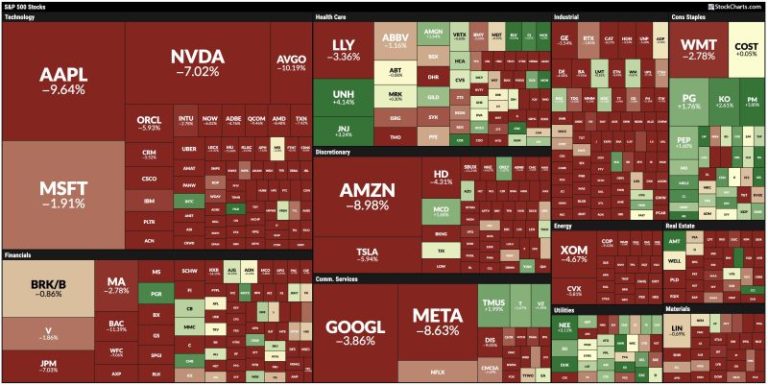
As much as it feels like “everything is down” after Wednesday’s news on increased tariffs on a vast number of products, a quick review of the S&P 500 MarketCarpet on Thursday afternoon provides a quick reminder that plenty of stocks were actually trading higher into the afternoon.

Let’s review two stocks and one ETF demonstrating strength in recent weeks.  And if you’re looking for more potential ideas, perhaps review my Top Ten Charts to Watch for April 2025 with Grayson Roze!

Kroger Co. (KR)

When the economy is strong, and consumer confidence is high, we often see a surge in “things you want” such as travel and luxury goods.  During periods of economic weakness, those Consumer Discretionary names will struggle relative to “things you need” like cleaning products, household goods, and beverages.  So it’s not surprising that our first two charts are in the Consumer Staples sector!

Indeed, the chart of Kroger has a “long and strong” look to it, featuring a consistent pattern of higher highs and higher lows since the October 2024 breakout.  

Two pullbacks in March saw Kroger achieve a higher low above the 50-day moving average, confirming that buyers are coming into “buy the dips” and push the stock to new highs.  The most impressive feature of this chart is the steady uptrend in the relative strength.  As long as that series remains trending higher, it means Kroger provides an opportunity to do better than our struggling benchmarks.

Keurig Dr Pepper Inc (KDP)

Back in October 2024, Keurig Dr Pepper saw a series of downside gaps on disappointing earnings results.  I’ve highlighted these gaps with shaded areas so we can see how often these price ranges have come into play during subsequent price action.

We can see that KDP struggled to regain the lower price gap range late last year, with the 200-day moving average also serving as resistance during that period.  Then in February we finally saw a break above the 200-day before KDP eventually found resistance at the upper price gap from last October.  From late February through early April, Keurig Dr Pepper has basically traded between these two price zones, with the most recent upswing taking the stock back up to test the upper price gap range.

Similar to Kroger, I would say the most compelling piece of this chart is the improving relative strength.  If most stocks are in primary uptrends, then perhaps KDP does not look nearly as impressive.  But with Magnificent 7 stocks and other growth names pounding out clear distribution phases, the chart of Keurig Dr Pepper could provide an opportunity to outperform.

Utilities Select Sector SPDR Fund (XLU)

Now let’s consider utilities, a sector which is usually bucketed with other defensive groups yet has actually traded along with growth sectors at times over the last 12 months.  The reason for this shift has been partly due to the incredible energy needs of artificial intelligence, cryptocurrency mining, and other enterprises requiring heavy computer power.

The price structure of the XLU is fairly neutral at the moment, with this ETF basically stuck in a trading range since the 4th quarter of 2024.  But with most S&P 500 names trading below their 200-day moving averages, I’m immediately drawn to charts that remain above this long-term trend barometer.  The XLU has actually successfully tested the 200-day moving average three times in 2025, all resulting in short-term rallies.

The question here is whether the XLU can gain enough momentum to push above a clear resistance level around $82.  But even that does not actually come to pass, a chart remaining in a sideways trend could provide an easy way to ride out a period where the major benchmarks are losing value.  And given the higher-than-average dividend yield along with decent price action, the utilities sector seems like it deserves a second look.

Both KR and KDP were featured in our Top Ten Charts to Watch for April 2025, which you can access below!

RR#6,

Dave

PS- Ready to upgrade your investment process?  Check out my free behavioral investing course!

David Keller, CMT

President and Chief Strategist

Sierra Alpha Research LLC

Disclaimer: This blog is for educational purposes only and should not be construed as financial advice.  The ideas and strategies should never be used without first assessing your own personal and financial situation, or without consulting a financial professional.  

The author does not have a position in mentioned securities at the time of publication.    Any opinions expressed herein are solely those of the author and do not in any way represent the views or opinions of any other person or entity.

In this exclusive StockCharts video, Joe Rabil shows you how to use the ADX on monthly and weekly charts to find stocks with massive breakout potential. Joe walks you through several examples of stocks and ETFs that broke out of an extended period of trading sideways. He also discusses the recent stock market correction and where the SPY and QQQ are trading with respect to the support of moving averages.

This video was originally published on April 2, 2025. Click this link to watch on Joe’s dedicated page.

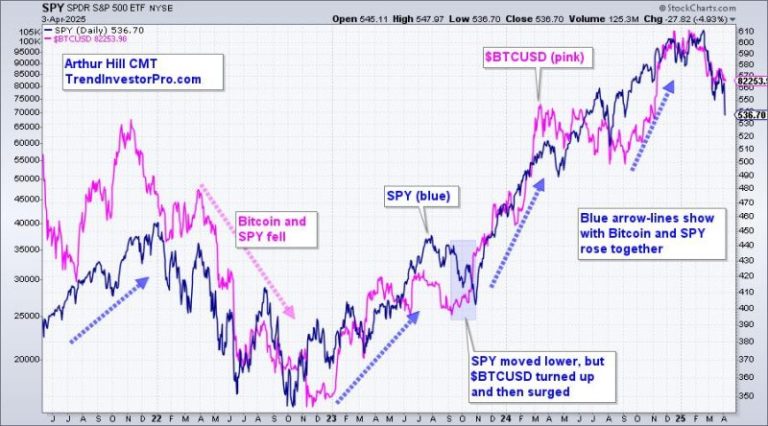
Stocks are in a freefall with selling pressure spreading into industrial metals and other economically sensitive commodities. There are few places to hide in bear markets, and the list of alternatives continues to shrink. Bitcoin, an alternative, is holding up relatively well since March, but this crypto is positively correlated with stocks long-term and has yet to achieve a relative breakout. Today’s report focuses on Bitcoin’s correlation and relative performance. 

TrendInvestorPro takes a weight of the evidence approach to define bull and bear markets. This evidence turned bearish on March 13th and remains bearish until proven otherwise. As noted in s to all our reports and videos.

/////////////////////////////////////////

Galan Lithium (ASX:GLN) has rejected a US$150 million (AU$240 million) cash bid from China’s Zhejiang Huayou Cobalt Co and France’s Renault Group to acquire its Hombre Muerto West and Candelas lithium brine projects in Argentina, The West Australian reports.

Described as unsolicited, conditional, and non-binding, the offer from battery materials giant Zhejiang Huayou and EV manufacturer Renault was deemed “opportunistic” and “undervalued,” the report noted.

Galan and its advisors refused the offer, asserting confidence in the long-term value of its flagship Hombre Muerto West project, which is nearing production of 5,400 tonnes per annum (tpa) of lithium carbonate equivalent. They believe the project holds greater potential to deliver superior returns for shareholders.

Read the full study here.

Click here to connect with Galan Lithium (ASX:GLN) for an Investor Presentation

This post appeared first on investingnews.com

The lithium market faced continued pressure in Q1 2025 as oversupply and weaker-than-expected demand pushed prices to a four-year low, with the lithium carbonate CIF North Asia price dipping below US$9,550 per metric ton.

The broad market decline led many analysts to speculate that the market had bottomed and a rebound was imminent. This was further supported by production cuts in China and Australia aimed at stabilizing supply.

Despite near-term challenges, long-term prospects remain strong, highlighted by Rio Tinto’s (ASX:RIO,NYSE:RIO,LSE:RIO) AU$6.7 billion acquisition of Arcadium Lithium, the company formed by the merger of Allkem and Livent.

The major is also reportedly in talks to develop the Roche Dure lithium deposit in the Democratic Republic of Congo.

Long term electric vehicle (EV) market growth and a projected draw down in excess supply has prompted Benchmark Intelligence researchers to forecast a 12 percent compound annual growth rate for the lithium market over the next 10 years.

All lithium stocks listed had market caps above $20 million in their respective currencies when data was gathered. Data for Canadian stocks was collected on March 25, 2025, data for Australian stocks was gathered on March 27, 2025, and data for US stocks was gathered on March 31, 2025.

Top Canadian lithium stocks

1. Power Metals (TSXV:PWM)

Company Profile

Year-to-date gain: 163.04 percent
Market cap: C$196.57 million
Share price: C$1.21

Exploration company Power Metals holds a portfolio of diversified assets in Ontario and Québec, Canada. The company’s flagship Case Lake project in Ontario hosts spodumene-bearing lithium-cesium-tantalum pegmatites.

In November 2024, Power Metals identified a new pegmatite zone at Case Lake through soil sampling. The samples from the zone, located north-northwest of its West Joe prospect, revealed anomalous levels of cesium, tantalum, lithium and rubidium, which the company said ‘affirmed prospective drill targets’ for its winter exploration program.

On February 10, Power Metals announced the beginning of work associated with the maiden mineral resource estimate and preliminary economic assessment for Case Lake, which it expected to release in Q1 and Q2 of 2025 respectively.

Days later, on February 14, the company followed that announcement by releasing the final assays from its Phase 3 drilling at Case Lake, including “exceptional cesium oxide and tantalum intercepts” from the West Joe prospect. Power Metals stated it planned to begin its 2025 Phase 1 drilling sometime after early March.

The company’s share price rose in the weeks following the pair of announcements to reach a Q1 high of C$1.46 on February 25.

2. NOA Lithium Brines (TSXV:NOAL)

Company Profile

Year-to-date gain: 41.18 percent
Market cap: C$46.99 million
Share price: C$0.36

NOA is a lithium exploration and development company with three projects in Argentina’s Lithium Triangle region. The company’s flagship Rio Grande project and prospective Arizaro and Salinas Grandes land packages total more than 140,000 hectares.

In late January, NOA reported its completion of 28 vertical electrical sounding geophysics tests at the Rio Grande project as part of its 2025 exploration program.

The recent testing expands on past studies and will aid NOA’s water exploration program, refining one of three identified potential water sources.

In a subsequent corporate update on February 7, NOA outlined its plans for Q1 2025, which largely focused on the advancement of the Rio Grande project through geophysical evaluation and water exploration drilling. The company also plans to review engineering proposals for preliminary economic assessment work.

The company’s share price began climbing in early February and reached a Q1 high of C$0.37 on March 13.

The high came days after a Simply Wall Street report highlighted insider buying at the company, a signal of strong internal confidence.

According to the report, NOA insiders invested C$862,600 over the prior six months, with C$358,000 of that coming in a single transaction by CEO and Director Gabriel Rubacha. Additionally, they had not sold any shares in the prior 12 months.

3. Frontier Lithium (TSXV:FL)

Press ReleasesCompany Profile

Year-to-date gain: 35.56 percent
Market cap: C$141.38 million
Share price: C$0.61

Pre-production mining company Frontier Lithium aims to be a strategic and integrated supplier of premium spodumene concentrates as well as battery-grade lithium salts in North America.

The Company’s flagship PAK lithium project, which is a joint venture with Mitsubishi (TSE:8058), holds the “largest land position and resource” in a premium lithium mineral district located in the Great Lakes region of Ontario, Canada. Frontier also owns the Spark deposit, located northwest of the PAK project.

Shares of Frontier Lithium reached a Q1 high of C$0.79 on March 4. After already trending upwards through February, its share price peaked alongside news that the Government of Canada and the Ontario Government supported the company’s plans to build a critical minerals refinery in Northern Ontario.

Once complete the proposed lithium conversion facility will process lithium from PAK into around 20,000 metric tons (MT) of lithium salts per year. “This expected capacity would support the production of batteries for approximately 500,000 electric vehicles per year,” Frontier’s statement reads.

Top Australian lithium stocks

1. Tyranna Resources (ASX:TYX)

Company Profile

Year-to-date gain: 40 percent
Market cap: AU$23.02 million
Share price: AU$0.007

Africa-focused explorer Tyranna Resources is currently focused on its flagship Muvero lithium project in Angola.

In a January 30 update, Tyranna reported it completed a drill program totalling 11 diamond drill holes spanning 817 meters. Initial results from drilling at the Muvero and Loop prospects confirmed visible spodumene-bearing pegmatite. Additionally, core from the Muvero prospect will be used for metallurgical testing and structural data.

The company is also pursuing and evaluating additional projects that align with its strategy of focusing on in-demand metals, and had applied for one licence at that time.

Shares of Tyranna reached a quarterly high of AU$0.007 several times over the three month period.

2. Liontown Resources (LTR:AU)

Company Profile

Year-to-date gain: 24.53 percent
Market cap: AU$1.58 billion
Share price: AU$0.66

Liontown Resources has two assets in Western Australia, including the producing Kathleen Valley mine, which entered production during the second half of 2024 and transitioned to commercial production in January 2025.

The company’s Buldania project in the Eastern Goldfields Province of Western Australia has an initial mineral resource of 15 million MT at 1.0 percent lithium oxide.

In its fiscal H1 2025 financial update, Liontown reported that over 100,000 wet metric tons of spodumene concentrate had been shipped from Kathleen Valley between July and the end of December.

Liontown’s shares rose to a Q1 high of AU$0.735 on March 19, 2025, shortly after the release of the half year results.

3. Delta Lithium (ASX:DLI)

Year-to-date gain: 9.09 percent
Market cap: AU$125.39 million
Share price: AU$0.18

Delta Lithium is a diversified exploration and development company focused on discovering high quality, lithium bearing pegmatite deposits in Western Australia.

Currently, Delta is developing the Mount Ida gold and lithium project, which reportedly has a JORC-compliant resource of 14.6 million MT grading 1.2 percent. Additionally, the company is exploring its Yinnetharra lithium project, including the Malinda deposit, in the Upper Gascoyne Region.

Company shares registered a Q1 high of AU$0.20 on January 14.

On January 21, Delta released an exploration update for Yinnetharra that highlighted drilling and metallurgical results from the M1 pegmatite at the Malinda deposit.

“The program has realised highly positive metallurgical results, with pilot plant spodumene recoveries exceeding our Internal financial modelling and proving the whole-of-ore flotation flowsheet as suitable for the M1 mineralogy,” Managing Director James Croser said.

In a subsequent financial statement, Delta noted the submission of the mining lease application for the Malinda mining area and the commencement of Native Title negotiations. The company is also advancing its environmental permitting process at Malinda.

Top US Lithium Stocks

1. SQM (NYSE:SQM)

Company Profile

Year-to-date gain: 9.29 percent
Market cap: AU$11.36 billion
Share price: US$40.23

SQM is one of the world’s largest lithium producers with projects in South America and China, outputting both lithium carbonate and hydroxide.

In 2024, SQM produced approximately 210,000 MT of lithium, with about 180,000 MT sourced from its chemical plant in northern Chile and an additional 30,000 MT processed in China.

The lithium major also saw lithium sales increase 21 percent year-over-year to nearly 205,000 MT of lithium carbonate equivalent (LCE).

“However, the increase in volume was not enough to offset the continuous decline in prices, a trend we have been observing since early 2023,” the 2024 earnings report noted. “As a result, our average realized price dropped by more than 64 percent, from US$30,467 per ton in 2023 to US$10,936 per ton in 2024.”

Shares of SQM reached a Q1 high of US$45.61 on March 17, 2025.

In late February, SQM’s US$7 million investment in Andrada Mining’s (LSE:ATM,OTCQB:ATMTF)Lithium Ridge project received final approval from the Namibian government. The deal will see SQM obtain a 30 percent stake in the project with an option to increase to 50 percent.

FAQs for investing in lithium

How much lithium is on Earth?

While we don’t know how much total lithium is on Earth, the US Geological Survey estimates that global reserves of lithium stand at 22 billion metric tons. Of that, 9.2 billion MT are located in Chile, and 5.7 billion MT are in Australia.

Where is lithium mined?

Lithium is mined throughout the world, but the two countries that produce the most are Australia and Chile. Australia’s lithium comes from primarily hard-rock deposits, while Chile’s comes from lithium brines. Chile is part of the Lithium Triangle alongside Argentina and Bolivia, although those two countries have a lower annual output.

Rounding out the top five lithium-producing countries behind Australia and Chile are China, Argentina and Brazil.

What is lithium used for?

Lithium has many uses, including the lithium-ion batteries that power electric vehicles, smartphones and other tech, as well as pharmaceuticals, ceramics, grease, lubricants and heat-resistant glass. Still, it is largely the electric vehicle industry that is boosting demand.

How to invest in lithium?

Those looking to get into the lithium market have many options when it comes to how to invest in lithium.

Lithium stocks like those mentioned above could be a good option for investors interested in the space. If you’re looking to diversify instead of focusing on one stock, there is the Global X Lithium & Battery Tech ETF (NYSE:LIT), an exchange-traded fund (ETF) focused on the metal. Experienced investors can also look at lithium futures.

Unlike many commodities, investors cannot physically hold lithium due to its dangerous properties.

How to buy lithium stocks?

Through the use of a broker or an investing service such as an app, investors can purchase lithium stocks and ETFs that match their investing outlook.

Before buying a lithium stock, potential investors should take time to research the companies they’re considering; they should also decide how many shares will be purchased, and what price they are willing to pay. With many options on the market, it’s critical to complete due diligence before making any investment decisions.

It’s also important for investors to keep their goals in mind when choosing their investing method. There are many factors to consider when choosing a broker, as well as when looking at investing apps — a few of these include the broker or app’s reputation, their fee structure and investment style.

Securities Disclosure: I, Georgia Williams, hold no direct investment interest in any company mentioned in this article.
This post appeared first on investingnews.com