Astral Resources NL (ASX: AAR) (Astral or the Company) refers to its off market takeover bid to acquire all of the ordinary shares of Maximus Resources Limited (ASX:MXR) (Maximus) (Offer) it does not already own on the basis of one (1) Astral share for every two (2) Maximus shares held pursuant to the Bidder’s Statement dated 3 February 2025 (Bidder’s Statement). The Offer is unconditional and will close at 7pm (AEDT) on Friday, 21 March 2025 (unless further extended).
HIGHLIGHTS
The Offer consideration has been declared best and final, and will not be increased
The Offer will close at 7pm (AEDT) on Friday, 21 March 2025 (unless further extended)
The Offer is unconditional and Astral has accelerated payment terms
Astral has majority control of Maximus with voting power of 81.67% as at 14 March 2025
With Astral’s ownership of Maximus now exceeding 80%, Maximus shareholders may now be eligible for rollover tax relief
As at 14 March 2025, Astral had voting power in Maximus of 81.67%. That being the case, Maximus shareholders may be eligible for rollover tax relief. For further information, please refer to section 10 of the Bidder’s Statement.
Offer declared best and final as to consideration
Astral declares its Offer of 1 Astral share for every 2 Maximus shares best and final as to consideration. There will be no increase in the number of Astral shares offered under the Offer.
Accelerated payment terms
On 24 February 2025, Astral announced that payment terms for validly accepting Maximus shareholders had been accelerated such that Maximus shareholders who have yet to validly accept the Offer will be issued their Astral Shares within 10 Business Days of their acceptance being processed in accordance with the terms of the Offer.
Minority Maximus shareholders – Liquidity and valuation risk
Maximus shareholders who do not accept the Offer prior to its close will not receive the consideration under the Offer, unless Astral is entitled to proceed to compulsory acquisition (in which case they will receive the consideration, but at a later date than if they accepted the Offer).
Maximus shareholders should be aware that, if Astral is NOT entitled to proceed to compulsory acquisition (e.g. if Astral does not acquire more than 90% voting power in Maximus), and Maximus continues to be listed on the ASX following the Offer, then the decrease in the number of Maximus shares available for trading may have a material adverse impact on their liquidity and valuation. Furthermore, depending on the level of acceptances received and other considerations, Maximus may apply to de-list from the ASX, in which case it may become more difficult and expensive for Maximus shareholders to sell their shares.
Nestled in a modest storefront in New York City’s East Village, Mary O’s Irish Soda Bread Shop blends into the other red-brick businesses on the block. But one thing sets it apart: Customers routinely line up, sometimes for hours, to get their hands on her freshly baked goods before they sell out.
The shop’s menu is simple, featuring Irish soda bread loaves and scones served with salty butter and fresh raspberry jam. The recipes, passed down through generations of Mary O’Halloran’s family, are at the core of her operations. But the secret to her success is precision. Only O’Halloran herself handles the batter, a non-negotiable standard she insists maintains the quality of her baked goods.
“I’ve had people come and say, ‘Why don’t you have somebody come in and help you?’ It’s not going to work,” she said. “The scone does not come out the same.”
Mary O’Halloran mixes her next batch of soda bread batter for customers waiting in the store.NBC NewsMary O’s storefront in the East Village of New York.NBC News
O’Halloran said the demand for her soda bread scones surges every March for St. Patrick’s Day, but her journey to success hasn’t been easy. Five years ago, O’Halloran was facing the closure of her East Village pub due to the financial strain of the Covid-19 pandemic. Her husband, a longshoreman working in Alaska, was unable to return home due to travel restrictions, leaving her to manage the business alone.
Mary O’Halloran’s Irish soda bread loaf.NBC NewsMary O’Halloran’s Irish soda bread scone served with Irish butter and fresh raspberry jam.NBC News
It was her loyal pub customers who encouraged her to start selling her scones, a treat they had grown to love. What began as a small-scale venture soon caught the attention of Brandon Stanton, the creator of the viral “Humans of New York” social media account with more than 12 million followers.
After interviewing O’Halloran, Stanton offered to help spread the word about her scones. Reluctant at first, O’Halloran eventually agreed, leading to a spike in sales.
“So I wrote a story on this, and we ended up that night selling a million dollars’ worth of scones,” Stanton told NBC News. “It is one of the greatest stories in the world.”
Customers line up inside Mary O’Halloran’s shop for scones and loaves of Irish soda bread.NBC News
The overwhelming response turned O’Halloran’s small baking operation into a community effort. Regular customers and neighbors pitched in by packing orders, printing labels and decorating boxes with handwritten notes and custom drawings from one of her daughters. Despite the surge in demand, O’Halloran remained committed to quality, handling every batch of batter herself.
“Mary is where she is because that scone tastes so dang good,” Stanton said. “She would have got there without me.”
It took more than a year to fulfill the backlog of orders, but the hard work paid off. The revenue not only saved her pub, but allowed her to open Mary O’s Irish Soda Bread Shop in November 2024. Customers from around the world flock to her store to sample the viral scones and meet the woman behind the treats.
“I live in Los Angeles, but they told me, you know, next time you’re in town, there’s a place we have to go, and it’s the best scone you’ve ever had. It’s the best soda bread,” out-of-towner David Murphy said.
For O’Halloran, the hard work has been worth it.
“I love it, so it’s easy,” she said. “Of course I’m tired, but I love what I get from it with people. So it’s easy.”
Flagging global sales and Elon Musk’s increasingly outspoken political activities are combining to rock the value of Tesla.
Shares in the once-trillion-dollar company saw their worst day in five years this week. Year to date, Tesla’s stock has plunged 36% — though it is still up by some 54% over the past 12 months.
For Musk, Tesla’s shares remain his primary source of paper wealth, though he has also turned his stake in SpaceX into a personal lending tool. But it was proceeds from selling Tesla shares that helped Musk complete his acquisition of Twitter, now known as X.
Musk’s wealth also allowed him to help vault Donald Trump into a second presidential term. Even as Musk’s net worth has diminished as a result of Tesla’s recent share-price declines, data suggests he is in no danger of losing his title as the world’s wealthiest person.
Musk has said on X that he is not concerned about Tesla’s recent drop in value. Still, evidence suggests the company is entering a period of transition.
A spokesperson for Tesla did not respond to a request for comment.
Musk’s wealth has propelled him to a global presence that lacks precedent — and has polarized world opinion about the tech entrepreneur in the process. Any weakening of his financial position, therefore, could undercut his influence in the political and tech spaces where he now commands outsize attention.According to Bank of America, Tesla’s European sales plummeted by about 50% in January compared with the same month a year prior.
Some say this is attributable to a growing distaste for Musk, who has begun dabbling in the continent’s politics in the wake of his successful support of Trump’s candidacy last year.
Others note Tesla’s European market is facing increased competition from the Chinese electric-vehicle maker BYD, which has telegraphed ambitious plans for expansion on the continent.
A more decisive blow to Tesla’s near-term fortunes may be emanating from China itself. There, Tesla’s shipments plunged 49% in February from a year earlier, to just 30,688 vehicles, according to official data cited by Bloomberg News. That’s the lowest monthly figure registered since July 2022 — amid the throes of Covid-19 — when it shipped just 28,217 EVs, Bloomberg said.
Donald Trump accompanied by Elon Musk speaks Tuesday next to a Tesla Model S on the South Lawn of the White House.Andrew Harnik / Getty Images
Tesla is now facing intense competition from other Chinese EV makers, including BYD.
Yet even there, a Chinese official also warned about the impact of Musk’s high-profile politicking.
“As a successful businessman, one should be embracing 100% of the market: Treat everyone nicely, and everyone will be nice in return,” the secretary of China’s Passenger Car Association, said in a briefing Monday, Bloomberg reported. “But if you look at it in terms of voting, then half of voters will be friendly to you and half of them won’t be.”
“This is the unavoidable risk that’s come after he got his personal glory,” the secretary, Cui Dongshu, said Monday, referring to Musk.
On Friday, Reuters reported Tesla was planning to sell a Model Y costing at least 20% less to produce to defend its China share.
And in the U.S., Tesla’s January sales were down about 11%, according to data from the S&P Global analytics group — an outlier at a time when EV sales for all other brands are trending higher in America.
Though he has long worn multiple proverbial hats, Musk’s role in the White House as nominal head of the Department of Government Efficiency may be his most consequential. And having influence with the Trump administration could be critical to Tesla’s fortunes. This week, Trump promised he would purchase a Tesla in a showy presentation on the White House lawn, seemingly further cementing the Trump-Musk alliance.
On X — the social media platform he owns — Musk’s frenetic posting is increasingly focused on politics and America’s culture wars, with an occasional nod to SpaceX launches.
His apparently undiminished role in the Trump administration — he was seen leaving the White House last weekend alongside Commerce Secretary Howard Lutnick — has sparked boycotts in Europe, as well as protests and even acts of vandalism against auto owners in the U.S.
“When people’s cars are in jeopardy of being keyed or set on fire out there, even people who support Musk or are indifferent to Musk might think twice about buying a Tesla,” Ben Kallo, an analyst at Baird, told CNBC’s “Squawk on the Street” on Monday.
In a note to clients this week downgrading its estimate of deliveries, analysts with JPMorgan said the damage to Tesla’s brand has been serious.
“We struggle to think of anything analogous in the history of the automotive industry, in which a brand has lost so much value so quickly,” they wrote.
Tesla itself is warning about the fallout from retaliatory measures taken by countries targeted by Trump’s tariffs, saying in a letter to the U.S. trade representative this week that the company may be “exposed to disproportionate impacts when other countries respond to US trade actions.”
Already, the Canadian province of British Columbia has announced it was ending subsidies for Tesla’s products.
For all the oxygen Musk has taken up with his political activities, concerns about Tesla products themselves are equally keeping investors and analysts up at night.
Musk has “neglect[ed] the rest of Tesla’s automotive business as he thought that by the end of every year for the last 6 years, Tesla would be able to flip a switch and make all its vehicles self-driving — automatically increasing their value and making them infinitely more competitive than other vehicles,” Fred Lambert, who covers the company for the Electrek electric vehicle blog, wrote in a recent post.
Meanwhile, Musk decided to kill Tesla’s cheaper, $25,000 model while going all-in on the Cybertruck, whose sales have yet to take off, Lambert said.
“Tesla’s core business remains selling cars and batteries,” he wrote. “There’s no doubt that the business of selling cars is not going well for Tesla right now, and under Musk, there’s no clear path to improvement.”
By contrast, many analysts continue to take a much longer view of Tesla’s outlook. In his most recent note to clients about the company, Morgan Stanley analyst Adam Jonas, one of the most closely watched observers of Tesla, summarized the long-term outlook that he says continues to justify the company’s eye-watering valuation.
“Tesla’s softer auto deliveries are emblematic of a company in the transition from an automotive ‘pure play’ to a highly diversified play on AI and robotics,” he wrote in a note March 2.
While that was before the most recent sell-off intensified, Jonas said he was already discounting market gyrations.
“While the journey may be volatile and non-linear, we believe 2025 will be a year where investors will continue to appreciate and value these existing and nascent industries of embodied AI where we believe Tesla has established a material competitive advantage,” he wrote.
This week brought a rollercoaster ride for the stock market
A dramatic Monday (March 10) selloff hit mega-cap tech stocks hard, and was followed by a correction in the S&P 500 (INDEXSP:.INX) on Tuesday (March 11). Friday (March 14) witnessed a partial recovery fueled by a week of positive economic data; however, lingering uncertainties about global conflicts and potential tariffs kept overall gains in check.
The latest University of Michigan consumer sentiment survey, released on Friday, reveals a 10.5 percent decrease in consumer confidence in March, reflecting a broader 27.1 percent decrease for the year.
Tesla (NASDAQ:TSLA) led the retreat on Monday with a significant 12.25 percent drop by the closing bell. The decline came as CEO Elon Musk continued to cause controversy over his actions at the Department of Government Efficiency.
Protests this week included calls for a boycott of the company’s electric vehicles. After news hit that Tesla plans to make a lower-cost version of its Model Y in Shanghai, shares rose 3.9 percent to end the week at US$249.98.
Here’s a look at other key events that made tech headlines this week.
1. CoreWeave continues expansion with OpenAI deal
Insider told Reuters on Monday that AI startup CoreWeave has signed a five year contract worth US$11.9 billion with OpenAI to provide cloud computing services in exchange for a stake in CoreWeave worth approximately US$350 million.
CoreWeave will issue the shares through a private placement at the time of its initial public offering (IPO), which is expected to take place sometime in March. Investor interest in CoreWeave has grown since the company filed for an IPO on March 3. Investment research platform Sacra reveals a 730 percent increase in revenue between 2023 and 2024, and the company is projecting further revenue growth of over 320 percent to US$8 billion in 2025.
Multiple outlets have reported that the company is seeking to raise US$4 billion, targeting a valuation of US$35 billion. CoreWeave has also recently acquired the machine learning platform Weights & Biases.
However, the filing also revealed substantial debt and losses, and analysts have warned that CoreWeave’s multibillion-dollar partnership with its primary customer, Microsoft (NASDAQ:MSFT), and, to a lesser extent, its reliance on chips from NVIDIA (NASDAQ:NVDA), represent concentration risks. Analysts for Fitch Solutions believe that the agreement with OpenAI will alleviate some of those concerns.
2. Oracle stumbles after earnings report
Oracle (NYSE:ORCL) delivered its latest quarterly results on Monday, showing a mixed financial performance.
The company’s cloud infrastructure saw healthy growth thanks to demand for computing power, surging by 49 percent to US$2.7 billion. Meanwhile, its cloud services revenue reached US$11.01 billion, a 10 percent increase from the previous year; this segment accounted for 78 percent of Oracle’s total sales.
“We are on schedule to double our data center capacity this calendar year,” said Chair Larry Ellison.
Oracle’s total revenue and net income both saw substantial growth, reaching US$14.1 billion and US$2.9 billion, with annual increases of 6 percent and 22 percent, respectively.
However, the results did not quite meet investor forecasts, which anticipated US$14.39 billion in revenue. Earnings per share (EPS) also came up short at US$1.47 versus the expected US$1.49.
According to CNBC, Oracle CEO Safra Catz said during an earnings call that the US$48 billion in new contracts from this period has brought the company’s remaining performance obligations to over US$130 billion, a 62 percent increase from last year. Notably, this figure doesn’t include contracts related to the Stargate venture announced earlier this year with SoftBank Group (TSE:9984) and OpenAI.
Looking ahead, Oracle expects EPS to be between US$1.61 and US$1.65, a notable difference from the forecast US$1.79. Catz also said that Oracle expects to double its capital expenditure to US$16 billion this year.
Despite these shortfalls, Oracle’s board of directors announced a 25 percent increase in the company’s quarterly cash dividend to US$0.50 per share. The Information reported this week that the company is also the leading contender for helping run TikTok operations in the US.
3. Intel names new CEO
Taiwan Semiconductor Manufacturing Company (TSMC) (NYSE:TSM) approached NVIDIA, Advanced Micro Devices (AMD) (NASDAQ:AMD) and Broadcom (NASDAQ:AVGO) to propose a joint venture to operate Intel’s (NASDAQ:INTC) factories, according to a report from Reuters on Wednesday (March 12).
Qualcomm (NASDAQ:QCOM) was also approached in a separate discussion.
According to insiders familiar with the matter, the proposal would involve TSMC running operations at Intel’s chip-making (foundry) division while holding a stake of less than 50 percent.
The news sent shares of Intel 7 percent higher on Wednesday from its previous closing price.
The company has faced scrutiny from shareholders over its lagging chip business, and its share price has lost over 43 percent of its value compared to a year ago. Intel gained another 10 percent after hours on Wednesday, when the company named Lip-Bu Tan, a former board member, as its new CEO. In a letter to shareholders, Tan signaled that he intends to improve Intel’s chip foundry and did not address the report regarding TSMC.
After a rough several months, Intel ended the week up 18.82 percent.
4. Google powers humanoid robot
Google (NASDAQ:GOOGL) expanded its artificial intelligence (AI) capabilities by announcing two new Gemini Robotics models on Wednesday, along with an update to its large language model, Gemma 3.
Google’s AI research subsidiary, DeepMind, integrated its AI model, Gemini 2.0, with humanoid robots developed by Texas-based robotics company Apptronik. The two enterprises formed a partnership agreement to accelerate advancement in AI-powered humanoid robots in December 2024.
Apptronik was founded in 2016 and has developed 15 robotic systems, including NASA’s Valkyrie, which was built to help astronauts explore the Moon or Mars. The company’s flagship robot, Apollo, was designed as a general-purpose robotic assistant for a range of sectors, including aerospace and logistics, as well as retail and hospitality.
The robot made its debut in 2023. In March 2024, it partnered with Mercedes-Benz Group (OTC Pink:MBGAF,ETR:MBG) on a pilot program to test the robot in Mercedes’ manufacturing facilities.
Earlier this year, Apptronik secured US$350 million in a Series A funding round co-led by B Capital and Capital Factory, with Google also participating in the round.
On Thursday (March 13), Google launched an experimental capability to its chatbot, Gemini, giving users the option to connect Gemini to their search history and other apps for more personalized responses. Powered by Google’s Gemini 2.0 Flash Thinking model, the new feature is simply called Gemini with personalization.
“Early testers have found Gemini with personalization helpful for brainstorming and getting personalized recommendations,” said Dave Citron, senior director of product management for Gemini.
5. Cohere launches efficient, low-cost LLM
Canadian AI company Cohere revealed its newest large language model (LLM), Command A, a tool designed to help businesses handle complex tasks like coding by efficiently processing large data sets
“Command A is on par or better than GPT-4o and DeepSeek-V3 across agentic enterprise tasks — tasks where the LLM can act somewhat independently to complete a business goal — with significantly greater efficiency,’ the firm said.
What’s more, Cohere said it spent less than US$30 million to build the model, which can run on just two graphics processing units (GPUs). This is a stark contrast to the tens of thousands of GPUs used by other LLMs, demonstrating Cohere’s ability to achieve high performance with significantly optimized resource utilization.
In an interview with the Globe and Mail, Cohere co-founder Nick Frosst said the company achieved such amazing efficiency by focusing on fulfilling the needs of its customer base rather than pursuing the development of artificial general intelligence (AGI), AI systems that surpass human intelligence.
“We’re training it to be good at the things that our customers want,” he explained. “By being focused on that, we’ve been able to be significantly more efficient than the other players.
“The people who are saying AI is getting bigger and bigger are the people constantly saying they’re around the corner from AGI. That’s not our focus, nor is that my scientific belief.”
Cohere has attracted investment from a range of well-known venture capital firms, including Radical Ventures, SalesForce Ventures and Cisco Investments. It is also backed by prominent players in the AI sector, including Oracle, NVIDIA, AMD and SAP (NYSE:SAP), indicating strong confidence in its potential.
Securities Disclosure: I, Meagen Seatter, hold no direct investment interest in any company mentioned in this article.
Here’s a quick recap of the crypto landscape for Friday (March 15) as of 9:00 p.m. UTC.
Bitcoin and Ethereum price update
Bitcoin (BTC) is currently trading at US$84,601.01, reflecting a 5.5 percent increase over the past 24 hours. The day’s trading range has seen a high of US$85,139.55 and a low of US$82,705.87.
Bitcoin’s price performance has been influenced by macroeconomic factors, regulatory developments and market sentiment. US-China tariffs, US Federal Reserve policies and Trump’s crypto-friendly stance have also been key drivers.
On Friday, Bitcoin breached a rising support trend line against gold that had been intact for over 12 years.
Bitcoin performance, March 14, 2025.
Chart via TradingView.
Ethereum (ETH) is priced at US$1,935.01, marking a 4.8 percent increase over the same period. The cryptocurrency reached an intraday high of US$1,941.99 and a low of US$1,893.58.
Altcoin price update
Solana (SOL) is currently valued at US$134.17, up 10.6 percent over the past 24 hours. SOL experienced a high of US$134.61 and a low of US$126.41 during Friday’s trading session.
XRP is trading at US$2.36, reflecting a 5.3 percent increase over the past 24 hours. The cryptocurrency recorded an intraday high of US$2.39 and a low of US$2.31.
Sui (SUI) is priced at US$2.35, showing a 10.5 percent increase over the past 24 hours. It achieved a daily high of US$2.38 and a low of US$2.24.
Cardano (ADA) is trading at US$0.7364, reflecting a 5.3 percent increase over the past 24 hours. Its highest price on Friday was US$0.7484, with a low of US$0.7188.
Crypto news to know
Senate Banking Committee passes GENIUS Act
On Thursday, the Senate Banking Committee passed Republican Senator Bill Hagerty’s (R-TN) GENIUS Act with an 18-6 vote, sending it to the full chamber for debate.
Senator Elizabeth Warren (D-MA), along with many Democrats, have opposed the bill, arguing it lacked sufficient protections for users in the event of a stablecoin failure and would enable tech billionaires to accrue even more power by launching their own dollar-backed tokens. During her remarks, Warren referenced the Washington Post’s report on possible talks between the Trump family and Binance founder Changpeng Zhao, who has been pushing for the Trump administration to grant him a pardon after serving four months in prison on charges related to money laundering. “We should be standing up to this naked corruption,” she said. Both Zhao and Trump deny the allegations.
The newest iteration of the bill, shared by FOX Business reporter Eleanor Terrett, holds foreign stablecoin issuers to “extra high standards” in areas such as reserve and liquidity requirements, money laundering checks and sanctions checks.
BNY Mellon deepens ties with Circle for stablecoin services
Financial giant BNY Mellon is expanding its services to include digital assets by partnering with stablecoin giant Circle. This collaboration will allow select BNY Mellon clients to send and receive funds to and from Circle, and to buy and sell Circle’s USDC stablecoins. This move signifies the increasing acceptance of stablecoins in traditional finance and demonstrates BNY Mellon’s dedication to innovation and adapting to client needs.
BlackRock’s Bitcoin ETF sees significant inflows
According to Arkham Intelligence, BlackRock, the world’s largest asset manager, received a transfer of 268 Bitcoin valued at over US$22 million to its iShares Bitcoin ETF wallet from a Coinbase Prime wallet on Friday.
The recent transaction brings BlackRock’s total Bitcoin holdings to more than 567,000 Bitcoin valued at over US$47.8 billion, making BlackRock one of the largest Bitcoin holders in the world.
Securities Disclosure: I, Giann Liguid, hold no direct investment interest in any company mentioned in this article.
Securities Disclosure: I, Meagen Seatter, hold no direct investment interest in any company mentioned in this article.
This week, the US Bureau of Labor Statistics released key inflation data, including its consumer and producer price index data on Wednesday (March 12) and Thursday (March 13). The reports show all items inflation was up 2.8 percent year-over-year in February, while core inflation — all items minus food and energy — was up 3.1 percent over that period. Both rose by 0.2 percent compared to January.
The numbers show that inflation has largely become stuck and is still far from the 2 percent target rate set by the US Federal Reserve. The data provides further insight into the health of the overall economy ahead of the Federal Open Market Committee meeting next week. The consensus among analysts is the Fed will choose to maintain its benchmark rate at 4.25 to 5 percent.
Trade tensions between the US and Canada also continued to rise during the week as the US escalated its trade threats against its key trading partners in North America and Europe.
On Tuesday (March 11), temperatures came close to boiling over as Ontario Premier Doug Ford applied a 25 percent surcharge to electricity exports destined for the US and US President Donald Trump threatened to raise incoming 25 percent tariffs on steel and aluminum imports to 50 percent on Canada in response.
However, Ford agreed to suspend the surcharges after US Commerce Secretary Howard Lutnick invited Ford and federal officials to a face-to-face meeting in Washington, DC, on Thursday to discuss the trade situation.
According to Ford, the Thursday meeting was productive and has helped lower some of the tension between Canada and the United States. The two groups are scheduled to meet again next week. Both sides hope that the temperature will be dialed back and trade can begin to normalize between the long-time trade allies.
On Wednesday, US President Trump maintained his decision to apply a blanket 25 percent tariff on all incoming steel and aluminum imports, but did not raise Canada’s to 50 percent. The move will still broadly affect the Canadian industrial sector, which remains the largest exporter of steel and aluminum products to the United States.
Canada responded to the move with tariffs on US$20 billion worth of goods, while the European Union hit back with tariffs on US$28 billion worth of goods.
On Thursday, the president also issued a fresh round of tariff threats aimed at Europe, including a 200 percent tax on alcohol. Trump’s comments came after the EU applied a 50 percent charge on incoming alcohol from the US.
In addition to tariff news, the Trump administration announced plans to roll back 31 environmental policies on Wednesday. The changes by the Environmental Protection Agency include broad loosening or elimination of pollution-related regulations, such as emissions rules for power plants and automobiles that require them to use cleaner forms of energy, and regulations on soot, mercury and coal ash pollution.
The agency is also considering striking down key findings about climate pollution, effectively ending the EPA’s ability to manage climate change.
Markets and commodities react
In Canada, markets were mixed but more positive than those in the US. The S&P/TSX Venture Composite Index (INDEXTSI:JX) gained 1.56 percent during the week to close at 621.08 on Friday (March 14), the S&P/TSX Composite Index (INDEXTSI:OSPTX) lost 0.16 percent to 24,556.38 and the CSE Composite Index (CSE:CSECOMP) dropped 1.55 percent to 123.76.
US equity markets were broadly down again this week. The S&P 500 (INDEXSP:INX) lost 1.16 percent to close the week at 5,638.93 and the Nasdaq 100 (INDEXNASDAQ:NDX) fell 0.59 percent to 19,715.71. The Dow Jones Industrial Average (INDEXDJX:.DJI) fell the most, slipping another 2.4 percent to 41,488.18.
Gold broke the US$3,000 mark for the first time in early morning trading Friday, briefly going to US$3,004 before pulling back. Silver also moved above the US$34 mark early Friday for the first time since October 2024. Overall, the gold price gained 2.48 percent over the week to US$2,983.09 per ounce at 4:00 p.m. EST Friday. The silver price rose even more, adding 3.52 percent during the period to US$33.66.
In base metals, the copper price was up 3.61 percent on the week, closing out Friday at US$4.88 per pound on the COMEX. Meanwhile, the S&P GSCI (INDEXSP:SPGSCI) was flat, gaining just 0.06 percent to close at 551.68.
Top Canadian mining stocks this week
So how did mining stocks perform against this backdrop?
We break down this week’s five best-performing Canadian mining stocks below.
Data for this article was retrieved at 4:00 p.m. EST on Friday using TradingView’s stock screener. Only companies trading on the TSX, TSXV and CSE with market capitalizations greater than C$10 million are included. Companies within the non-energy minerals and energy minerals sectors were considered.
Noble Mineral Exploration is an exploration and development company that uses a project generator model to build a portfolio of base and precious metals projects, royalties and partnerships.
Noble owns a 20 percent stake in the Mann nickel-cobalt project in Ontario, Canada, a joint venture with Canada Nickel (TSXV:CNC,OTCQX:CNIKF). The property is located near Timmins and hosts four primary targets: Mann North, West, Central and South. In addition to nickel and cobalt, the site also hosts some platinum, chromium and iron mineralization.
On February 24, the company announced that it had finalized an agreement with Canada Nickel to spin off the Mann project into a new subsidiary under Canada Nickel named East Timmins Nickel, which also holds Canada Nickel’s projects in the region. The subsidiary will be a 20/80 joint venture between Noble and Canada Nickel. Noble said that consolidating the properties into a separate company would maximize its value without significant dilution to Noble
Under the deal, Noble also transferred its interest in its Project 81 properties in Northern Ontario to Canada Nickel, retaining a royalty.
Most recently, Noble and Canada Nickel reported successful exploration results from the Mann property on Thursday, including the highest grades yet from the Mann West target. A highlighted assay from the deposit returned 0.27 percent nickel over 452 meters, which included intersections with 0.4 percent over 18 meters and 0.63 percent over 4.5 meters.
Canada Nickel CEO Mark Selby said the targets at Mann “each have a footprint larger than the company’s flagship Crawford Nickel Sulphide Project, underscoring the large-scale potential of the Timmins Nickel District.”
Homeland Nickel is an exploration company working to advance projects in the US and Canada.
The company owns four nickel projects in Oregon: Cleopatra, Red Flat, Eight Dollar Mountain and Shamrock. The projects are in the early exploration stage, with the company being guided by historic work at each property.
Homeland is also working on the Spruce Ridge project in Newfoundland and Labrador, a 30/70 joint venture with Benton Resources (TSXV:BEX,OTC Pink:BNTRF), which earned its stake in the property through an earn-in agreement with Homeland in July 2024.
While the company did not release any news, its shares gained this week following Noble Mineral Exploration and Canada Nickel’s announcement on Thursday of positive assay results from their joint venture Mann nickel project in Ontario. Homeland owns 2.95 million shares in Canada Nickel and 9.96 million shares of Noble.
Brunswick Exploration is a lithium-focused grassroots exploration company working to advance its assets in Canada and Greenland.
The company owns the Mirage lithium project in the Eeyou Istchee James Bay region of Québec, Canada, as well as several exploration licenses in Greenland, with hundreds of staked and untested targets across the island.
The company announced on Thursday that it has identified new high-potential lithium targets and applied for a mineral license to cover them. Named Hinksland, the license covers a five-block claim located near the country’s northeast coast. The company has mapped 50 interpreted outcrops at Hinksland, nine of which are between 500 and 10,000 feet of strike.
Brunswick said it intends to visit the region in 2025. In the release, the company also said it expects first results from its ongoing drill program at Mirage will be released in the next few weeks.
Bayhorse Silver is a silver-focused company currently working to bring the Bayhorse silver, copper and antimony mine in Oregon, US, back online.
The mine was originally in operation until late 1984 and closed when the price of silver dropped to under US$6 per ounce. Historic sampling during the 1980s identified grades of 2,146 grams per metric ton (g/t) silver, and a bulk sampling program conducted by Bayhorse in 2014 found bonanza grades of 150,370 g/t silver.
The company has continued to explore the property and, in October 2018, produced a maiden resource estimate that showed the property hosts inferred resources of 6.33 million ounces of silver from 292,300 US tons of ore with an average grade of 21.65 ounces per US ton.
The most recent update came on March 4, when Bayhorse announced it had received assay results from the first 115 meters of the silicified breccia zone encountered in a drill hole used to test an anomaly at the mine. The company said that the 115 meter intersection showed continuous copper up to 125 parts per million (ppm), zinc up to 695 ppm and intermittent gold up to 0.023 ppm.
The company also shared preliminary IP survey results from the project.
Bayhorse CEO Graeme O’Neill commented that he was encouraged by the results and they may indicate the presence of massive sulfides and copper porphyry. The company said it is waiting on results from a further 112 meters of samples from the brecciation zone.
Pacific Booker Minerals is an exploration and development company focused on its Morrison property, located in Central British Columbia, Canada. The site is in the advanced stages of development and hosts copper, gold and molybdenum mineralization. The company has been working on development plans since 2004, and completed a feasibility study in 2009. However, work hasn’t been able to proceed as it needs approval from the nearby Lake Babine Nation.
In May 2024, Pacific Booker announced it would be seeking legal recourse after communications between itself and Lake Babine Nation broke down. The company indicated it had received a memorandum of understanding from Lake Babine Nation in 2012, but legal counsel for the nation has refuted that the understanding was in existence and an environmental assessment certificate for Morrison was refused in 2012.
Shares of Pacific Booker saw gains this week, but the company has not released further news.
FAQs for Canadian mining stocks
What is the difference between the TSX and TSXV?
The TSX, or Toronto Stock Exchange, is used by senior companies with larger market caps, and the TSXV, or TSX Venture Exchange, is used by smaller-cap companies. Companies listed on the TSXV can graduate to the senior exchange.
How many companies are listed on the TSXV?
As of June 2024, there were 1,630 companies listed on the TSXV, 925 of which were mining companies. Comparatively, the TSX was home to 1,806 companies, with 188 of those being mining companies.
Together the TSX and TSXV host around 40 percent of the world’s public mining companies.
How much does it cost to list on the TSXV?
There are a variety of different fees that companies must pay to list on the TSXV, and according to the exchange, they can vary based on the transaction’s nature and complexity. The listing fee alone will most likely cost between C$10,000 to C$70,000. Accounting and auditing fees could rack up between C$25,000 and C$100,000, while legal fees are expected to be over C$75,000 and an underwriters’ commission may hit up to 12 percent.
The exchange lists a handful of other fees and expenses companies can expect, including but not limited to security commission and transfer agency fees, investor relations costs and director and officer liability insurance.
These are all just for the initial listing, of course. There are ongoing expenses once companies are trading, such as sustaining fees and additional listing fees, plus the costs associated with filing regular reports.
How do you trade on the TSXV?
Investors can trade on the TSXV the way they would trade stocks on any exchange. This means they can use a stock broker or an individual investment account to buy and sell shares of TSXV-listed companies during the exchange’s trading hours.
Article by Dean Belder; FAQs by Lauren Kelly.
Securities Disclosure: I, Dean Belder, hold no direct investment interest in any company mentioned in this article.
Securities Disclosure: I, Lauren Kelly, hold no direct investment interest in any company mentioned in this article.
In this exclusive video, legendary trader Larry Williams breaks down why the stock market is primed for a rally, using technical analysis, fundamental signals, and seasonal trends. He explains how tariffs, crude oil, and cyclical patterns could fuel the next big market surge, plus stocks to watch during this potential upswing. Don’t miss these key insights from a market expert!
Five Below, Inc. (FIVE) has had a rough year, to say the least. The stock is trading near its 52-week lows and 65% below its 52-week highs. The company’s CEO resigned last July and, since then, shares have struggled to rebound.
The discount retailer that caters to low-income shoppers rallied 10% after last quarter’s results and quickly gave back all those gains. It’s hoping to follow in the footsteps of its peer, Dollar General (DG), which guided higher than expectations and rallied last week.
Technically, shares are in a long-term downtrend that has accelerated headed into this week’s numbers. Every rally has been an opportunity to sell, as shares have consistently trended below its downward-sloping 200-day simple moving average (SMA).
Shares are oversold based on their relative strength index (RSI), but the stock has remained oversold for weeks. It appears closer to a tradable near-term bottom, where there is support for a bigger sell-off to around $65.
As a result of this, risk/reward favors the bulls. Look for shares to rally back into the downtrend channel on a near-term rally. That would take shares into the $78 to $85 area. Sadly, each rally has been a great opportunity to sell. There is much resistance to get through any upswing to signal that this is a good long-term buy, but, for the swing trader, a rally may be in order.
Nike, Inc. (NKE) shares have been mired in a two-year slump. Shares have fallen after the last five quarterly reports with an average loss of -9%. They have traded lower after seven of the last 8 releases. Shareholders are hoping that the second full quarter under CEO Elliot Hill’s leadership will start the much-needed turnaround for investors.
The sneaker giant expects slower sales and a decline in numbers thanks to markdowns to clear out unpopular inventory. However, hope springs eternal. Have new shoe models grown in popularity? Has Mr. Hill started to stem the tide of weaker growth? We shall find out when they report after the close on Thursday.
Technically, since breaking below the 200-day moving average in December 2023, shares have consistently stayed below this key moving average. There was hope that a recent announcement with Kim Kardashian’s Skims could lead to the breakout. It did lift for a couple of days, but couldn’t sustain upward momentum, so the bears won out again.
There is a small silver lining in the chart above, though. When shares hit a recent low, the RSI reading had a bullish divergence. This means price made a new low, but the momentum indicator made a higher low. This could be a change demonstrating that the worst may be over.
To the upside, expect a test with that pesky 200-day moving average again. Look for a break above there and a run to recent highs at $82.62. If it fails at that level, you want to see old resistance in the 200-day act as support. Then the bulls may be able to take control. To the downside, you do not want to see any new lows, Look for support at the $68 to $70 level. The risk/reward set-up favors the bulls taking a shot here and keeping sell stops nearby if it fails.
Micron Technology, Inc. (MU) has experienced some rather large moves after reporting earnings over the last four quarters. Last Q, it dropped -16.2%; before that, it gained +14.7%, lost -7.1%, and rallied +14.1%. So it’s not surprising to see that a move of +/-10.4% is expected when it reports after the close on Thursday.
Investors will focus on a few fundamental stories. Projected gross margins might decline according to their guidance. That could be a headwind. Data center revenue has been a strength; let’s see if it continues. Then, of course, there’s the all-important guidance—will they mention demand metrics and address potential tariff concerns?
Technically, shares continue to be mired in a neutral, yet very tradable, range. Going back to its August lows, shares have found a solid level of support around $85. Shares have tested that level multiple times and held. On the first three occasions, shares rallied back to $110. Recently, they have struggled to get that high, and the downward sloping 200-day now acts as resistance.
If shares were to gap higher, watch two strong levels of resistance. The first is the 200-day at $105.20, while the second, and most important, is just above $110 to $114. It may take a miraculous guide to break and stay above these key resistance levels.
As to the downside, we have seen $85 stand the test of time again and again. The more often it is tested, the more likely it is to fail. So there are clear lines in the sand of this rectangular formation. The measured move from this pattern is for a move of +/- $25. That would give upside and downside targets of $135 and $60, respectively. Clearly, it’s a coin flip at the moment from a risk/reward perspective. We will need more information to see how this resolves. For now, keep trading the channel.
Disclaimer: This blog is for educational purposes only and should not be construed as financial advice. The ideas and strategies should never be used without first assessing your own personal and financial situation, or without consulting a financial professional.
Even with an impressive run of relative performance thus far in 2025, some investors still remain skeptical of gold’s uptrend. Let’s look at the performance of gold through three different angles, all using the best practices of technical analysis.
Gold Has Dramatically Outperformed in 2025
Whether you think gold has merit as a store of value, as a safe haven, or for no reason at all, there is no denying that gold has registered much stronger returns than stocks so far in 2025.
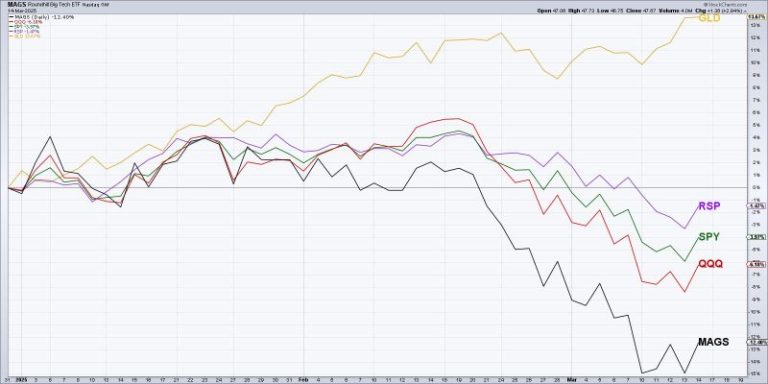
The S&P 500 index is now down about 4.0% for the year, even with Friday’s strong finish to the week. The Roundhill Big Tech ETF (MAGS) is down 12.4%, while the growth-heavy Nasdaq 100 is down about 6.2%. The SPDR Gold Shares (GLD), meanwhile, is up another 13.7% in 2025 after an exceptionally strong 2024.
There have been a number of times over my career where people have pushed back when gold is doing well. They have claimed that it’s just an anomaly, or that it shouldn’t go higher because of some particular reason. My answer is always to bring up the chart and remind us both, “The market doesn’t care what we think!”
Gold Prices Remain in a Primary Uptrend
Let’s break down gold’s outperformance in greater detail using a daily chart of GLD. At a time when many stocks and ETFs have broken below moving average support, gold stands out as remaining above two upward-sloping moving averages.
GLD has featured two clear consolidation phases since the end of 2023, one from April to July of 2024, and the other from October through December 2024. In both cases, the ETF bounced off price support a number of times before eventually resolving these patterns to the upside. Consolidations are very common in long-term bullish phases. What’s important is that the uptrend continues after the price exits the range, as we’ve often seen recently with GLD.
We can also apply our proprietary Market Trend Model to gold prices, which can help us to better compare the trend in gold to other ETFs and indexes. We can see that the GLD is currently bullish on all three time frames, compared to the S&P 500, which is now bearish on the short-term and medium-term time frames. When stocks are in a confirmed downtrend, I prefer to look for things that remain in primary uptrends, and gold fits the bill.
Gold Stocks Are Catching Up to Physical Gold
I’m often asked whether it’s better to play gold using an ETF that holds physical gold versus one that offers exposure to gold stocks. By focusing on the relative performance of gold stocks compared to gold futures, we can perhaps identify where opportunities could lie going forward.
Here we’re showing the VanEck Vectors Gold Miners ETF (GDX), along with RSI and then the relative performance of GDX vs. GLD. When that ratio is sloping higher, gold stocks are outperforming physical gold. Going into the end of last year, the GLD was outperforming as gold stocks experienced a significant pullback. But, so far in 2025, we’ve noticed a strong reversal in relative performance which shows gold stocks are performing better.
The GDX is now testing its October 2024 high around $43.50, and we would consider a confirmed break above this level as an additional sign that gold stocks could continue a “catch up trade” versus physical gold. And with so many gold stocks starting to appear in the top decile of the StockCharts Technical Rating (SCTR), we see this as an area of emerging strength in the weeks to come.
Looking for our daily market recap show? CHART THIS with David Keller, CMT runs every trading day at 5pm ET over on our YouTube channel!
Disclaimer: This blog is for educational purposes only and should not be construed as financial advice. The ideas and strategies should never be used without first assessing your own personal and financial situation, or without consulting a financial professional.
The author does not have a position in mentioned securities at the time of publication. Any opinions expressed herein are solely those of the author and do not in any way represent the views or opinions of any other person or entity.
Is a new market uptrend on the horizon? In this video, Mary Ellen breaks down the latest stock market outlook, revealing key signals that could confirm a trend reversal. She dives into sector rotation, explains why defensive stocks are losing ground, and shares actionable short-term trading strategies for oversold stocks. Don’t miss these crucial market insights to spot the next rally before it takes off!
New videos from Mary Ellen premiere weekly on Fridays. You can view all previously recorded episodes at this link.
If you’re looking for stocks to invest in, be sure to check out the MEM Edge Report! This report gives you detailed information on the top sectors, industries and stocks so you can make informed investment decisions.