Author

admin

Browsing

A former deputy Palm Beach County sheriff who fled to Moscow and became one of the Kremlin’s most prolific propagandists is working directly with Russian military intelligence to pump out deepfakes and circulate misinformation that targets Vice President Kamala Harris’s campaign, according to Russian documents obtained by a European intelligence service and reviewed by The Washington Post.

This post appeared first on washingtonpost.com

Problem: How can you tell if an index is about to reverse—even before the price reflects it?

Answer: Look at what’s happening internally within the index—in other words, analyze market breadth, also called “participation.”

Spotting a Rebound in a Plunging Market

Like most investors, you look to the three major indices—DJIA, S&P 500, and the Nasdaq—to get an immediate glimpse of the market. But when all three are cratering, like most of the sessions we’ve seen this week and last, you often won’t find any early hint of a rebound or reversal from the indices themselves.

Indices can be misleading because they don’t reflect the movement of individual stocks within them. They are market-cap-weighted, meaning a few big stocks can skew the picture, masking broader market trends.

What this means is that, if you’re looking for signs that the market may be turning more bullish amid a wave of selling, you need to look at what’s happening internally. Are all stocks and sectors following the decline, or are some starting to rise—even if their movements aren’t reflected in the index price?

Enter the McClellan Oscillator

The McClellan Oscillator is one of many market breadth indicators that track the internal movements of the stock market and, by extension, the indices that represent them. Breadth indicators can help confirm trends and, more importantly, expose underlying weaknesses in rallies or hidden strengths in declines, helping you spot potential reversals before they appear in price.

Specifically, here’s a nutshell description of how the McClellan Oscillator works:

  • It measures market breadth, tracking advancing vs. declining stocks to give a clear picture of overall participation.
  • A reading above zero indicates bullish momentum (more advancing than declining stocks).
  • A reading below zero suggests bearish momentum (more declining than advancing stocks).
  • Crossovers help identify trend reversals. A crossover above or below zero can confirm a shift in market momentum.
  • Divergences also suggest potential reversals early on. If the oscillator moves opposite the index, it may signal that a reversal may be underway.

The last two points are what I will focus on in this article. Given the current tariff-fueled plunge, are any of the three indices showing signs of a potential reversal? And, if not, what should you look out for?

Let’s start with the S&P 500 ($SPX). Here’s a daily chart. For a more expansive breadth context, I am including the Bullish Percent Index (BPI) to show yet another angle on market breadth.

FIGURE 1. DAILY CHART OF THE S&P 500. Buyers are jumping in at the key 61.8% Fibonacci Retracement level. But does the overall participation support this reversal thesis?

Anticipating a downside target, I drew a Fibonacci Retracement from the (2024) August low to the December high. Bullish traders anticipating a rebound at the 61.8% level have started to enter their positions.

From a market breadth perspective, it’s too early to tell whether this key support level will signal a reversal. The NYSE McClellan Oscillator (a large portion of S&P 500 stocks trade on the NYSE) shows that declining shares within the index outweigh the advancing shares. The BPI reading, on the other hand, confirms this reading, as fewer than 50% of S&P 500 stocks are generating Point & Figure buy signals, a condition favoring the bears as it also signals technical weakness.

What to look for in the coming sessions: Notice the pink lines on both the chart and the McClellan indicator window signaling divergences. Look for bullish divergences or a crossover above the zero line in the coming sessions. However, don’t treat these as automatic buy signals. Instead, they suggest potential bullish conditions, suggesting you construct an entry setup if one presents itself.

Now, let’s look at a daily chart of the Nasdaq 100 ($NDX).

FIGURE 2. DAILY CHART OF THE NASDAQ 100. Declines are starting to stabilize as buyers enter the market, but it may be too soon to call a reversal.

The Nasdaq 100 shows a similar Fib Retracement reaction as in the S&P 500 example above; namely, buyers are jumping in at the 61.8% level.

The McClellan Oscillator remains bearish, but declines appear to be stabilizing (see pink lines). Notably, communications and healthcare stocks are slowing the drop. While not a bullish reversal signal, this shift could lead to a turnaround depending on how other sectors react in the coming sessions. Meanwhile, the BPI at 35%, tells you that the current price environment continues to favor the bears.

What to look for in the coming sessions. Similar to the previous S&P 500 example, keep an eye on the McClellan Oscillator readings for any bullish divergence or a crossover above the zero line. Remember, these signals indicate improving market breadth and potential upward momentum, but they are not automatic buy signals. Once a positive shift occurs, it’s going to require further confirmation from price action, volume, and other technical indicators before you jump into a trade.

A Two-Step Process

What I just demonstrated was a simple two-step process. Feel free to tweak it according to your preference. When a major selloff is underway…

  1. You need a means to forecast downside price targets. I used Fibonacci Retracements to set my downside targets (you can use other indicators to project potential support and resistance levels).
  2. Use a breadth indicator like the McClellan Oscillator to gauge how prices react to those downside targets. Namely, divergences and crossovers should alert you to the possibility of a reversal.
  3. Add other indicators to confirm the reversal when it happens. Don’t rely solely on one indicator; check price action, volume, and momentum, and have an exit plan in case it doesn’t follow through.

At the Close

Here’s the main point. You can use the McClellan Oscillator to anticipate turns in an index before it tips its hand, so to speak. It reveals shifts in market participation before such shifts become evident in prices. While major indices can be misleading due to their market-cap weighting, the oscillator focuses on breadth and momentum across all stocks and sectors comprising an entire index or market.

As of now, the S&P 500 and Nasdaq 100 show no clear signs of a bullish reversal. However, when a shift does occur, the McClellan Oscillator may be among the breadth indicators to signal it first—so keep an eye on it.


Disclaimer: This blog is for educational purposes only and should not be construed as financial advice. The ideas and strategies should never be used without first assessing your own personal and financial situation, or without consulting a financial professional.

The S&P 500 ($SPX), Nasdaq Composite ($COMPQ), and DJIA ($INDU) are trading below their 200-day simple moving averages (SMAs). It doesn’t paint an optimistic picture, but the reality is that the stock market’s price action is more unpredictable than usual.

When President Trump imposed an additional 25% tariff on steel and aluminum imports from Canada, the stock market sold off. However, the selloff eased in afternoon trading, when there was a narrative shift in the tariff and Ukraine/Russia tensions front. But that changed towards the end of Tuesday’s close, with the broader indexes closing lower.

Navigating a headline-driven market is challenging. The Cboe Volatility Index ($VIX), the market’s fear gauge, eased a little on Tuesday, but has risen relatively steeply since February 21. All investors should monitor this closely, especially in a market that fluctuates several times on any given trading day.

Percentage Performance

It’s also important not to lose sight of the bigger picture. From a percentage performance point of view, how much damage has been done? To answer this question, it helps to view a PerfChart of the three broader indexes, S&P 500, Nasdaq, and Dow (see chart below).

FIGURE 1. ONE-YEAR PERFORMANCE OF S&P500, DOW JONES INDUSTRIAL AVERAGE, AND NASDAQ COMPOSITE. All three indexes are displaying weakening performance, but are still in positive territory.Chart source: StockCharts.com. For educational purposes.

Over the last year, the performance of the three indexes is in positive territory. The Dow is the weakest of the three, with a 6.87% gain. During the April 2024 low, performance was negative, but during the August low, the Dow skirted the zero level but was able to hang on. Given the trend in the performance of all three indexes is pointing lower, investors should be cautious when it comes to making decisions.

Value Performance

The daily chart of any of the three indexes is bleak. The one that looks the bleakest is probably the tech-heavy Nasdaq. Tech stocks have taken a beating of late, and the Nasdaq has been trading below its 200-day SMA for a few days (see chart below).

The bottom panel displays the percentage of Nasdaq stocks trading below their 200-day SMA. As you can see, it’s below 30%, which indicates an oversold level. There are no signs of reversal on this chart. In August, when the Nasdaq slipped below its 200-day SMA, it quickly recovered.

On Wednesday morning, investors will be tuned in to the February CPI data. Be sure to save the PerfChart in Figure 1 and the chart of the Nasdaq Composite in Figure 2 to your ChartLists. Click on the charts to see the live chart. Monitor them closely, since we’re likely to see a seesawing stock market for a while.

Closing Position

Note that when viewing a PerfChart, you can also compare the performance of different sectors or industry groups in addition to the broader indexes. All you have to do is change the symbols on the chart. If you see confirmed signals of a reversal in any asset class or group, it may be time to reevaluate your portfolio allocations.


Disclaimer: This blog is for educational purposes only and should not be construed as financial advice. The ideas and strategies should never be used without first assessing your own personal and financial situation, or without consulting a financial professional.

In this video, Dave analyzes the bearish rotation in his Market Trend Model, highlighting the S&P 500 breakdown below the 200-day moving average and its downside potential. He also identifies five strong stocks with bullish technical setups despite market weakness. Watch now for key technical analysis insights to navigate this volatile market!

This video originally premiered on March 10, 2025. Watch on StockCharts’ dedicated David Keller page!

Previously recorded videos from Dave are available at this link.

Mining giant BHP (ASX:BHP,NYSE:BHP,LSE:BHP) is providing up to AU$40 million for exploration work atCobre’s (ASX:CBE) Kitlanya East and West copper projects in Botswana, Cobre said on Monday (March 10).

The funding is under an earn-in agreement between Cobre, other Cobre-owned subsidiaries and a wholly owned subsidiary of BHP. It gives BHP the right to acquire a 75 percent interest in the Kitlanya assets.

The agreement comes after Cobre’s participation in BHP’s Xplor program in 2024. Through Xplor, Cobre received US$500,000 to accelerate its exploration plans for its Kalahari copper projects in Africa.

It also follows the signing of a letter of intent with a BHP subsidiary in September 2024. The companies agreed at the time to negotiate a material earn-in joint venture agreement for Kitlanya East and West.

“This significant transaction with BHP … is a major moment in time for Cobre as a company as well as a testament to the success of BHP’s Xplor program,” said Cobre CEO Adam Woolridge in a press release.

“The partnership with BHP will provide us with the funding and support necessary to implement a technology-driven work program designed to discover the Tier 1 deposits we believe may be hosted in our Kitlanya East and West Projects.”

Cobre acquired Kitlanya East and West through its November 2022 purchase of Kalahari Metals. BHP conducted fixed-wing AEM surveys over much of Kitlanya West’s project area in the late 1990s, but there was little on-site work.

The copper market is reportedly growing in Africa, with the Democratic Republic of Congo and Zambia as its largest producers. Botswana is also recognized as one of the continent’s primary producers.

Mobilisation for drilling at Kitlanya West is set to start next month, and will test targets identified in a 2024 seismic program. The plan is to assess the mineral system for components required for tier-one copper deposit formation.

Cobre and BHP’s Xplor program

‘We are thrilled to continue our partnership with one of the BHP Xplor alumni, Cobre Limited, through this agreement,” said BHP Group Exploration Officer Tim O’Connor in Cobre’s release.

“This collaboration reflects our excitement for the exploration potential in Botswana and underscores the high standard of partnerships we see coming out of the BHP Xplor program.”

The Xplor program was introduced by BHP in 2022 as a means of assisting companies in accelerating exploration opportunities and developing new critical minerals sources.

Selected companies receive benefits such as an equity-free grant of up to US$500,000 and access to a network of BHP and external industry experts to build out and accelerate their exploration concepts.

The 2025 BHP Xplor cohort holds the highest number of successful applicants in the program’s history at eight companies. Cobre formed part of the 2024 cohort, joining five other companies.

This week’s transaction between Cobre and BHP does not involve Cobre’s flagship Ngami and Okavango copper projects, which are also located in Botswana. Cobre will continue advancing both assets independently.

Securities Disclosure: I, Gabrielle de la Cruz, hold no direct investment interest in any company mentioned in this article.

This post appeared first on investingnews.com

(TheNewswire)

TORONTO TheNewswire – March 13, 2025 Noble Mineral Exploration Inc. (‘Noble’ or the ‘Company’) (TSXV: NOB) (OTCQB: NLPXF) is pleased to announce successful exploration drilling results from its joint venture partner Canada Nickel Company Inc. (‘Canada Nickel’) (TSXV:CNC) in East Timmins Nickel Ltd. (‘East Timmins Nickel’) a private company operating in the Timmins area of Northern Ontario.

Canada Nickel Company Inc. announced strong results from the Reid, Mann West and Midlothian properties, its Three Giants. One of its Three Giants, Mann West delivered the highest grade interval within the property to date with 0.63% nickel over 4.5 metres within 0.40% nickel over 18.0 metres within an overall mineralized core length of 0.27% nickel over 452 metres, in hole MAN24-79.

Canada Nickel CEO Mark Selby said, ‘ Our regional exploration program is consistently yielding excellent outcomes with each of the Three Giants delivering strong drilling results. These targets each have a target footprint larger than our flagship Crawford Nickel Sulphide Project, underscoring the large-scale potential of the Timmins Nickel District. We are excited to publish the remaining six resources by mid-2025, bringing the total to eight regional resources and showcasing the vast scale of nickel resources within the District.’

The Three Giants each have a target footprint larger than CNC’s flagship Crawford Nickel Sulphide Project, underscoring the large-scale potential of the Timmins Nickel District. Canada Nickel will publish the remaining six resources by mid-2025, bringing the total to eight regional resources and showcasing the vast scale of nickel resources within the District.  For full details, drill results and maps, see the news release published by Canada Nickel, March 12, 2025.

Noble CEO Vance White said , ‘We congratulate our partner Canada Nickel on the work completed and results on the Mann Twp property and we are very excited about the prospects for East Timmins Nickel along the several additional projects to be included.’

Mann Property

The Mann property is located 22 kilometres east of Crawford between Timmins and Cochrane and is 80% owned by Canada Nickel and 20% by Noble Mineral Exploration. The target consists of four separate targets, Mann North, Mann West (together formerly Mann Northwest), Mann Central and Mann South. The CNC release provides an assay update from six holes, three holes at Mann West, and three holes at Mann South.

Mann West

Mann West is approximately 3.5 kilometres long by up to 1.1 kilometres wide (covering 3.4 square kilometres). The drill program completed focused on the southern half of the target with drilling completed over a strike length of 1.7 kilometres and a width of at least 600 metres. All drillholes intersected long sections of well-serpentinized peridotite and minor dunite with disseminated and visible nickel sulphide mineralization consisting primarily of pentlandite and heazlewoodite. The Company has drilled a total of 40 holes to date at Mann West with 31 holes drilled during the 2024 program. CNC is currently working on an initial resource estimate expected by April 2025. Assays from three holes are presented in this release and a final two holes are awaiting assays. See Table 1 and Figure 1.

Table 1 – Mann West drilling highlights.

Hole ID

From (m)

To (m)

Length (m)*

Ni %

Co %

Pd g/t

Pt g/t

Cr %

Fe %

S %

MAN24- 79

48.7

501.0

452.3

0.27

0.01 2

0.025

0.01 3

0.25

6.28

0.1 0

Including

192.0

210.0

18.0

0.40

0.012

0.124

0.042

0.15

6.16

0.09

Including

205.5

210.0

4.5

0.63

0.011

0.434

0.138

0.15

5.82

0.13

and

358.5

412.5

54.0

0.34

0.013

0.037

0.017

0.15

6.11

0.15

MAN24-80

6.0

337.5

331.5

0.24

0.012

0.016

0.012

0.35

6.42

0.15

Including

43.5

54.0

10.5

0.41

0.011

0.092

0.041

0.15

5.31

0.11

and

118.5

157.5

39.0

0.29

0.014

0.019

0.006

0.57

6.32

0.12

MAN24-98

94.5

211.8

117.3

0.24

0.012

0.016

0.009

0.31

6.22

0.07

and

218.4

501.0

282.6

0.23

0.013

0.021

0.011

0.37

6.78

0.09

*True width undetermined. All lengths are drillhole lengths.

Figure 1. – Mann W – CNC Drillholes Over Total Magnetic Intensity.


Click Image To View Full Size

Mann South

This target is approximately 5.9 kilometres long by up to 1.2 kilometres wide, having an arcuate and irregular shape, with an overall area of 4.1 square kilometres. The company drilled 20 holes in 2024 and successfully intersected varying degrees of serpentinized peridotite and minor pyroxenite. Peridotite shows anomalous values of PGE in hole MAN24-96. Assays from three holes are presented in this release. See Table 2 and Figure 2.

Table 2 – Mann South drilling highlights.

Hole ID

From (m)

To (m)

Length (m)*

Ni %

Co %

Pd g/t

Pt g/t

Cr %

Fe %

S %

MAN24-88

61.4

496.5

435.1

0.23

0.011

0.003

0.005

0.48

5.70

0.05

MAN24-95

33.0

402.0

369.0

0.18

0.013

0.005

0.005

0.46

7.17

0.05

MAN24-96

32.1

402.0

369.9

0.17

0.013

0.052

0.065

0.38

7.06

0.01

including

38.0

65.0

27.0

0.18

0.016

0.360

0.046

0.08

8.09

0.02

and

92.5

154.5

62.0

0.08

0.014

0.109

0.347

0.33

7.58

0.01

*True width undetermined. All lengths are drillhole lengths.

Figure 2 – Mann S – CNC Drillholes Over Total Magnetic Intensity.


Click Image To View Full Size

Table 3: Drillhole Orientation

Hole ID

Easting (mE)

Northing (mN)

Azimuth (⁰)

Dip (⁰)

Length (m)

MANN WEST

MAN24-79

496793.5

5412392

215

-50

501

MAN24-80

496749.9

5411989

215

-50

474

MAN24-98

495901.7

5412589

220

-50

501

MANN SOUTH

MAN24-88

503622

5408792

50

-50

501

MAN24-95

502507

5405555

55

-50

402

MAN24-96

502253

5405841

35

-50

402

REID

REI24-49

456964.1

5404097

130

-50

483

REI24-51

457900

5404100

90

-60

447

REI24-52

457349.4

5404196

180

-55

759

REI24-53

457930.1

5404253

90

-60

372

REI24-54

456960

5403900

180

-55

501

REI24-55

457754.4

5404635

90

-60

561

REI24-56

457327.8

5404025

180

-60

621

REI24-57

456960.9

5403900

130

-55

537

REI24-58

457929.4

5404172

270

-60

531

MIDLOTHIAN

MID24-13

500117

5303240

180

-50

554

MID24-14

498707

5303083

180

-52

537

Qualified Person and Data Verification

Stephen J. Balch P.Geo. (ON), VP Exploration of Canada Nickel and a ‘Qualified Person’ as such term is defined by National Instrument 43-101, has verified the data disclosed in this news release, and has otherwise reviewed and approved the technical information in this news release on behalf of Canada Nickel Company Inc.

About Canada Nickel

Canada Nickel is advancing the next generation of nickel-sulphide projects to deliver nickel required to feed the high growth electric vehicle and stainless-steel markets. Canada Nickel Company has applied in multiple jurisdictions to trademark the terms NetZero Nickel TM , NetZero Cobalt TM , NetZero Iron TM and is pursuing the development of processes to allow the production of net zero carbon nickel, cobalt, and iron products. Canada Nickel provides investors with leverage to nickel in low political risk jurisdictions. Canada Nickel is currently anchored by its 100% owned flagship Crawford Nickel-Cobalt Sulphide Project in the heart of the prolific Timmins-Cochrane mining camp. Canada Nickel’s common shares trade on the TSX Venture Exchange under the symbol ‘CNC.’

For more information, please visit www.canadanickel.com.

About Noble Mineral Exploration Inc.

Noble Mineral Exploration Inc. is a Canadian-based junior exploration company, which has holdings of securities in Canada Nickel Company Inc., Homeland Nickel Inc., East Timmins Nickel Inc.(20%), and its interest in the Holdsworth gold exploration property in the area of Wawa, Ontario.

Noble holds mineral and/or exploration rights in ~70,000ha in Northern Ontario, ~14,000ha elsewhere in Quebec and Newfoundland, upon which it plans to generate option/joint venture exploration programs .

Noble holds mineral rights and/or exploration rights in ~18,000 hectares in the Timmins-Cochrane areas of Northern Ontario known as Project 81, ~2,215 hectares in Thomas Twp/Timmins, as well as an additional 20% interest in ~38,700 hectares in the Timmins area and ~175 hectares of mining claims in Central Newfoundland.  Project 81 hosts diversified drill-ready gold, nickel-cobalt and base metal exploration targets at various stages of exploration.  Noble also holds ~4,600 hectares in the Nagagami Carbonatite Complex and its ~3,200 hectares in the Boulder Project both near Hearst, Ontario, as well as ~3,700 hectares in the Buckingham Graphite Property, ~10,152 hectares in the Havre St Pierre  Nickel, Copper, PGM property, and ~1,573 hectares in the Cere-Villebon Nickel, Copper, PGM property, ~569 hectare Uranium/Rare Earth property (Chateau) and a ~461 hectare Uranium/Molybdenum property (Taser North),  all of which are in the province of Quebec.

Noble’s common shares trade on the TSX Venture Exchange under the symbol ‘NOB’.

More detailed information on Noble is available on the website at www.noblemineralexploration.com .

Cautionary Statement

Neither TSX Venture Exchange nor its Regulation Services Provider (as that term is defined in the policies of the TSX Venture Exchange) accepts responsibility for the adequacy or accuracy of this release. No stock exchange, securities commission or other regulatory authority has approved or disapproved the information contained herein.

The foregoing information may contain forward-looking statements relating to the future performance of Noble Mineral Exploration Inc. Forward-looking statements, specifically those concerning future performance, are subject to certain risks and uncertainties, and actual results may differ materially from the Company’s plans and expectations. These plans, expectations, risks and uncertainties are detailed herein and from time to time in the filings made by the Company with the TSX Venture Exchange and securities regulators.  Noble Mineral Exploration Inc. does not assume any obligation to update or revise its forward-looking statements, whether as a result of new information, future events or otherwise.

Contacts:

H. Vance White, President

Phone:         416-214-2250

Fax:             416-367-1954

Email:          info@noblemineralexploration.com

Investor Relations

Email:   ir@noblemineralexploration.com

Copyright (c) 2025 TheNewswire – All rights reserved.

News Provided by TheNewsWire via QuoteMedia

This post appeared first on investingnews.com

Where can investors find a safe haven during a period of market uncertainty?  Personally, I think it’s as simple as focusing on the stocks managing to display bullish technical structures at a time when they are becoming remarkably rare!  Today we’ll use the StockCharts scan engine to identify charts showing strength despite broader market weakness.

There’s Strength in Financials But Not the Banks

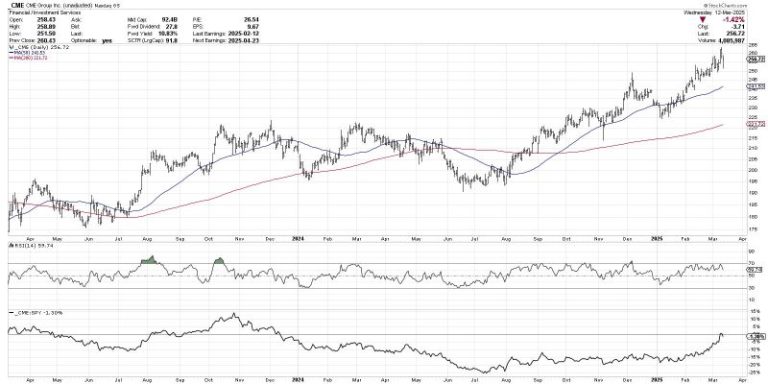
The first chart on my list from this week’s scan, CME Group (CME), was featured in my recent podcast interview with Jay Woods, CMT.  We talked about how the financial sector had been quite strong so far in 2025, but that the really impressive charts were the exchanges.  

The simple fact that CME currently sits above two upward-sloping moving averages means this name is in a small subset of the S&P 500 that can still make that claim.  The momentum picture has remained quite strong, with recent pullbacks bringing the RSI no lower than the 40 level.  The improving relative strength at the bottom tells perhaps the most important story, showing how this stock has consistently outperformed the S&P 500 in 2025.

As long as the trend continues to form a pattern of higher highs and higher lows, and the moving averages continue to slope higher, I would consider this chart “innocent until proven guilty.” 

Auto Parts Remains a Strong Group in a Struggling Sector

While I’ve found numerous ideas in the Consumer Staples sector in 2025, given the renewed strength in this previously beaten down sector, this next chart is actually in the Consumer Discretionary sector.  Auto parts names like Autozone Inc. Nevada (AZO) have pulled back this week from an overbought condition, but the chart remains in a primary uptrend of higher highs and higher lows.

Similar to CME, we can observe a classic uptrend pattern over the last 18 months.  We can also see an ascending triangle pattern through much of 2024, with a fairly consistent resistance level and an upward-sloping trendline connecting the swing lows. The upside breakout in December 2024, followed by a retest of that previous resistance level into mid-January, seems to confirm the long-term bullish technical structure.

What strikes me about both of these charts is that they show no real signs of market instability.  At a time when it feels like pretty much everything is rotating lower amidst growing market turmoil, stocks that indicate they are somehow immune to bearish market forces deserve our respect and attention.

Three-Month Highs Often Signal Renewed Strength

How did I identify these winning names at a time when they seem very difficult to find?  I simply used the StockCharts scan engine to identify stocks making a new 13-week high.  You can copy and paste the text below into the Scan Workbench to run this scan using your own login.

[type = stock]

and [group is not ETF]

and [[exchange = NYSE] or [exchange = NASD]]

and [market cap > 5,000]

//and [group is SP500]

and [Weekly Close > Last Week’s MAX(13,Close)]

Those last two lines are the most important, as the rest is basically filtering the universe down to stocks traded on the major US exchanges with a market cap over $5 billion.  The fifth line has two slashes before the parameter “group is SP500”, which tells the scan engine to ignore that line.  I like to include that line in every scan I run, as I often toggle between a larger equity universe and then just to the S&P 500 members.

The final line looks for stocks where the current weekly closing price is higher than the previous 13 weekly closing prices.  And while this particular scan would certainly include stocks that have been in long-term uptrends for well over three months, I’ve found new three-month highs can be a great place to start to look for charts just beginning to emerge from a basing pattern.

For the other three stocks I found earlier this week using this scan, and much further detail on the technical implications of these charts, check out my latest video on the StockCharts TV YouTube channel!

RR#6,

Dave

PS- Ready to upgrade your investment process?  Check out my free behavioral investing course!

David Keller, CMT

President and Chief Strategist

Sierra Alpha Research LLC

Disclaimer: This blog is for educational purposes only and should not be construed as financial advice.  The ideas and strategies should never be used without first assessing your own personal and financial situation, or without consulting a financial professional.  

The author does not have a position in mentioned securities at the time of publication.    Any opinions expressed herein are solely those of the author and do not in any way represent the views or opinions of any other person or entity.

In this exclusive StockCharts video, Joe revisits a critical ADX signal that gave a major market warning, explaining the pattern and a new low ADX setup to watch. He breaks down SPY and QQQ support zones, sector rotation, and reviews viewer symbol requests including T, WBD, and more. Don’t miss this technical analysis update to stay ahead of the market!

This video was originally published on March 12, 2025. Click this link to watch on Joe’s dedicated page.

Archived videos from Joe are available at this link. Send symbol requests to stocktalk@stockcharts.com; you can also submit a request in the comments section below the video on YouTube. Symbol Requests can be sent in throughout the week prior to the next show.

Gold has long been considered a store of wealth, and the price of gold all time high often makes its biggest gains during turbulent times as investors look for cover in this safe-haven asset.

The 21st century has so far been heavily marked by episodes of economic and sociopolitical upheaval. Uncertainty has pushed the precious metal to record highs as market participants seek its perceived security. And each time the gold price rises, there are calls for even higher record-breaking levels.

Gold market gurus from Lynette Zang to Chris Blasi to Jordan Roy-Byrne have shared eye-popping predictions on the gold price that would intrigue any investor — gold bug or not.

While some have posited that the gold price may break US$3,000 per ounce and carry on as high as US$4,000 or US$5,000, there are those with hopes that US$10,000 gold or even US$40,000 gold could become a reality.

These impressive price predictions have investors wondering, what is gold’s all time high? In the past year, a new gold all time high (ATH) has been reached dozens of times, and we share the latest one and what has driven it to this level below. We also take a look at how the gold price has moved historically and what has driven its performance in recent years.

In this article

    How is gold traded?

    Before discovering what the highest gold price ever was, it’s worth looking at how the precious metal is traded. Knowing the mechanics behind gold’s historical moves can help illuminate why and how its price changes.

    Gold bullion is traded in dollars and cents per ounce, with activity taking place worldwide at all hours, resulting in a live price for the metal. Investors trade gold in major commodities markets such as New York, London, Tokyo and Hong Kong. London is seen as the center of physical precious metals trading, including for silver. The COMEX division of the New York Mercantile Exchange is home to most paper trading.

    There are many popular ways to invest in gold. The first is through purchasing gold bullion products such as bullion bars, bullion coins and rounds. Physical gold is sold on the spot market, meaning that buyers pay a specific price per ounce for the metal and then have it delivered. In some parts of the world, such as India, buying gold in the form of jewelry is the largest and most traditional route to investing in gold.

    Another path to gold investment is paper trading, which is done through the gold futures market. Participants enter into gold futures contracts for the delivery of gold in the future at an agreed-upon price. In such contracts, two positions can be taken: a long position under which delivery of the metal is accepted or a short position to provide delivery of the metal. Paper trading as a means to invest in gold can provide investors with the flexibility to liquidate assets that aren’t available to those who possess physical gold bullion.

    One significant long-term advantage of trading in the paper market is that investors can benefit from gold’s safe-haven status without needing to store it. Furthermore, gold futures trading can offer more financial leverage in that it requires less capital than trading in the physical market.

    Interestingly, investors can also purchase physical gold via the futures market, but the process is complicated and lengthy and comes with a large investment and additional costs.

    Aside from those options, market participants can invest in gold through exchange-traded funds (ETFs). Investing in a gold ETF is similar to trading a gold stock on an exchange, and there are numerous gold ETF options to choose from. For instance, some ETFs focus solely on physical gold bullion, while others focus on gold futures contracts. Other gold ETFs center on gold-mining stocks or follow the gold spot price.

    It is important to understand that you will not own any physical gold when investing in an ETF — in general, even a gold ETF that tracks physical gold cannot be redeemed for tangible metal.

    With regards to the performance of gold versus trading stocks, gold has an interesting relationship with the stock market. The two often move in sync during “risk-on periods” when investors are bullish. On the flip side, they tend to become inversely correlated in times of volatility. There are a variety of options for investing in stocks, including gold mining stocks on the TSX and ASX, gold juniors, precious metals royalty companies and gold stocks that pay dividends.

    According to the World Gold Council, gold’s ability to decouple from the stock market during periods of stress makes it “unique amongst most hedges in the marketplace.” It is often during these times that gold outperforms the stock market. For that reason, it is often used as a portfolio diversifier to hedge against uncertainty.

    What was the highest gold price ever?

    The gold price peaked at US$2,989.58, its all-time high, on March 13, 2025 at 3:38 p.m. PDT. What drove it to set this new ATH?

    Gold set a new record high on March 13 as US President Donald Trump expanded his tariff war to the European Union, and continued to reiterate his sentiment that the United States may need to go through a period of economic pain to enter a new ‘golden age’ of economic prosperity.

    Gold set multiple new highs in the prior month as uncertainty continues to reign under Trump, from his announcement that he would enact extensive tariffs on North American allies Canada and Mexico, to the proposed resettlement of Palestinians out of the Gaza Strip to develop it into ‘the Riviera of the Middle East,’ (a suggestion that has been condemned globally), followed by his announcement of blanket 25 percent tariffs on steel and aluminum imports.

    Gold also set a previous record high on February 20 as US President Donald Trump continued tariff talks and sided with Russian President Vladimir Putin against Ukrainian President Volodymyr Zelenskyy. Elon Musk’s call to audit the gold holdings in Fort Knox has also brought attention to the yellow metal.

    Read our in-depth breakdown of gold’s recent price performance below.

    2025 gold price chart

    2025 gold price chart. December 31, 2024, to March 13, 2025.

    What factors have driven the gold price in the last five years?

    Despite these recent runs, gold has seen its share of both peaks and troughs over the last decade. After remaining rangebound between US$1,100 and US$1,300 from 2014 to early 2019, gold pushed above US$1,500 in the second half of 2019 on a softer US dollar, rising geopolitical issues and a slowdown in economic growth.

    Gold’s first breach of the significant US$2,000 price level in mid-2020 was due in large part to economic uncertainty caused by the COVID-19 pandemic. To break through that barrier and reach what was then a record high, the yellow metal added more than US$500, or 32 percent, to its value in the first eight months of 2020.

    The gold price surpassed that level again in early 2022 as Russia’s invasion of Ukraine collided with rising inflation around the world, increasing the allure of safe-haven assets and pulling the yellow metal up to a price of US$2,074.60 on March 8, 2022. However, it fell throughout the rest of 2022, dropping below US$1,650 in October.

    Five year gold price chart. March 12, 2020, to March 13, 2025.

    Although it didn’t quite reach the level of volatility as the previous year, the gold price experienced drastic price changes in 2023 on the back of banking instability, high interest rates and the breakout of war in the Middle East.

    After central bank buying pushed the gold price up to the US$1,950.17 mark by the end of January, the US Federal Reserve’s 0.25 percent rate hike on February 1 sparked a retreat as the dollar and Treasury yields saw gains. The precious metal went on to fall to its lowest price level of the year at US$1,809.87 on February 23.

    The banking crisis that hit the US in early March caused a domino effect through the global financial system and led to the mid-March collapse of Credit Suisse, Switzerland’s second-largest bank. The gold price jumped to US$1,989.13 by March 15. The continued fallout in the global banking system throughout the second quarter of the year allowed gold to break above US$2,000 on April 3, and go on to flirt with a near-record high of US$2,049.92 on May 3.

    Those gains were tempered by the Fed’s ongoing rate hikes and improvements in the banking sector, resulting in a downward trend in the gold price throughout the remainder of the second quarter and throughout the third quarter. By October 4, gold had fallen to a low of US$1,820.01 and analysts expected the precious metal to be on the path to drop below the US$1,800 level.

    That was before the October 7 attacks by Hamas on Israel ignited legitimate fears of a much larger conflict erupting in the Middle East. Reacting to those fears, and rising expectations that the US Federal Reserve would begin to reverse course on interest rates, gold broke through the important psychological level of US$2,000 per ounce and closed at US$2,007.08 on October 27. As the Israel-Hamas fighting intensified, gold reached a then new high of US$2,152.30 during intraday trading on December 3.

    That robust momentum in the spot gold price has continued into 2024, chasing new highs on fears of a looming US recession, the promise of Fed rate cuts on the horizon, the worsening conflict in the Middle East and the tumultuous US presidential election year. By mid-March, gold was pushing up against the US$2,200 level.

    That record-setting momentum continued into the second quarter of 2024 when gold broke through US$2,400 per ounce in mid-April on strong central bank buying, sovereign debt concerns in China and investors expecting the Fed to start cutting interest rates. The precious metal went on to hit US$2,450.05 per ounce on May 20.

    Throughout the summer, the hits have just kept on coming. The global macro environment is highly bullish for gold in the lead up to the US election. Following the failed assassination attempt on former US President Donald Trump and a statement about coming interest rate cuts by Fed Chair Jerome Powell, the gold spot price hit a new all-time high on July 16 at US$2,469.30 per ounce.

    One week later, news that President Joe Biden would not seek re-election and would instead pass the baton to his VP Kamala Harris eased some of the tension in the stock markets and strengthened the US dollar. This also pushed the price of gold down to US$2,387.99 per ounce on July 22.

    However, the bullish factors supporting gold over the past year remain in play and the spot price for gold has gone on to breach the US$2,500 level first on August 2 on a less than stellar US jobs report before closing just above the US$2,440 level. A few weeks later, gold pushed past US$2,500 once again on August 16, to close above that level for the first time ever after the US Department of Commerce released data showing a fifth consecutive monthly decrease in a row for homebuilding.

    The news that the Chinese government issued new gold import quotas to banks in the country following a two month pause also helped fuel the gold price rally. Central bank gold buying has been a significant tailwind for the gold price this year, and China’s central bank has been one of the strongest buyers.

    Market watchers expected the Fed to cut interest rates by a quarter point at their September meeting, but news on September 12 that the regulators were still deciding between the expected cut or a larger half-point cut led gold prices on a rally that carried through into the next day, bringing gold prices near US$2,600.

    At the September 18 Fed meeting, the committee ultimately made the decision to cut rates by half a point, news that sent gold even higher. By Friday, September 20, it moved above US$2,600 and held above US$2,620.

    In October, gold breached the US$2,700 level and continued to set new highs on a variety of factors, including further rate cuts and economic data anticipation, the escalating conflict in the Middle East between Israel and Hezbollah, and economic stimulus in China — not to mention the very close race between the US presidential candidates.

    While the gold price fell following President Trump’s win in early November and largely held under US$2,700 through the end of the year, it began trending upwards in 2025 to the new all-time high discussed earlier in the article.

    Gold has seen upward momentum in the last year on a variety of factors. In 2025, the gold price was on the rise early in the new year as President Trump and his team began to talk seriously about a wide-ranging set of tariffs on several countries in the run-up and following his inauguration on January 20.

    On January 29, the Bank of Canada shaved 25 basis points off its policy interest rate, marking its sixth consecutive decrease, and announced plans to end quantitative tightening. On the same day, the US Federal Reserve opted to leave its interest rate unchanged. The following day, President Trump announced it very likely will be placing 25 percent tariffs on Mexico and Canada as of February 1, alongside tariffs on the EU and China.

    Gold price set new highs in all currencies alongside a weakening US dollar, the US Federal Reserve leaving interest rates unchanged, a rush to safe haven assets and the looming threat of US President Donald Trump’s tariffs on February 1. Additionally, new US economic data showed inflation-adjusted gross domestic product in the country increased an annualized 2.3 percent in the fourth quarter of 2024 after rising 3.1 percent in the third quarter.

    What’s next for the gold price?

    What’s next for the gold price is never an easy call to make. There are many factors that affect the gold price, but some of the most prevalent long-term drivers include economic expansion, market risk, opportunity cost and momentum.

    Economic expansion is one of the primary gold price contributors as it facilitates demand growth in several categories, including jewelry, technology and investment. As the World Gold Council explains, “This is particularly true in developing economies where gold is often used as a luxury item and a means to preserve wealth.” Market risk is also a prime catalyst for gold values as investors view the precious metal as the “ultimate safe haven,” and a hedge against currency depreciation, inflation and other systemic risks.

    Going forward, in addition to the Fed, inflation and geopolitical events, experts will be looking for cues from factors like supply and demand. In terms of supply, the world’s five top gold producers are China, Australia, Russia, Canada and the US. The consensus in the gold market is that major miners have not spent enough on gold exploration in recent years. Gold mine production has fallen from around 3,200 to 3,300 metric tons each year between 2018 and 2020 to around 3,000 to 3,100 metric tons each year between 2021 and 2023.

    On the demand side, China and India are the biggest buyers of physical gold, and are in a perpetual fight for the title of world’s largest gold consumer. That said, it’s worth noting that the last few years have brought a big rebound in central bank gold buying, which dropped to a record low in 2020, but reached a 55 year high of 1,136 metric tons in 2022.

    The World Gold Council has reported that central bank gold purchases in 2023 came to 1,037 metric tons, marking the second year in a row above 1,000 MT. In the first half of 2024, the organization says gold purchases from central banks reached a record 483 metric tons.

    David Barrett, CEO of the UK division of global brokerage firm EBC Financial Group, is also keeping an eye on central bank purchases of gold.

    In addition to central bank moves, analysts are also watching for escalating tensions in the Middle East, a weakening US dollar, declining bond yields, and further interest rate cuts as factors that could push gold higher as investors look to secure their portfolios.

    Speaking at the Metals Investor Forum, held in Vancouver, British Columbia, this September, Eric Coffin, editor of Hard Rock Analyst, outlined those key factors as supporting his prediction that gold could reach US$2,800 by the end of 2024.

    “When it comes to outside factors that affect the market, it’s just tailwind after tailwind after tailwind. So I don’t really see the trend changing,” Coffin said.

    Also speaking at the Metals Investor Forum, Jeff Clark, founder and editor at TheGoldAdvisor.com, was even more bullish on the precious metal. He sees Santa delivering US$3,000 gold as a good possibility.

    However, others see gold taking a little longer to breach the US$3,000 level. Delegates at the London Bullion Market Association’s annual gathering in October have forecasted a gold price of US$2,941 in the next 12 months.

    Should you beware of gold price manipulation?

    As a final note on the price of gold and buying gold bullion, it’s important for investors to be aware that gold price manipulation is a hot topic in the industry.

    In 2011, when gold hit what was then a record high, it dropped swiftly in just a few short years. This decline after three years of impressive gains led many in the gold sector to cry foul and point to manipulation. Early in 2015, 10 banks were hit in a US probe on precious metals manipulation. Evidence provided by Deutsche Bank (NYSE:DB) showed “smoking gun” proof that UBS Group (NYSE:UBS), HSBC Holdings (NYSE:HSBC), the Bank of Nova Scotia (NYSE:BNS) and other firms were involved in rigging gold and silver rates in the market from 2007 to 2013.

    Not long after, the long-running London gold fix was replaced by the LBMA gold price in a bid to increase gold price transparency. The twice-a-day process, operated by the ICE Benchmark Administration, still involves a variety of banks collaborating to set the gold price, but the system is now electronic.

    Still, manipulation has by no means been eradicated, as a 2020 fine on JPMorgan (NYSE:JPM) shows. The next year, chat logs were released in a spoofing trial for two former precious metals traders from the Bank of America’s (NYSE:BAC) Merrill Lynch unit. They show a trader bragging about how easy it is to manipulate the gold price.

    Gold market participants have consistently spoken out about manipulation. In mid-2020, Chris Marcus, founder of Arcadia Economics and author of the book “The Big Silver Short,” said that when gold fell back below the US$2,000 mark after hitting close to US$2,070, he saw similarities to what happened with the gold price in 2011.

    Marcus has been following the gold and silver markets with a focus specifically on price manipulation for nearly a decade. His advice? “Trust your gut. I believe we’re witnessing the ultimate ’emperor’s really naked’ moment. This isn’t complex financial analysis. Sometimes I think of it as the greatest hypnotic thought experiment in history.”

    Investor takeaway

    While we have the answer to what the highest gold price ever is as of now, it remains to be seen how high gold can climb, and if the precious metal can reach as high as US$5,000, US$10,000 or even US$40,000.

    Even so, many market participants believe gold is a must have in any investment profile, and there is little doubt investors will continue to see gold price action making headlines this year and beyond.

    Securities Disclosure: I, Melissa Pistilli, hold no direct investment interest in any company mentioned in this article.

    This post appeared first on investingnews.com